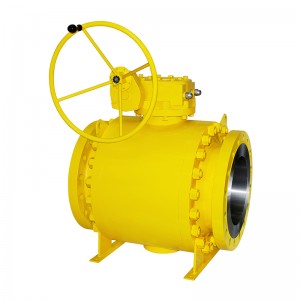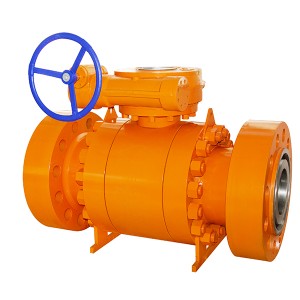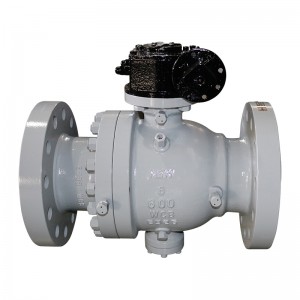


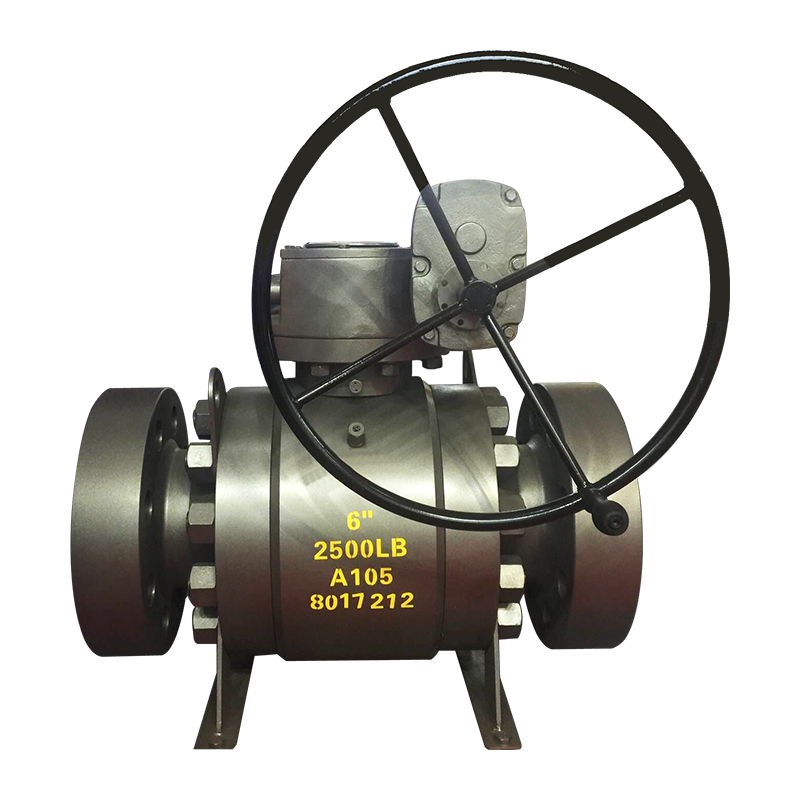
Trunnion Mounted Ball Valve
NSW Valve — Wenzhou Newsway Valve Co., Ltd. | Established 1986 | 10,000 m² Manufacturing Facility | ISO 9001 / API 607 / CE-PED Certified
A trunnion mounted ball valve is a quarter-turn isolation valve in which the ball is mechanically anchored by upper and lower trunnion bearings. Unlike a floating ball valve, the ball does not move under line pressure — spring-loaded seats move against the fixed ball instead. This design keeps operating torque low and predictable across Class 150–2500, making it the standard choice for large-diameter, high-pressure pipelines requiring true double block and bleed isolation. NSW Valve manufactures trunnion mounted ball valves in sizes NPS 2–48, with cast and forged bodies, soft or metal seats, and full NACE MR0175 compliance.
Product Overview
A trunnion mounted ball valve differs from a floating ball valve in one fundamental way: the ball is fixed. Upper and lower trunnion shafts anchor the ball inside the body, preventing lateral movement. Sealing is achieved by spring-loaded seat rings that press against the ball. As upstream pressure increases, it acts on the back of the upstream seat ring, pushing it tighter against the ball — a piston effect. The downstream seat provides a secondary independent seal. Because the trunnions absorb the hydraulic thrust, the seats never carry the full force of line pressure. Operating torque stays low and predictable, even at Class 2500 and large diameters.
This structural difference unlocks capabilities that floating ball valves cannot provide: true double block and bleed, online seat maintenance, and reliable sealing in abrasive or dirty media. The trade-off is higher upfront cost and a more complex body structure. For pipelines above NPS 8 at Class 300, or any application requiring verified isolation integrity, the trunnion design is the standard engineering choice.
NSW Valve has manufactured trunnion mounted ball valves for over 20 years, with a 10,000 m² factory, 5 production lines, and an annual output capacity of 8,000 tons. Our trunnion valves serve oil and gas transmission, chemical processing, power generation, and offshore applications worldwide.
Design & Manufacturing Standards
All NSWValve trunnion mounted ball valves are designed, manufactured, and tested to the following international standards:
| Standard | Scope |
|---|---|
| API 6D | Pipeline valve design, manufacturing, and testing |
| API 608 | Ball valve design specification |
| ASME B16.34 | Pressure-temperature ratings |
| ASME B16.10 / API 6D | Face-to-face dimensions |
| ASME B16.5 / B16.47 | Flange dimensions |
| ASME B16.25 | Butt weld ends |
| API 598 / API 6D | Valve inspection and testing |
| API 607 / API 6FA / ISO 10497 | Fire-safe testing |
| ISO 15848-1 / API 641 | Fugitive emissions performance |
| NACE MR0175 / ISO 15156 | Sour service compliance |
Every finished valve undergoes shell hydrostatic testing, seat tightness testing to ISO 5208 Rate A, and backseat testing to API 598. Fire-safe designs are tested to API 607 and API 6FA, with metal-to-metal sealing on every potential leak path. Anti-static devices and anti-blowout stems are standard on all configurations.
Quality documentation: Mill test certificates (EN 10204 3.1), pressure test certificates, NACE hardness reports, PMI reports, and dimensional inspection records are supplied with every valve.

How It Works: Trunnion vs. Floating Sealing Mechanism
The trunnion design solves a specific engineering problem: what happens when line pressure becomes too high for a moving ball to seal reliably?
| Feature | Floating Ball Valve | Trunnion Mounted Ball Valve |
|---|---|---|
| Ball support | Free-floating (no bottom bearing) | Fixed on upper and lower trunnion bearings |
| Sealing force source | Line pressure pushes ball against downstream seat | Spring-loaded seats press against fixed ball |
| Operating torque | Increases rapidly with pressure and size | Relatively constant (spring-driven) |
| Practical size limit | NPS 8–10 | NPS 60+ |
| Pressure classes | Class 150–600 | Class 150–2500 |
| Double block & bleed | No (single downstream seal) | Yes (both seats seal independently) |
| Cavity pressure relief | Not required | Required (self-relieving seat or external valve) |
| Online seat maintenance | No | Yes (seat and stem injection) |
| Abrasive media tolerance | Lower (ball pushed into seat) | Higher (balanced load across seats) |
| Weight (6” Class 150) | ~40 kg | ~100 kg |
| Cost (6” Class 150) | Baseline | 2–4× floating |
Data sources: NSW Valve internal testing; ProjectMaterials floating vs trunnion comparison; API 6D and API 608 standards.
For a detailed engineering comparison covering torque profiles, actuation economics, and cavity pressure relief, read our Trunnion vs Floating Ball Valve Sourcing Guide.
Material Options
Trunnion mounted ball valves are available in a complete range of body, trim, and seat materials to suit diverse media and operating temperatures.
Body Materials
| Material Category | Grade (Cast) | Grade (Forged) | Temperature Range | Typical Service |
|---|---|---|---|---|
| Carbon Steel | A216 WCB | A105 | -29°C to 425°C | Oil & gas transmission, water, general isolation |
| Low-Temp Carbon Steel | A352 LCB/LCC | A350 LF2 | -46°C to 340°C | LNG, cryogenic pipelines |
| Stainless Steel | A351 CF8 | A182 F304 | -196°C to 538°C | Weakly corrosive media, food & pharma |
| Stainless Steel | A351 CF8M | A182 F316 | -196°C to 538°C | Chlorides, acids, offshore |
| Duplex | A995 GR.4A (2205) | A182 F51 | -46°C to 315°C | Sour service, seawater, offshore |
| Super Duplex | A995 GR.5A (2507) | A182 F53 | -46°C to 315°C | Severe chloride service |
| High-Alloy | Inconel 625, Alloy C276 | — | Up to 650°C | Strong acids, severely corrosive media |
Seat & Sealing Options
| Seat Type | Material | Pressure Class | Temperature Range | Best For |
|---|---|---|---|---|
| Soft Seat | PTFE | Class 150–300 | -29°C to 200°C | General clean media, low torque |
| Soft Seat | RPTFE | Class 150–600 | -29°C to 220°C | Improved creep resistance |
| Soft Seat | PEEK | Class 150–1500 | -60°C to 260°C | High-temperature soft seat |
| Soft Seat | Devlon / Nylon | Class 150–600 | -50°C to 120°C | Abrasion-resistant soft seat |
| Metal Seat | Stellite hard-faced | Class 150–2500 | -29°C to 600°C | High-temperature, abrasive, fire-safe |
Seat configuration options: Double Piston Effect (DPE), Self-Relieving (SR), and Double Isolation & Bleed (DIB-1 / DIB-2). These configurations determine how cavity pressure is managed and whether isolation is required from both directions.
NSW Valve can also supply weld overlay (Inconel 625 or 316 SS) on seat bores and stem sealing areas for added corrosion protection in sour or highly corrosive service.
Specifications
| Parameter | Specification |
|---|---|
| Size Range | NPS 2–48 (DN 50–1200) |
| Pressure Classes | ASME Class 150, 300, 600, 900, 1500, 2500 |
| Body Configurations | 2-piece side entry, 3-piece side entry, top entry, fully welded |
| Bore Options | Full bore / Reduced bore |
| End Connections | Flanged RF / FF / RTJ (ASME B16.5 / B16.47), Butt Weld (ASME B16.25), Socket Weld (ASME B16.11) |
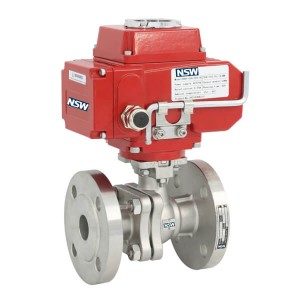
| Operation | Manual lever, gear operator, pneumatic actuator, electric actuator, electro-hydraulic |
| Design Temperature | -196°C to 600°C (depending on material and seat selection) |
| Leakage Rating | ISO 5208 Rate A / API 598 / API 6D QSL 1 |
| Fire-Safe Rating | API 607, API 6FA, ISO 10497 |
| Fugitive Emissions | ISO 15848-1, API 641 |
| Top Work | ISO 5211 mounting pad |
| Body Testing | Shell: 1.5× MAWP; Seat: 1.1× MAWP; Backseat: per API 598 |
Standard design features:
• Trunnion mounted ball, full or reduced bore
• Double Block & Bleed (DBB) capability
• Double Isolation & Bleed (DIB-1 / DIB-2) — optional
• Emergency seat and stem injection (6” and above)
• Anti-static device
• Anti-blowout stem
• Cavity relief valve / vent valve (6” and above)
• Lifting lugs and supporting feet (8” and above)
• Extended stem for cryogenic or high-temperature service — optional
Working Conditions & Industrial Applications
Trunnion mounted ball valves are engineered for the most demanding isolation duties in oil and gas, petrochemical, and power generation service.
| Industry | Specific Applications |
|---|---|
| Oil & Gas Transmission | Mainline transmission, pumping and compressor stations, metering skids, pig launcher/receiver isolation |
| Offshore | Emergency shutdown valves (ESDV), high-integrity pressure protection systems (HIPPS), blowdown valves (BDV) |
| Refining | Hydrocracker isolation, coker service, hydrogen pipelines |
| Chemical & Petrochemical | Corrosive media handling, acid service, polymer production |
| Power Generation | Feedwater isolation, main steam isolation, combined-cycle piping |
| LNG & Cryogenic | LNG loading arms, cryogenic pipelines, low-temperature storage isolation |
| Subsea | Shallow-water subsea isolation, manifold valves |
NSW Valve field experience: In a recent sour gas transmission project, a major EPC contractor required NPS 16, Class 900 trunnion ball valves with full NACE MR0175 compliance and DIB-2 seat configuration. NSW Valve supplied 12 valves with A995 GR.4A duplex bodies, Inconel 625 overlay on wetted surfaces, and Stellite metal seats. After 3 years in continuous service, zero seat leakage was reported during annual maintenance inspections.
Why Trunnion Mounted Ball Valve: Core Technical Advantages
1. Low, Predictable Operating Torque
The trunnion bearings carry the hydraulic thrust, so the seats only experience spring pre-load and controlled pressure-assisted force. Operating torque remains manageable even at Class 2500 and NPS 24+, reducing actuator size and compressed-air consumption. In NSWValve’s internal testing, a 6” Class 900 trunnion valve required approximately 60% less torque than an equivalent floating design at the same pressure differential.
2. True Double Block & Bleed (DBB)
Both upstream and downstream seats seal independently. A body cavity bleed valve confirms isolation integrity by verifying zero pressure in the cavity. This capability is mandatory in many pipeline and process isolation standards and is impossible with floating ball valves.
3. Double Isolation & Bleed (DIB)
For applications requiring isolation from both directions, DIB-1 and DIB-2 seat configurations provide dual independent sealing barriers. DIB-1 isolates from both seats simultaneously; DIB-2 allows the cavity to be relieved to either side depending on pressure direction.
4. Online Seat and Stem Injection
For NPS 6 and above, emergency sealant injection ports allow seat or stem sealing to be restored without removing the valve from the line. This is particularly valuable in offshore and remote pipeline applications where valve removal is impractical.
5. Fire-Safe Design
Tested to API 607, API 6FA, and ISO 10497, with metal-to-metal sealing on the ball-to-seat, stem-to-body, and body-to-bonnet interfaces. Fire-safe design is standard on all metal-seated configurations and available on soft-seated valves.
6. Abrasive Media Tolerance
Because the seat load is balanced and the ball does not push into the seat under pressure, trunnion valves handle abrasive particles with less seat and ball surface damage than floating designs. This extends service life in slurry, sand-laden, and particulate-containing media.
7. Cavity Pressure Relief
When the valve is closed, thermal expansion of trapped fluid in the body cavity can overpressure the cavity. Trunnion valves include a self-relieving seat or external relief valve to manage this risk safely.
8. Full Automation Compatibility
ISO 5211 mounting pad, anti-blowout stem, and low operating torque make trunnion valves straightforward to automate with pneumatic, electric, or electro-hydraulic actuators. NSW Valve provides factory-mounted and tested automation packages on request.
Selection Guide: When to Specify Trunnion vs. Floating
| Parameter | Floating Ball Valve | Trunnion Mounted Ball Valve |
|---|---|---|
| Best size range | NPS 1/2–8 | NPS 2–48 |
| Best pressure range | Class 150–600 | Class 150–2500 |
| Standard | API 608 | API 6D |
| DBB capability | No | Yes |
| Online maintenance | No | Yes (seat/stem injection) |
| Abrasive media | Not recommended | Preferred |
| Cryogenic service | Limited | Yes (LCB/LCC bodies, extended stem) |
| Subsea service | No | Yes (API 6DSS available) |
| Cost | Lower upfront | Higher upfront, lower lifecycle cost at scale |
NSW 3-Question Selection Framework:
1. Does the application require verified isolation (DBB)? → If yes, trunnion is mandatory.
2. Is the bore size above NPS 8 at Class 300, or above NPS 4 at Class 600? → If yes, trunnion is recommended.
3. Is the medium abrasive, or does the service require online maintenance capability? → If yes, trunnion is preferred.
If any answer is unclear, choose trunnion. At high pressure and large diameter, the cost difference is small compared to the risk of inadequate isolation.
Procurement Checklist
Before accepting a quotation for a trunnion mounted ball valve, verify these points:
| Item | What to Request |
|---|---|
| Design standard | Confirm API 6D and ASME B16.34 compliance |
| Material certificates | Mill certs for body, bonnet, ball, stem, seat. Trace heat numbers. |
| NACE compliance | If sour service: hardness reports for all wetted parts, including bolting (B7M / B8M Class 2) |
| Fire-safe test | API 607 or API 6FA certificate for the actual valve configuration |
| Seat configuration | Confirm DPE, SR, DIB-1, or DIB-2 as required by the isolation philosophy |
| Pressure test certificates | Shell, seat, and backseat test reports per API 598 / API 6D |
| Fugitive emissions | ISO 15848-1 or API 641 test report if required |
| Spare parts | Seat rings, stem seals, and body O-rings available as spares |
| Actuator compatibility | ISO 5211 mounting pad verified for the specified actuator |
| Dimensional drawings | General arrangement (GA) drawing for piping layout verification |
Frequently Asked Questions
Q1: What is the difference between a trunnion mounted ball valve and a floating ball valve?
A trunnion mounted ball valve has a ball anchored by upper and lower trunnion bearings. The ball does not move; spring-loaded seats press against it to seal. A floating ball valve has a free-moving ball that is pushed against the downstream seat by line pressure. Trunnion valves handle higher pressures and larger sizes with lower operating torque, and they can provide true double block and bleed. Floating valves are simpler and more cost-effective for smaller sizes and lower pressures.
Q2: What is the maximum pressure class for trunnion mounted ball valves?
NSWValve manufactures trunnion mounted ball valves from Class 150 to Class 2500. Higher API pressure ratings (up to API 15,000 psi) are available on request. The practical size limit for Class 2500 is approximately NPS 12–16, depending on bore type and material.
Q3: Can trunnion mounted ball valves provide double block and bleed?
Yes. Both upstream and downstream seats seal independently. A body cavity bleed valve allows verification of isolation integrity. DIB-1 and DIB-2 configurations are available for applications requiring double isolation and bleed.
Q4: What seat materials are available for trunnion ball valves?
Soft seats: PTFE, RPTFE, PEEK, Devlon, Nylon. Metal seats: Stellite hard-faced, with optional Tungsten Carbide or Inconel overlay. Seat type is selected based on temperature, pressure, and media abrasiveness.
Q5: Are trunnion mounted ball valves suitable for sour service?
Yes. NSWValve offers full NACE MR0175 / ISO 15156 compliance, including body materials (WCB + Inconel 625 overlay, CF8M, Duplex 2205, Super Duplex 2507), trim materials, and bolting with hardness below the NACE limits. NACE compliance certificates and hardness test reports are supplied with each valve.
Q6: Can trunnion ball valves be used for cryogenic service?
Yes. LCB/LCC carbon steel or CF8M stainless steel bodies with extended bonnets and cryogenic-rated seats (PEEK or Devlon) are available for service down to -196°C. Cryogenic testing to BS 6364 is available on request.
Q7: Do you offer automation for trunnion mounted ball valves?
Yes. NSWValve supplies pneumatic, electric, and electro-hydraulic actuator packages, factory-mounted and tested. All valves have ISO 5211 mounting pads. Actuator sizing is verified against actual operating torque data from NSWValve’s testing records.
About NS WValve — Wenzhou Newsway Valve Co., Ltd.
Wenzhou Newsway Valve Co., Ltd. is a professional industrial valve manufacturer with over 20 years of experience in ball valve manufacturing and design. Our 10,000 m² factory operates 5 production lines with an annual output capacity of 8,000 tons of valves.
Certifications: ISO 9001, ISO 14001, CE-PED, API 6FA, API 607, SIL3
Main Products: Trunnion mounted ball valves, floating ball valves, gate valves, butterfly valves, globe valves, and custom-engineered valve solutions
Export Markets: North America, Europe, Southeast Asia, Middle East, South America
Contact:
• Phone: +86 577 15858860365
• Email: sales1@nswvalve.com
• Website: www.nswvalve.com
• Request a Quote
Last updated: September 2026. Technical specifications are subject to change without notice. Contact our engineering team for application-specific recommendations.
Materials of Newsway Valve Manufacturer Products
The China Valve Manufacturer from China, its valves body and trim material can be offered in Forged type and Casting type. Next to Stainless Steel and Carbon Steel material, we also manufacture valves in special materials such as titanium, nickel alloys, HASTELLOY®*, INCOLOY®, MONEL®, Alloy 20, super-duplex, corrosion resistant alloys and urea grade materials.
Available Valve Materials
| Tradename | UNS nr. | Werkstoff nr. | Forging | Casting |
| Carbon steel | K30504 | 1.0402 | A105 | A216 WCB |
| Carbon steel | 1.046 | A105N | ||
| Low Temp Carbon steel | K03011 | 1.0508 | A350 LF2 | A352 LCB |
| High Yield steel | K03014 | A694 F60 | ||
| 3 1/2 Nickel steel | K32025 | 1.5639 | A350 LF3 | A352 LC3 |
| 5 Chrome, 1/2 Moly | K41545 | 1.7362 | A182 F5 | A217 C5 |
| 1 1/4 Chrome, 1/2 Moly | K11572 | 1.7733 | A182 F11 | A217 WC6 |
| K11597 | 1.7335 | |||
| 2 1/4 Chrome, 1/2 Moly | K21590 | 1.738 | A182 F22 | A217 WC9 |
| 9 Chrome, 1 Moly | K90941 | 1.7386 | A182 F9 | A217 CW6 |
| X 12 Chrome, 091 Moly | K91560 | 1.4903 | A182 F91 | A217 C12 |
| 13 Chrome | S41000 | A182 F6A | A351 CA15 | |
| 17-4PH | S17400 | 1.4542 | A564 630 | |
| 254 SMo | S31254 | 1.4547 | A182 F44 | A351 CK3MCuN |
| 304 | S30400 | 1.4301 | A182 F304 | A351 CF8 |
| 304L | S30403 | 1.4306 | A182 F304L | A351 CF3 |
| 310S | S31008 | 1.4845 | A182 F310S | A351 CK20 |
| 316 | S31600 | 1.4401 | A182 F316 | A351 CF8M |
| S31600 | 1.4436 | |||
| 316L | S31603 | 1.4404 | A182 F316L | A351 CF3M |
| 316Ti | S31635 | 1.4571 | A182 F316Ti | |
| 317L | S31703 | 1.4438 | A182 F317L | A351CG8M |
| 321 | S32100 | 1.4541 | A182 F321 | |
| 321H | S32109 | 1.4878 | A182 F321H | |
| 347 | S34700 | 1.455 | A182 F347 | A351 CF8C |
| 347H | S34709 | 1.4961 | A182 F347H | |
| 410 | S41000 | 1.4006 | A182 F410 | |
| 904L | N08904 | 1.4539 | A182 F904L | |
| Carpenter 20 | N08020 | 2.466 | B462 N08020 | A351 CN7M |
| Duplex 4462 | S31803 | 1.4462 | A182 F51 | A890 Gr 4A |
| SAF 2507 | S32750 | 1.4469 | A182 F53 | A890 Gr 6A |
| Zeron 100 | S32760 | 1.4501 | A182 F55 | A351 GR CD3MWCuN |
| Ferralium® 255 | S32550 | 1.4507 | A182 F61 | |
| Nicrofer 5923 hMo | N06059 | 2.4605 | B462 N06059 | |
| Nickel 200 | N02200 | 2.4066 | B564 N02200 | |
| Nickel 201 | N02201 | 2.4068 | B564 N02201 | |
| Monel® 400 | N04400 | 2.436 | B564 N04400 | A494 M35-1 |
| Monel® K500 | N05500 | 2.4375 | B865 N05500 | |
| Incoloy® 800 | N08800 | 1.4876 | B564 N08800 | |
| Incoloy® 800H | N08810 | 1.4958 | B564 N08810 | |
| Incoloy® 800HT | N08811 | 1.4959 | B564 N08811 | |
| Incoloy® 825 | N08825 | 2.4858 | B564 N08825 | |
| Inconel® 600 | N06600 | 2.4816 | B564 N06600 | A494 CY40 |
| Inconel® 625 | N06625 | 2.4856 | B564 N06625 | A494 CW 6MC |
| Hastelloy® B2 | N10665 | 2.4617 | B564 N10665 | A494 N 12MV |
| Hastelloy® B3 | N10675 | 2.46 | B564 N10675 | |
| Hastelloy® C22 | N06022 | 2.4602 | B574 N06022 | A494 CX2MW |
| Hastelloy® C276 | N10276 | 2.4819 | B564 N10276 | |
| Hastelloy® C4 | N06455 | 2.461 | B574 N06455 | |
| Titanium GR. 1 | R50250 | 3.7025 | B381 F1 | B367 C1 |
| Titanium GR. 2 | R50400 | 3.7035 | B381 F2 | B367 C2 |
| Titanium GR. 3 | R50550 | 3.7055 | B381 F3 | B367 C3 |
| Titanium GR. 5 | R56400 | 3.7165 | B381 F5 | B367 C5 |
| Titanium GR. 7 | R52400 | 3.7235 | B381 F7 | B367 C7 |
| Titanium GR. 12 | R53400 | 3.7225 | B381 F12 | B367 C12 |
| Zirconium® 702 | R60702 | B493 R60702 | ||
| Zirconium® 705 | R60705 | B493 R60705 |