


A trunnion mounted ball valve is a quarter-turn isolation valve designed to provide reliable shutoff in a wide range of industrial pipeline applications. Its ball is supported by fixed upper and lower trunnions, while the seat rings move against the ball to establish the seal. This arrangement helps manage operating torque and seat loading, particularly in larger-bore and higher-pressure applications.
However, selecting a trunnion mounted ball valve involves more than matching the nominal pipe size and pressure class. Engineers and purchasing teams must also evaluate the process medium, operating pressure, temperature, seat configuration, leakage requirements, end connections, actuation method, and applicable standards.
This guide explains how a trunnion mounted ball valve works, how it differs from a floating ball valve, which design features affect performance, and what to verify when selecting a valve for an industrial project.
1. What Is a Trunnion Mounted Ball Valve?
A trunnion mounted ball valve is a ball valve in which the ball is mechanically supported by fixed upper and lower trunnions or an equivalent bearing-supported arrangement. The ball rotates around a fixed axis when the valve opens or closes.
Unlike a floating ball valve, the ball in a trunnion mounted design is not intended to move downstream under differential pressure to generate the primary seating force. Instead, the seat rings are designed to move toward the ball through spring loading, pressure-assisted loading, or another mechanism specified by the manufacturer.
This construction can help control operating torque and manage mechanical loads as valve size and pressure requirements increase. For this reason, trunnion mounted ball valves are widely used in pipeline isolation, oil and gas facilities, petrochemical plants, gas processing systems, and other industrial services where the design is suitable for the operating conditions.
Common configuration options include:
• Seat materials: Soft seats, such as PTFE-based materials, or metal seats for suitable demanding services.
• Bore design: Full-bore or reduced-bore flow passages.
• End connections: Flanged or butt-weld connections, depending on the design and project specification.
• Operating methods: Lever, gearbox, pneumatic actuator, or electric actuator.
• Sealing arrangements: Single piston effect (SPE), double piston effect (DPE), and other seat configurations.
• Special requirements: Double block and bleed (DBB), double isolation and bleed (DIB), fire-tested designs, or sour-service material requirements where specified.
The correct configuration depends on the process conditions and the required isolation performance rather than on valve size alone.
2. How Does a Trunnion Mounted Ball Valve Work?
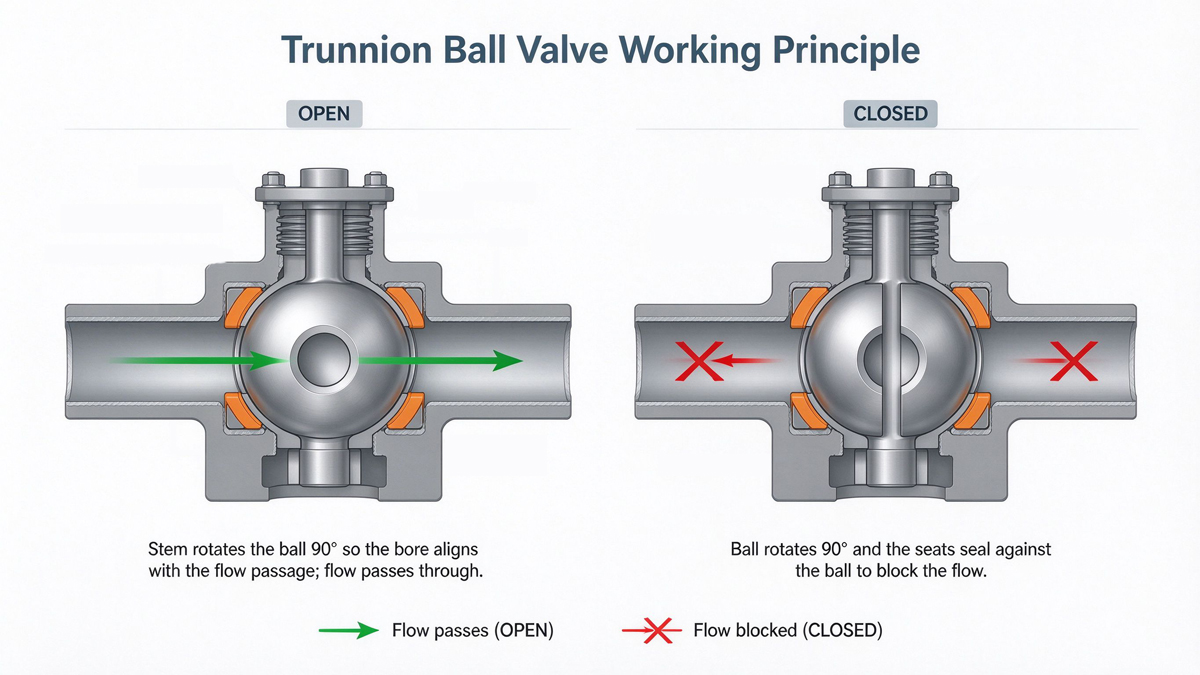
A trunnion mounted ball valve uses the same basic quarter-turn operating principle as other ball valves. The ball contains a bore that aligns with the pipeline when the valve is open. Turning the ball approximately 90 degrees moves the bore away from the flow path and closes the valve.
The main difference lies in how the ball is supported and how the seats establish sealing contact.
2.1 Ball Support and Load Distribution
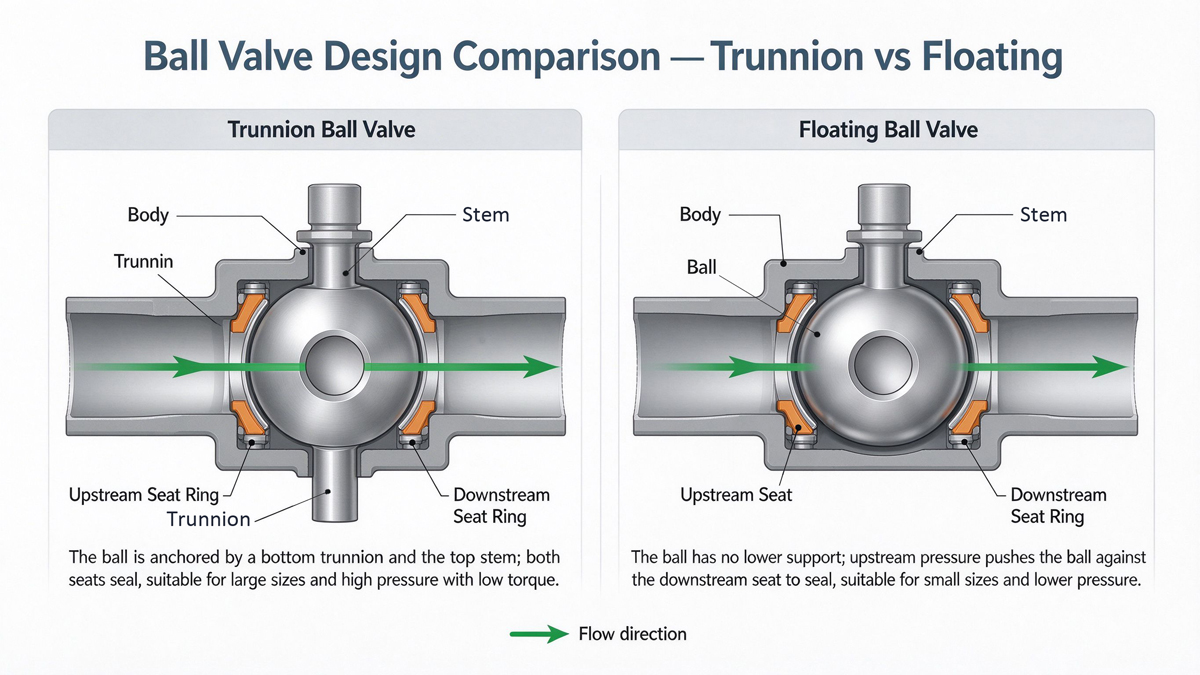
In a floating ball valve, differential pressure can push the ball toward the downstream seat. The downstream seat therefore experiences the resulting ball load, and the required operating torque may increase as pressure and ball size increase.
In a trunnion mounted ball valve, the trunnions and their supporting structure restrain the ball and transfer mechanical loads into the valve body. This reduces the extent to which the seats must support ball movement under differential pressure.
The seats still carry important sealing loads. Their performance depends on the seat design, contact geometry, material properties, pressure conditions, and manufacturing tolerances. A trunnion-mounted arrangement therefore changes the load path; it does not eliminate seat loading or guarantee a particular operating torque.
This distinction becomes important when evaluating larger valves, higher differential pressures, and automated isolation systems.
2.2 Seat Loading and Sealing
Seat rings form the sealing interface between the ball and the valve body. Depending on the design, springs may maintain initial contact between the seats and the ball, while line pressure may contribute to the sealing force.
In a pressure-assisted arrangement, the pressure acting on the seat carrier can increase the seating force under certain operating conditions. The exact behavior depends on the seat configuration and pressure direction.
Sealing performance is influenced by several factors:
• Seat material and its compatibility with the process medium
• Ball surface condition and dimensional accuracy
• Operating and differential pressure
• Fluid temperature and chemical properties
• Seat loading and spring characteristics
• Wear, contamination, and operating frequency
• Required leakage acceptance criteria
Soft-seated designs can provide tight shutoff in compatible services within the specified limits of the seat material and valve design. Metal-seated designs may be considered for applications involving elevated temperatures, abrasive particles, or other demanding conditions, provided the design has been validated for the intended service.
Typical reference values can guide early evaluation: PTFE-based soft seats are commonly rated to around 200 °C in compatible service, and the ball sealing-zone surface finish is often held to 0.4 µm Ra or better per API 6D. For cryogenic service (for example, LNG duties to approximately −196 °C), extended-bonnet designs and low-temperature-qualified materials are typically required. These are typical values, not universal limits — buyers should confirm the exact figures against the manufacturer’s drawings, technical data, applicable standards, and project requirements.
2.3 Quarter-Turn Operation and Actuation
A trunnion mounted ball valve can be operated manually or equipped with a pneumatic or electric actuator. The actuator rotates the stem, which transmits torque to the ball.
The supported-ball design can offer manageable operating torque in applications where a comparable floating ball design would require greater torque. Actual torque, however, depends on the valve’s size, pressure, seat arrangement, materials, differential pressure, and operating conditions. As an illustration, a 24-inch Class 600 trunnion valve can require on the order of tens of thousands of newton-metres of operating torque — far above the typical range of a floating-ball actuator — which is why verified manufacturer torque data is essential for sizing.
For automated valves, actuator selection should be based on verified valve torque data across the required operating conditions. The sizing review should consider breakaway torque, running torque, seating torque, operating time, supply pressure or voltage, control signals, and any specified fail-safe action.
An actuator should not be selected solely from nominal valve size or a general rule of thumb.
3. Trunnion Mounted Ball Valve vs. Floating Ball Valve
Both trunnion mounted and floating ball valves use a rotating ball to control flow. Their main difference is the way the ball is supported and how differential pressure contributes to sealing.
Table 1 — Trunnion Mounted vs. Floating Ball Valve
|
Comparison factor |
Trunnion mounted ball valve |
Floating ball valve |
| Ball support | Ball is restrained by trunnions or an equivalent supported arrangement | Ball can move slightly under differential pressure |
| Sealing mechanism | Seat rings move toward the supported ball according to the seat design | Differential pressure pushes the ball against the downstream seat |
| Operating torque | Can provide more manageable torque in larger or higher-pressure applications | Torque may increase significantly with ball size and differential pressure |
| Typical application | Often selected for demanding pipeline isolation and larger-bore duties | Often suitable for smaller or medium-size valves and compatible pressure conditions |
| Construction | Includes trunnion supports and associated components | Generally has a simpler ball-support arrangement |
| Cost considerations | May involve higher initial cost and more complex construction | Often economical for applications within its suitable operating range |
| Selection priorities | Seat design, bearing arrangement, torque, pressure, and isolation requirements | Pressure, seat loading, torque, size, and required shutoff performance |
Which Design Should You Choose?
A floating ball valve may be a practical choice when its pressure rating, size, torque, and sealing performance meet the application requirements. A trunnion mounted ball valve may be more suitable when the supported-ball arrangement offers advantages in managing mechanical loads and operating torque.
There is no universal or hard rule that fixes the switchover point, but a common engineering rule of thumb is that trunnion-mounted designs are the default for NPS 6 and above at Class 300 and higher, and for Class 900–2500 services across all sizes. The final decision should still be based on the manufacturer’s design limits, the governing specification, differential pressure, operating frequency, shutoff requirements, and total installed cost.
For projects involving automated operation, engineers should compare the complete valve-and-actuator package rather than the valve purchase price alone.
4. Main Components of a Trunnion Mounted Ball Valve
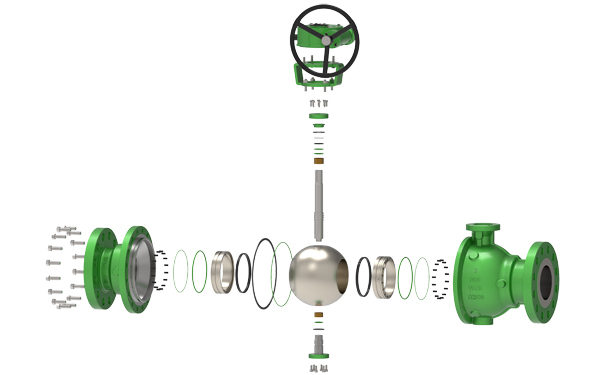
Understanding the main components helps engineers evaluate design suitability, maintenance requirements, and supplier documentation.
4.1 Valve Body
The valve body forms the main pressure boundary and houses the internal components. Depending on the design, the body may use a split-body, top-entry, or another construction.
Body material must be compatible with the process fluid and suitable for the specified pressure-temperature conditions. The pressure boundary, wall thickness, end connections, and applicable design requirements should be verified against the project specification.
4.2 Ball and Trunnions
The ball contains the flow passage and rotates between the open and closed positions. The trunnions support the ball and help transfer mechanical loads to the valve structure.
Ball material, surface treatment, dimensional accuracy, and the condition of the sealing surface can affect operating performance and service life. The selected design should provide the required compatibility with the process medium and the intended operating conditions.
4.3 Seat Rings
Seat rings establish sealing contact with the ball. Their construction may include springs, pressure-responsive features, or other mechanisms depending on the manufacturer’s design.
Seat selection should consider leakage requirements, pressure direction, fluid compatibility, temperature, wear resistance, and maintenance expectations. The specification should identify the required leakage test and acceptance criteria rather than relying only on terms such as “tight shutoff.”
4.4 Stem and Stem Seals
The stem transfers torque from the operating device to the ball. Stem retention and packing arrangements help maintain mechanical integrity and control external leakage.
For hazardous or emission-sensitive services, buyers should specify the required stem-sealing performance, applicable test requirements, and documentation. Requirements should be confirmed against the actual valve design and project standards.
4.5 Bearings, Secondary Seals, and Auxiliary Fittings
Bearings support ball rotation and help manage mechanical loads. Depending on the valve design, additional components may include secondary seals, sealant injection fittings, body vents, drains, or cavity-pressure relief features.
These features should be selected according to the service conditions and maintenance plan. Not every valve requires the same auxiliary fittings, and their presence should not be assumed to provide a particular isolation function without technical confirmation.
5. Key Advantages of Trunnion Mounted Ball Valves
5.1 Manageable Operating Torque
The supported-ball arrangement can reduce the effect of differential-pressure-induced ball loading on the seats. In suitable applications, this can help provide more manageable operating torque and simplify actuator selection.
The actual torque advantage must be confirmed using manufacturer data for the specific valve and operating conditions.
5.2 Suitability for Larger and Higher-Pressure Applications
Trunnion mounted ball valves are commonly considered for larger-bore and higher-pressure duties because the ball is mechanically supported rather than relying on downstream seat contact to restrain its movement.
Suitability still depends on the valve’s rated pressure, materials, seat design, construction, and specified operating conditions.
5.3 Flexible Seat and Material Options
Soft-seated and metal-seated designs serve different application requirements. A suitable material combination can help address fluid compatibility, temperature, wear, and leakage requirements.
Material selection should cover the pressure-containing components and wetted trim, not just the body material.
5.4 Compatibility with Automated Operation
Trunnion mounted ball valves can be configured for pneumatic or electric actuation. This makes them candidates for remote isolation, automated pipeline systems, and shutdown applications where the valve design meets the required service conditions.
For automated packages, the valve torque curve, actuator output, operating time, power or air supply, environmental protection, and fail action should be reviewed together.
6. Common Applications of Trunnion Mounted Ball Valves
6.1 Oil and Gas Pipelines
Trunnion mounted ball valves are used in gas transmission, liquid transportation, gathering systems, and other pipeline applications. The required valve design, pressure rating, materials, inspection, and testing depend on the pipeline specification and applicable standards.
6.2 Petrochemical and Refining Plants
Process systems may use trunnion mounted ball valves for hydrocarbon and other compatible media. Engineers must evaluate the fluid composition, temperature, pressure, material compatibility, sealing performance, and any fire-test or emissions requirements.
6.3 Gas Processing and Industrial Utilities
Gas handling and utility systems may use supported-ball valves where their operating characteristics and isolation performance suit the application. The selection should account for the medium, operating cycle, required leakage performance, and maintenance conditions.
6.4 Remote and Automated Pipeline Systems
When paired with a correctly selected actuator, a trunnion mounted ball valve can support remote operation and automated isolation. Projects requiring emergency shutdown or fail-safe operation should specify the required response, actuator configuration, and verification documents.
7. How to Select the Right Trunnion Mounted Ball Valve
A technically sound selection process begins with the service conditions and continues through design verification, testing, and documentation review.
7.1 Confirm Valve Size and Pressure-Temperature Rating
Specify the nominal size, pressure class, design pressure, operating pressure, design temperature, and operating temperature.
Verify that the selected valve’s pressure-temperature rating is suitable for the specified materials and construction. Nominal pressure class alone is not sufficient to establish the allowable working pressure at every temperature. As a reference, carbon-steel (WCB) pressure ratings at 38 °C are approximately Class 150 ≈ 19.6 bar, Class 300 ≈ 51 bar, and Class 600 ≈ 102 bar (typical values per ASME B16.34).
For project-critical services, ask the supplier to identify the applicable rating basis and provide the relevant technical documentation.
7.2 Define the Process Medium
Provide the process-fluid composition and relevant characteristics, including:
• Corrosiveness and chemical compatibility
• Gas, liquid, or multiphase service
• Solids, particles, or abrasive contaminants
• Viscosity and potential deposits
• Potential for hydrate formation, crystallization, or other operating issues
• Sour-service conditions, where applicable
These details can affect body metallurgy, ball and stem materials, seat selection, sealing arrangements, and maintenance requirements.
7.3 Specify the Required Seat Design and Leakage Performance
Determine whether a soft-seated or metal-seated design is suitable for the process. Consider the required shutoff performance, pressure direction, temperature, fluid compatibility, wear conditions, and expected operating frequency.
State the applicable valve testing standard and leakage acceptance criteria in the inquiry. If the valve must isolate pressure from one or both directions, make that requirement explicit and confirm the proposed seat configuration.
7.4 Choose Full-Bore or Reduced-Bore Construction
A full-bore valve provides a flow passage designed to closely match the pipeline’s internal diameter, subject to the manufacturer’s design. It may be required for pipeline pigging or other applications where a suitable through-bore is important.
A reduced-bore design may be acceptable where the project permits a smaller flow passage. Confirm the flow requirements, pressure loss considerations, pigging requirements, and connection dimensions before choosing the configuration.
7.5 Confirm End Connections
Common options include flanged and butt-weld ends. The purchase specification should identify the required connection type, size, facing, pressure class, dimensional standard, and any special project requirements.
For butt-weld valves, confirm the applicable end preparation and dimensional details. For flanged valves, verify the flange facing and dimensions against the mating pipeline specification.
7.6 Specify the Operating Method
Define whether the valve will use manual operation, a gearbox, a pneumatic actuator, or an electric actuator.
For automated operation, provide the information needed for package selection, including:
• Required opening and closing time
• Available air pressure or electrical supply
• Control signals and interface requirements
• Required fail-open, fail-closed, or fail-in-place behavior, if applicable
• Environmental and enclosure requirements
• Local controls, position indication, and accessories
• Required duty cycle and operating frequency
The supplier should confirm actuator sizing against the verified valve torque data and the specified operating conditions.
7.7 Review Applicable Standards and Project Specifications
Identify the standards required for design, manufacture, pressure testing, inspection, dimensions, fire testing, materials, and documentation.
Different standards cover different aspects of valve design and verification. Do not assume that compliance with one standard automatically establishes compliance with another. Confirm the required edition, scope, and acceptance criteria in the project documents.
7.8 Evaluate Inspection and Documentation
Before placing an order, confirm the inspection and test plan and the documentation package. Depending on the project, this may include:
• Material certificates and traceability
• Pressure-test and functional-test records
• Inspection reports
• Dimensional drawings and approved data sheets
• Bill of materials
• Applicable conformity or certification documents
• Nonconformance and deviation records
• Operation and maintenance instructions
• Spare-parts recommendations
For critical service, clarify documentation requirements during the inquiry stage instead of waiting until final inspection.
8. Trunnion Ball Valve Seat Configurations: SPE, DPE, DBB, and DIB
Seat configuration affects the valve’s sealing behavior, the direction in which isolation is provided, and how pressure trapped in the body cavity is managed.
8.1 Single Piston Effect (SPE)
A single piston effect seat is designed so that pressure in the valve body cavity can act on the seat in a way that allows the seat to relieve cavity pressure toward the designated side under specified conditions.
The actual pressure-relief behavior depends on the seat design and pressure direction. Buyers should verify the manufacturer’s description and confirm whether additional venting or drainage arrangements are required.
8.2 Double Piston Effect (DPE)
A double piston effect seat is designed so that pressure acting from the line side or body cavity can energize the seat according to the specific design. Depending on the arrangement, both seats may seal against pressure from their respective sides.
Because a configuration that seals in both directions can also affect cavity-pressure behavior, the pressure-relief strategy must be evaluated for the intended service. Do not assume that every DPE arrangement manages trapped cavity pressure in the same way.
8.3 Double Block and Bleed (DBB)
Double block and bleed generally describes an arrangement that provides two seating barriers against pressure from the two sides of a closed valve, with a means of bleeding or verifying pressure in the cavity between the barriers.
The exact isolation capability depends on the valve design, seat configuration, pressure direction, and applicable specification. Buyers should confirm that the offered valve meets the project’s definition of DBB.
8.4 Double Isolation and Bleed (DIB)
Double isolation and bleed generally describes an arrangement intended to provide two isolation barriers against pressure from a specified direction, together with a means of bleeding the cavity between them.
The required configuration and pressure direction must be clearly stated. DBB and DIB should not be treated as interchangeable terms without checking the applicable specification and the manufacturer’s design documentation.
When specifying SPE, DPE, DBB, or DIB, ask the supplier to confirm:
• The direction or directions in which isolation is required
• The expected behavior of each seat
• How trapped body-cavity pressure is managed
• Whether a vent, drain, or relief device is included
• The relevant pressure-test and acceptance requirements
For safety-critical applications, the final configuration should be reviewed against the applicable project standard and process hazard requirements.
9. Applicable Standards for Trunnion Mounted Ball Valves
Several standards may be relevant to trunnion mounted ball valves. Their applicability depends on the valve type, service, contract, and project specification.
Table 2 — Applicable Standards at a Glance
|
Standard |
General purpose |
What buyers should verify |
| API 6D | Pipeline and piping valves | Required design, manufacturing, testing, inspection, and documentation provisions |
| ISO 14313 | Pipeline transportation systems — pipeline valves | Applicable edition and project requirements; confirm the exact standard specified by the contract |
| ASME B16.34 | Valve pressure-temperature ratings and related design requirements | Material group, pressure-temperature limits, and applicable construction requirements |
| API 608 | Metal ball valves for specified industrial applications | Applicability to the offered valve type and project specification |
| API 607 | Fire testing for applicable quarter-turn valves and valves equipped with nonmetallic seats | Required test scope, valve configuration, and evidence of compliance |
| API 6FA | Fire testing for valves within its defined scope | Applicability to the valve type and the project’s fire-test requirements |
| NACE MR0175 / ISO 15156 | Materials for equipment used in H₂S-containing environments in oil and gas production | Whether the service falls within scope and whether selected materials meet the requirements |
| NACE MR0103 / ISO 17945 | Materials for resistance to sulfide stress cracking in corrosive petroleum refining environments | Applicability to the refinery service and specified material requirements |
These standards are not interchangeable. The relevant standard and edition should be identified in the purchase specification, and compliance should be supported by appropriate technical documents.
A standard reference in a product description does not by itself prove that a specific model is certified, tested, or approved for every application covered by that standard. Buyers should verify the actual scope of the supplier’s documentation.
For sour service, determine the applicable environment and governing specification before selecting materials. Do not assume that all H₂S-containing applications fall under the same material standard.
10. What Should Buyers Ask a Trunnion Mounted Ball Valve Manufacturer?
When comparing a trunnion mounted ball valve manufacturer or supplier, evaluate technical suitability and delivery requirements alongside unit price.
A practical request-for-quotation checklist includes:
• Size and rating: What are the required nominal size, pressure class, design pressure, and temperature range?
• Materials: Which materials are proposed for the body, ball, stem, seats, and other wetted components?
• Seat configuration: Is the valve soft-seated or metal-seated? Is the required isolation behavior clearly defined?
• Bore and connections: Is full-bore or reduced-bore construction required? Which end connections and dimensions apply?
• Operating method: Will the valve be manual, pneumatic, or electric? What are the actuator and control requirements?
• Applicable standards: Which design, testing, inspection, material, and fire-test standards are required?
• Leakage performance: Which test standard and acceptance criteria apply?
• Inspection and traceability: Which material certificates, test reports, and inspection records must be supplied?
• Project documentation: Are drawings, data sheets, operation manuals, and other documents required for approval?
• Commercial terms: What are the delivery time, warranty conditions, spare-parts availability, and after-sales support arrangements?
Ask the supplier to identify any deviations from the inquiry specification. Two quotations may appear similar while differing in seat design, material grade, testing scope, accessories, or documentation.
For automated valves, request the valve torque data and the basis for actuator sizing. This helps the project team compare complete operating packages rather than evaluating the valve body alone.
11. Frequently Asked Questions
1. What is the main difference between a trunnion mounted and a floating ball valve?
A trunnion mounted ball valve mechanically supports the ball with trunnions or an equivalent arrangement. A floating ball valve allows the ball to move slightly under differential pressure toward the downstream seat. The difference affects load transfer, seat loading, operating torque, and suitability for a particular service.
2. Are trunnion mounted ball valves suitable for high-pressure applications?
They are commonly used in high-pressure pipeline and industrial isolation duties. However, suitability depends on the specific valve design, size, material, pressure-temperature rating, seat configuration, and applicable standards. The manufacturer’s technical documentation should be checked against the project conditions.
3. Can a trunnion mounted ball valve be automated?
Yes. Depending on the valve design, it can be equipped with a pneumatic or electric actuator. Correct actuator sizing requires verified valve torque data and a review of operating time, supply conditions, control requirements, and any specified fail-safe action.
4. What is the difference between DBB and DIB?
DBB generally refers to two seating barriers that block pressure from both sides of a closed valve, with a means to bleed the cavity between them. DIB generally refers to two isolation barriers against pressure from a specified direction, also with a means of bleeding the cavity. The required configuration and pressure direction should be confirmed against the governing specification.
5. How do I choose between soft-seated and metal-seated trunnion ball valves?
Soft seats can provide tight shutoff in compatible services within their specified material and operating limits. Metal seats may be considered for higher-temperature or more demanding wear conditions when the design is suitable. The choice should reflect the medium, temperature, pressure, leakage criteria, and verified design limits.
6. What information is needed to request a quotation?
Provide the valve size, pressure class, process medium, operating and design temperatures, end connections, required materials, seat configuration, applicable standards, leakage requirements, and inspection documentation. For automated valves, also specify the actuator, control, power or air supply, and operating requirements.
12. Conclusion
A trunnion mounted ball valve can be an effective isolation solution for industrial pipelines when its ball-support arrangement, seat design, materials, and operating mechanism match the service conditions. Its advantages in load management and operating torque can be particularly relevant for larger-bore and higher-pressure applications, but performance must be verified for the specific valve and duty.
A reliable selection process starts with accurate process data, followed by a review of pressure-temperature ratings, seat configuration, bore, end connections, actuation, applicable standards, and inspection requirements. Clear specifications also help purchasing teams compare suppliers on a consistent technical basis.
If you are evaluating a trunnion mounted ball valve for an industrial or pipeline project, contact NSW Valve with your application requirements. You can also review the NSW Valve trunnion mounted ball valve product page for product configurations and technical information.
About NSW Valve (E-E-A-T)
Newsway Valve Co., Ltd. (NSW Valve) manufactures and exports industrial valves for a range of industrial applications. When evaluating a valve for your project, request the applicable product data sheet, drawings, material information, test documentation, and certification details for the specific model and configuration. Confirm that the supplied documents match your project requirements before placing an order.
Please Contact NSW Valve’s team for certification scope, Representative torque or test data that demonstrates verified performance on specific models, Engineering team credentials and relevant project references for pipeline / petrochemical isolation duty.
Post time: Oct-15-2026