


In modern petroleum refining, petrochemical processing, and chemical transport, controlling fugitive emissions is both an environmental mandate and an operational necessity. Volatile organic compounds (VOCs), hazardous air pollutants (HAPs), and toxic chemical leaks from pipeline valve stem packing contribute significantly to product loss, safety hazards, and global emissions penalties.
The **ISO 15848** international standard provides a standardized framework for testing, measuring, and qualifying valve stem seals and body joints against fugitive emissions. Selecting a certified **ISO 15848 Valve** equipped with engineered low-emission packing technology ensures long-term tightness, environmental compliance, and reduced maintenance downtime across severe process lines.
For EPC contractors, plant owners, and procurement teams, choosing the right **ISO 15848 Valve Manufacturer** and a qualified **ISO 15848 Valve Factory** is just as important as selecting the valve type itself. The difference between a standard valve and a true low-emission valve often lies in packing architecture, live-loading design, stem surface finish, and factory-level testing discipline.
—
## What Is ISO 15848 and How Is It Structured?
The **ISO 15848** standard specifies testing procedures for evaluating external leakage from valve stem seals or shafts and body joints. It is divided into two primary parts:
- **ISO 15848-1 (Type Testing):** Classification system and qualification procedures for type testing of industrial valves. It defines endurance classes, temperature levels, and tightness classes using helium or methane tracer gas.
- **ISO 15848-2 (Production Testing):** Quality assurance inspection procedures for verifying production valves manufactured in batch runs, ensuring compliance with the type-tested design.
“`
ISO 15848 CLASSIFICATION MATRIX
┌──────────────────────────────────────────────────────────────────┐
│ 1. Tightness Class: Class AH / BH / CH (Helium) | Class AM / BM (Methane) │
│ 2. Endurance Class: Mechanical Cycles (CO1, CO2, CO3) + Thermal Cycles │
│ 3. Temperature Range: Cryogenic (-196°C) to High Temp (+400°C+) │
└──────────────────────────────────────────────────────────────────┘
“`
### Key ISO 15848-1 Classification Categories
1. **Test Gas:** Helium (He) or Methane (CH₄).
2. **Tightness Classes (Helium Tracer):**
– **Class AH:** Leakage rate ≤ 10⁻¹⁰ Pa·m³/s per millimeter of stem diameter — highest tightness, typically achieved through bellows seal or engineered high-density PTFE sets.
– **Class BH:** Leakage rate ≤ 10⁻⁴ mg/(s·m) per millimeter of stem diameter — standard high-performance graphite/PTFE packing.
– **Class CH:** Leakage rate ≤ 10⁻² mg/(s·m) per millimeter of stem diameter.
3. **Endurance Classes (Mechanical Cycles):**
– **Isolation Valves (Quarter-Turn & Linear):** CO1 (500 cycles), CO2 (1,500 cycles), CO3 (2,500 cycles).
– **Control Valves:** CC1 (20,000 cycles), CC2 (60,000 cycles), CC3 (100,000 cycles).
—
## Core Sealing Technologies Behind ISO 15848 Low-Emission Packing
Achieving Class AH or Class BH tightness requires more than standard gland packing. Certified low-emission valves integrate specific seal material combinations and live-loading engineering.
### 1. Engineered Packing Set Architecture
- **Combination Graphite Sets:** Utilizes die-formed flexible graphite rings in the center for fire safety and thermal resistance, sandwiched between braided carbon/graphite anti-extrusion end-rings to prevent graphite migration under pressure.
- **V-Ring Chevron PTFE Sets:** Multi-lip PTFE designs with cup-and-cone geometries that expand under line pressure to provide ultra-low friction and dynamic sealing for low-temperature and chemical service.
- **Expanded Graphite with Braided Anti-Extrusion Ends:** A common high-performance architecture for severe thermal cycling, where soft graphite provides sealing and braided ends prevent extrusion into the stem clearance.
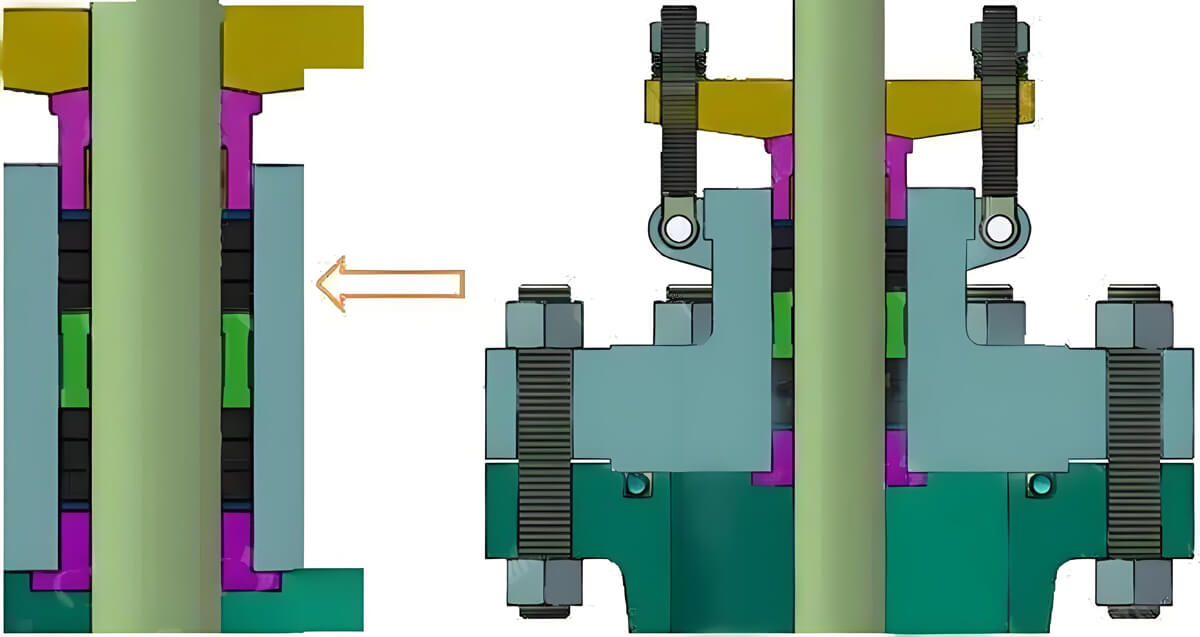
### 2. Live-Loaded Belleville Spring Assemblies
Thermal cycling and mechanical stem friction naturally cause packing relaxation over time. Live-loaded Belleville disc springs installed under the gland flange bolts maintain constant, continuous compressive stress on the packing set. This automatically compensates for wear, stress relaxation, and thermal expansion without requiring frequent manual gland tightening.
### 3. Precision Stem Finish & Stuffing Box Tolerances
To prevent micro-path leaks along metallic contact surfaces:
- Valve stems are precision ground and burnished to a surface roughness of **Ra ≤ 0.2–0.4 μm**.
- Stuffing box cylindrical wall finish is maintained at **Ra ≤ 1.6 μm** with strict verticality and concentricity control.
- Stem-to-gland clearance, packing chamber roundness, and gland follower alignment are critical for repeatable ISO 15848 performance.
“`
LIVE-LOADED STEM PACKING STRUCTURE
┌─────────────────────────────────────────────────────────────────┐
│ Gland Flange Bolt & Nut │
│ │ │
│ Belleville Disc Springs (Live-Loading) │
│ │ │
│ Gland Follower Bushing │
│ │ │
│ ┌─────────────────────────────────────┐ │
│ │ Top Anti-Extrusion Braided Ring │ │
│ │ High-Density Die-Formed Graphite │ (Stem Ra≤0.4µm) │
│ │ Bottom Anti-Extrusion Braided Ring │ │
│ └─────────────────────────────────────┘ │
└─────────────────────────────────────────────────────────────────┘
“`
—
## How to Select an ISO 15848 Valve Manufacturer and ISO 15848 Valve Factory
When specifying low-emission valves, the choice of an **ISO 15848 Valve Manufacturer** and **ISO 15848 Valve Factory** is as important as the valve type itself. A qualified **ISO 15848 Valve Manufacturer** should provide:
- ISO 15848-1 type test reports from accredited laboratories.
- ISO 15848-2 production test procedures and batch inspection records.
- Material traceability for graphite, PTFE, and anti-extrusion packing components.
- In-house stem grinding, burnishing, and surface roughness inspection.
- Live-loading spring calculation, assembly control, and torque documentation.
- Helium mass spectrometer leakage test benches.
A reliable **ISO 15848 Valve Factory** should also control stuffing box tolerances, stem concentricity, gland bolt torque, and packing installation procedures. These factory-level controls determine whether a valve can consistently achieve Class BH or Class AH in real service, not only in a one-time type test.
—
## ISO 15848 Compliance Across Core Industrial Valve Types
### 1. ISO 15848 Ball Valve
Quarter-turn ball valves subject stem seals to dynamic rotational shear forces. An **ISO 15848 Ball Valve** features a live-loaded stem gland combined with primary PTFE/PEEK thrust washers and multi-ring graphite secondary packing, guaranteeing tight rotational sealing over thousands of 90° cycles.
### 2. ISO 15848 Butterfly Valve
High-performance double offset and triple offset butterfly valves require dynamic shaft sealing under severe thermal shock. An **ISO 15848 Butterfly Valve** utilizes specialized anti-extrusion packing sets and precision-ground shaft sleeves to maintain zero fugitive emissions along the drive shaft.
### 3. ISO 15848 Gate Valve
Rising-stem gate valves subject packing to linear axial friction over long travel distances. An **ISO 15848 Gate Valve** combines hardened, burnished stem surfaces with die-formed graphite packing rings and Belleville spring-loaded gland bolting to prevent axial leakage during repeated opening and closing cycles.
### 4. ISO 15848 Globe Valve
Linear throttling globe valves experience high cycle counts in control loops. An **ISO 15848 Globe Valve** incorporates live-loaded chevron packing or hermetically sealed stainless steel bellows sets to deliver Class AH performance in toxic chemical and high-temperature steam lines.
—
## Technical Comparison: ISO 15848 Valve Types
| Feature / Metric | ISO 15848 Ball Valve | ISO 15848 Butterfly Valve | ISO 15848 Gate Valve | ISO 15848 Globe Valve |
| — | — | — | — | — |
| **Motion Type** | Quarter-Turn (90°) | Quarter-Turn (90°) | Linear Rising Stem | Linear Throttling |
| **Sealing System** | Rotational Live-Loaded Packing | Shaft Sleeve & Graphite Packing | Linear Live-Loaded Graphite Set | Live-Loaded Chevron or Bellows |
| **Typical Endurance** | CO1–CO3 (500–2,500) | CO1–CO3 (500–2,500) | CO1–CO2 (500–1,500) | CC1–CC3 (20,000–100,000) |
| **Tightness Class** | Class BH / AH | Class BH | Class BH / CH | Class AH / BH |
| **Core Advantage** | Rapid shutoff with low emissions | Lightweight for large lines | Heavy-duty isolation | Precision control with zero leaks |
—
## Testing Methods: Vacuum Hood Method vs. Sniffer Method
ISO 15848-1 specifies two primary test methods to measure tracer gas emissions:
1. **Vacuum Hood Method (Total Leakage Measurement):**
The valve stem and packing area are enclosed in an airtight sealed hood evacuated by a vacuum pump. Helium tracer gas escaping from the stem area is collected and measured using a mass spectrometer. This method provides the most accurate quantitative total leakage rate.
2. **Sniffer Method (Local Leakage Measurement):**
A sniffing probe measures local helium/methane concentration in ppm around the gland joint. While useful for field verification, the vacuum hood method is the benchmark for formal laboratory type testing.
—
## Why Specifying ISO 15848 Certified Valves Matters for EPCs
- **Environmental Compliance:** Meets stringent international environmental mandates including EPA Method 21, US EPA LDAR, and EU Industrial Emissions Directives.
- **Minimized Product Loss:** Eliminates continuous micro-leaks of valuable gases and solvents in refinery and petrochemical streams.
- **Enhanced Plant Safety:** Reduces toxic exposure risks for operators and eliminates hydrocarbon ignition hazards around valve bonnets.
- **Reduced Maintenance Costs:** Live-loaded packing assemblies dramatically reduce the need for manual gland tightening during plant operations.
- **Consistent Procurement Quality:** Working with a qualified **ISO 15848 Valve Manufacturer** and **ISO 15848 Valve Factory** ensures that every delivered valve follows the same tested design, packing specification, and assembly procedure.
—
## Frequently Asked Questions (FAQ)
### What is the main difference between ISO 15848-1 and API 622?
ISO 15848-1 tests the complete valve assembly, including stem, packing, bonnet, and mechanical/thermal cycles. API 622 tests only the fugitive emission performance of the packing material itself inside a standard test fixture.
### Why is live-loading essential for ISO 15848 valves?
Live-loading uses Belleville spring washers to maintain continuous compressive force on the packing set, compensating for stress relaxation, thermal expansion, and packing wear over long operating cycles.
### Can standard valves be upgraded to ISO 15848 compliance?
Yes. Existing valves can often be retrofitted by machining the stem to Ra ≤ 0.4 μm, installing certified low-emission graphite/PTFE packing sets, and adding Belleville live-loading spring assemblies to the gland bolts.
### How do I choose an ISO 15848 Valve Manufacturer or ISO 15848 Valve Factory?
Look for an **ISO 15848 Valve Manufacturer** that can supply complete type test certificates, packing material datasheets, live-loading calculations, and production test reports. A qualified **ISO 15848 Valve Factory** should have traceable machining, assembly, and helium/methane leakage testing procedures.
### What documentation should an ISO 15848 Valve Factory provide?
A qualified **ISO 15848 Valve Factory** should provide ISO 15848-1 type test certificates, ISO 15848-2 production test reports, packing material certificates, stem surface roughness records, and live-loading spring specifications.
—
## Request ISO 15848 Valve Documentation from Our Factory
Looking for a reliable **ISO 15848 Valve Manufacturer** and **ISO 15848 Valve Factory** for your next processing project?
**Contact our sales engineering team today** to request complete ISO 15848-1 type test certificates, CAD drawings, packing datasheets, or a factory-direct quotation.
As an experienced **ISO 15848 Valve Manufacturer**, we supply **ISO 15848 Ball Valve**, **ISO 15848 Butterfly Valve**, **ISO 15848 Gate Valve**, and **ISO 15848 Globe Valve** solutions for low-emission refinery, petrochemical, and chemical service.
Post time: Sep-19-2026