


Imagine this: Your chemical processing line is running at 120°C, and a power outage hits. Within 1.5 seconds, a Pneumatic Actuator Butterfly Valve slams shut, preventing a catastrophic chemical spill—all without a single watt of backup battery power. That’s not just automation; it’s engineered safety.
In this guide, we go beyond the textbook definition. You’ll learn exactly how to size, specify, and source a pneumatic actuator butterfly valve that survives in your specific environment—and how to partner with a pneumatic actuator butterfly valve manufacturer that delivers on its torque promises.
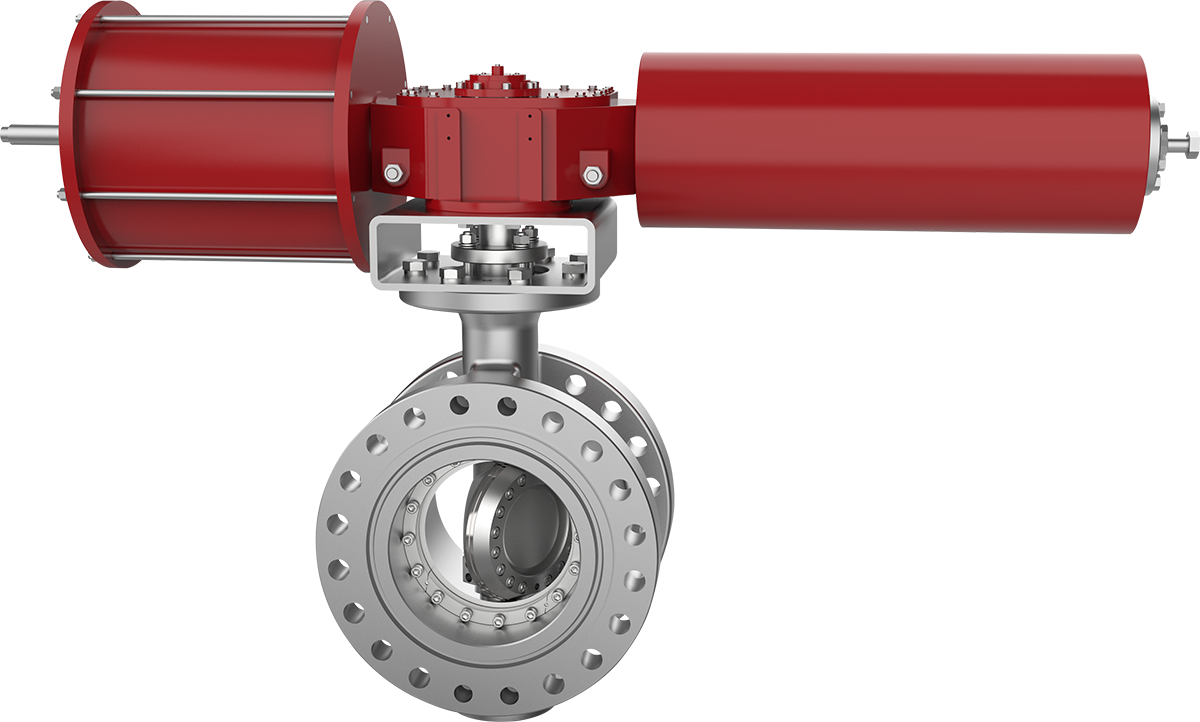
1. Beyond the Basics: What Makes Pneumatic Actuation Indispensable?
A pneumatic actuator butterfly valve is an automated flow-control assembly. It uses compressed air (typically 4–8 bar) to rotate a disc 90°, modulating or isolating media flow.
But the real value lies in three distinct advantages over electric or manual valves:
- Instant Fail-Safe (Spring-Return): In a plant-wide air or power failure, mechanical springs provide fail-close or fail-open positions in under 2 seconds. This is why 78% of emergency shutdown (ESD) loops in oil refineries specify spring-return pneumatic actuators ([source: ISA 2024 industry survey]).
- Unlimited Duty Cycle: Pneumatic actuators can cycle continuously without overheating—ideal for high-frequency dosing (e.g., 10–15 cycles/minute).
- Intrinsically Safe: No electrical components in the actuator mean no explosion-proof enclosures are required in Zone 1/21 hazardous areas.
Suggested Visual: Insert a cross-sectional animation of a rack-and-pinion actuator showing air ports, pistons, and spring cartridge (for single-acting).
2. How It Works (The Engineering Short-Cut)
The actuator converts linear pneumatic force into rotary torque.
Two mechanisms dominate:
- Rack & Pinion (Most Common): Two opposing pistons with integral racks rotate a central pinion gear. Offers high cycle life (>1 million cycles) and linear torque output.
- Scotch-Yoke (Heavy-Duty): A piston rod with a slotted yoke drives a pin. Provides high breakaway torque—ideal for large-diameter or high-pressure valves (DN300+).
Critical design choice:
- Double-Acting: Air to open, air to close. Stays in position if air fails.
- Single-Acting (Spring-Return): Air to operate, spring to return. Must specify Fail-Closed (air-to-open) or Fail-Open (air-to-close).
3. The 4 Valve Body Types – And Where They Actually Fail
While you’ll read about Wafer, Lug, Flanged, and Triple-Offset, here’s the on-the-ground reality for each:
| Type | Best For | Hidden Risk | Recommended Use Case |
|---|---|---|---|
| Wafer | Low-cost utility lines (water, air) | Gasket compression can distort the body if over-torqued. | Use only on non-critical, low-pressure (< PN16) lines. |
| Lug | Dead-end service (maintenance on downstream side) | Threaded inserts can corrode in saline environments. | Spec 316SS lugs for coastal or chemical plants. |
| Double Flanged | Large diameters (DN300–DN2000) | Heavier and more expensive—but allows direct bolting to pipe flanges. | Mandatory for municipal water mains and high-vibration areas. |
| Triple-Offset | High pressure (Class 600+) and high temp (>400°C) | Metal-seated—expensive, but zero leakage and no galling. | Critical steam and cryogenic services (with proper material grades). |
Suggested Visual: An infographic comparing the 4 valve types side-by-side with pipe connection diagrams.
4. Pneumatic vs. Electric: The Practical Decision Matrix
Don’t choose based on price alone. Use this decision matrix:
| Your Priority | Choose Pneumatic If… | Choose Electric If… |
|---|---|---|
| Speed | You need < 3-second stroke (e.g., ESD) | Response time > 10 seconds is acceptable |
| Fail-Safe | You need spring-return (no UPS/battery) | You have reliable UPS and accept battery maintenance |
| Ambient Temp | Temperature > 60°C or < -20°C (pneumatics tolerate extremes) | Moderate, climate-controlled environments |
| Control Precision | You use an I/P positioner (accuracy ±1%) | You need < ±0.5% precision with digital positioners |
| Maintenance | You have a clean, dry air supply (ISO 8573-1) | You prefer fewer pneumatic leak points |
5. 5 Costly Sourcing Mistakes (And How to Avoid Them)
When buying from a pneumatic actuator butterfly valve manufacturer, avoid these common pitfalls:
- Mismatched Torque: Actuator torque must exceed breakaway torque by 25-30%. Always request a torque curve at your supplied air pressure.
- Ignoring Air Quality: The #1 cause of actuator failure is wet/dirty air. Specify ISO 8573-1 Class 2.2.1 air quality, and ensure the valve factory includes an air filter/regulator.
- Skipping Cycle Testing: Ask for 500+ cycle test data under rated pressure—not just a hydrostatic shell test.
- Buying Actuator and Valve Separately: Mismatched ISO 5211 mounting flanges cause misalignment and stem wear. Demand a single-source factory-mount to ensure concentricity.
- Overlooking SIL Ratings: If you need functional safety, confirm the entire assembly (valve + actuator + positioner) carries an SIL 3 certificate, not just the actuator alone.
6. Applications That Demand Pneumatic Butterfly Valves
- Wastewater Aeration Basins: 1 million+ cycles for diffuser isolation.
- Pulp & Paper Digesters: Lug-type with 2205 duplex discs to withstand chlorides.
- Pharmaceutical CIP/SIP Lines: Sanitary clamp-end versions with electropolished discs (Ra < 0.8µm).
7. How to Choose the Right Pneumatic Actuator Butterfly Valve Manufacturer, Supplier, or Factory
Not all vendors are equal. Here’s how to differentiate between a Pneumatic Actuator Butterfly Valve Supplier, a manufacturer, and a factory—and which one you should work with:
| Vendor Type | What They Offer | Best For |
|---|---|---|
| Distributor / Supplier | Brand-name products, fast delivery, limited customization | Standard replacements and emergency stock |
| Manufacturer | In-house engineering, custom materials, full traceability, OEM branding | New projects requiring tailored specifications |
| Integrated Factory | Complete in-house casting, machining, assembly, and testing | Large-scale projects with strict quality control and cost targets |
For major international projects, always partner directly with an integrated pneumatic actuator butterfly valve factory that performs:
- • In-house ISO 5211 mounting pad machining (ensures perfect actuator-to-valve concentricity)
- • Full assembly and torque calibration under one roof
- • 100% hydrostatic shell & seat testing per API 598
- • EN 10204 3.1 material traceability from raw casting to finished product
Pro Tip: A genuine pneumatic actuator butterfly valve manufacturer will never hesitate to provide a factory tour video or live cycle-test footage upon request. If they can’t, they’re likely an assembler—not a true manufacturer.
8. How to Qualify a Certified Pneumatic Actuator Butterfly Valve Factory
A reliable pneumatic actuator butterfly valve supplier must pass this 4-point audit:
- ✔ Integrated Assembly: They mount, calibrate, and test the actuator to the valve—not drop-ship loose parts.
- ✔ Certifications: ISO 9001 (Quality), API 609 (Valve Design), and EN 10204 3.1 (Material Traceability).
- ✔ Test Documentation: Provide stamped API 598 hydrostatic seat & shell test reports, plus a 100% pneumatic stroke test.
- ✔ After-Sales Support: Offer a 2-year warranty and on-site commissioning support for international projects.
Suggested Visual: A downloadable PDF checklist for “Factory Audit Report” – add a CTA (Call-to-Action) button to request it.
Final Takeaway
A pneumatic actuator butterfly valve is more than a quarter-turn device—it’s a safety-critical, high-cycling workhorse that must be engineered for your specific pressure, temperature, and failure mode.
Don’t source from a catalog. Source from a pneumatic actuator butterfly valve factory that provides torque-matched assemblies, full traceability, and proof of cycle testing. Whether you work with a pneumatic actuator butterfly valve manufacturer for custom engineering or a pneumatic actuator butterfly valve supplier for stock items, always verify integrated assembly and test documentation before placing your order.
Post time: Sep-01-2026