


In modern process piping networks—from oil refineries and chemical processing facilities to power plants and LNG terminals—maintaining reliable, leak-free fluid isolation is paramount. Among all quarter-turn valve designs, the industrial ball valve stands out as the ultimate industry standard for fast, high-integrity shut-off.
Global Market Outlook
USD 12.6–14.94 Billion
Valued in 2025
Projected Growth (2034–2035)
USD 20.08–22.8 Billion
Growing at a CAGR of 3.3% to 6.2%
Navigating the vast array of valve configurations, seat materials, pressure ratings, and international design standards can be challenging for piping engineers, project managers, and global sourcing teams.
This guide breaks down everything you need to know about industrial ball valves, addressing how they work, how to select the right valve for severe process conditions, and how to partner with top-tier manufacturers.
Table of Contents
- 1. What Are Industrial Ball Valves?
- 2. Floating vs. Trunnion-Mounted: Which Design Is Right for You?
- 3. How to Select a Ball Valve for Industrial Process Piping
- 4. Engineering Comparison: Industrial Ball Valve Configurations
- 5. Leading Industrial Ball Valve Manufacturers
- 6. Conclusion: Partnering for Reliable Flow Control
1. What Are Industrial Ball Valves?
An industrial ball valve is a quarter-turn rotational valve that utilizes a hollow, perforated, and pivoting sphere (the ball) to control fluid flow through a piping system.
Core Working Principle
- Open Position: When the valve handle or actuator rotates 90° (a quarter turn), the internal bore of the ball aligns parallel to the pipe axis, allowing fluid to pass through with minimal pressure drop (ΔP).
- Closed Position: Rotating the stem another 90° turns the ball’s bore perpendicular to the flow path, creating a bubble-tight seal against the valve seats to halt fluid flow completely.
Primary Construction Styles: Floating vs. Trunnion-Mounted
To select the right ball valve for an industrial application, engineers must first choose between two primary structural designs:
1. Floating Ball Valve
- Mechanism: The ball is suspended in the fluid stream, supported only by two elastomeric or metallic seats. Under line pressure, the ball drifts slightly downstream, compressing against the downstream seat to form a seal.
- Best For: Small to medium sizes (NPS ½ to NPS 4) and lower pressure classes (Class 150 to Class 600). Floating ball valves are generally the best choice for pipelines under 6 inches with pressures below Class 600 (approximately 1,480 PSI).
- Advantages: Simpler design, more cost-effective, requires less maintenance than trunnion designs.
2. Trunnion-Mounted Ball Valve
- Mechanism: The ball is anchored by an upper stem and lower trunnion pivot with bearings. Spring-energized seats are pushed against the anchored ball by line pressure, eliminating ball movement within the body.
- Best For: Large diameter piping (NPS 2 to NPS 60+), high-pressure services (Class 600 to Class 2500), and severe pipeline service where operating torque must remain low.
- Advantages: Provides true double block and bleed (DBB) capability, lower operating torque at high pressures, and superior performance in automated or emergency shutdown (ESD) service.
Engineer’s Tip
Use a trunnion ball valve for DN100 and above, for any Class 600+ pressure application, for ESD or automated service requiring low actuator torque, or for API 6D pipeline isolation where DBB capability is required. Use a floating ball valve for DN15–DN80 general purpose isolation, instrument connections, and utility services at Class 150–300.
2. Floating vs. Trunnion-Mounted: Which Design Is Right for You?
| Feature | Floating Ball Valve | Trunnion-Mounted Ball Valve |
|---|---|---|
| Ball Support | Suspended, drifts downstream under pressure | Anchored by upper stem and lower bearings |
| Pressure Range | Class 150 – 600 | Class 150 – 2500 |
| Size Range | NPS ½ – 4 | NPS 2 – 60+ |
| Operating Torque | Increases with pressure | Constant / low torque |
| Double Block & Bleed | No (single downstream seal) | Yes (both seats seal independently) |
| Actuator Size | Smaller (low-pressure) | Smaller relative to floating at high pressure |
| Best Application | General process isolation, cost-sensitive projects | High-pressure pipelines, large diameters, critical service |
| Maintenance | Simpler, lower cost | More complex, higher cost |
3. How to Select a Ball Valve for Industrial Process Piping
Selecting the correct industrial ball valve requires systematically evaluating operating parameters against valve design specifications. Follow this step-by-step engineering selection framework:
Step 1: Evaluate Fluid Characteristics and Temperature
Body Metallurgy:
- Carbon Steel (ASTM A105 / WCB): Standard choice for non-corrosive hydrocarbons, natural gas, and water lines.
- Stainless Steel (ASTM A182 F316 / CF8M): Ideal for chemical processing, offshore environments, and corrosive fluids. Offers superior corrosion resistance.
- Duplex / Super Duplex / Inconel: Mandatory for sour gas (H₂S), high-chloride media, and severe offshore topside loops.
Seat Design (Soft vs. Metal-Seated):
- Soft Seats (PTFE, RPTFE, Devlon, PEEK): Offer zero-leakage shut-off up to 200°C. Suitable for clean, moderate-temperature services.
- Metal Seats (HVOF Tungsten Carbide / Chromium Carbide): Required for temperatures above 250°C, abrasive slurries, and severe-service throttling applications.
Step 2: Determine Pressure Rating and Size
- Select the appropriate ASME pressure class (Class 150 through Class 2500) based on maximum operating pressure and temperature.
- For high-pressure applications (Class 600 and above), trunnion-mounted designs are strongly preferred.
Step 3: Choose Port Size (Full Bore vs. Reduced Bore)
- Full Bore (Full Port): The internal diameter of the ball matches the pipe diameter. Minimizes friction loss, allows for inline pigging (cleaning/inspection), and delivers the highest Flow Coefficient (Cᵥ).
- Reduced Bore (Standard Port): The ball port is one size smaller than the pipe size. Offers a compact, cost-effective solution where minor pressure drop is acceptable.
Step 4: Verify Design Standards and Safety Certifications
Ensure your chosen ball valve complies with international engineering standards:
- Design Standards: API 6D (Specification for Valves—25th Edition, effective November 2022), ASME B16.34 (Valves Flanged/Welded), API 608 (Metal-Seated Ball Valves).
- Fire-Safe Certification: API 607 / API 6FA (ensures secondary metal-to-metal sealing if soft seats burn during a fire).
- Fugitive Emissions: API 641 / ISO 15848-1 Class AH (mandatory for hazardous gas and environmental compliance).
4. Engineering Comparison: Industrial Ball Valve Configurations
| Selection Criteria | Floating Ball Valve | Trunnion-Mounted Ball Valve | Metal-Seated Ball Valve | Top-Entry Ball Valve |
|---|---|---|---|---|
| Primary Application | General Process Isolation | High-Pressure / Large Pipeline | High-Temperature / Slurry | Inline Maintenance / Subsea |
| Pressure Class Range | ASME Class 150 – 600 | ASME Class 150 – 2500 | ASME Class 150 – 2500 | ASME Class 150 – 2500 |
| Operating Torque | Increases with pressure | Constant / Low Torque | Higher Torque | Medium |
| Sealing Capability | Unidirectional / Bidirectional | DBB / DIB-1 / DIB-2 | High-Temp Tight Shut-off | Bidirectional |
| Maintenance Style | End-entry / 2-Piece / 3-Piece | End-entry / 3-Piece Split Body | Split-Body | Top-Entry (No pipe removal) |
5. Leading Industrial Ball Valve Manufacturers
When sourcing mission-critical flow control equipment, project procurement managers look for trusted tier-1 global manufacturers and certified severe-service specialists.
Top Global Tier-1 Manufacturers:
- Emerson (Fisher / KTM / Virgo): Global leader in automated process control and high-performance quarter-turn valves for chemical and refining projects.
- Cameron (Schlumberger): The benchmark manufacturer for API 6D pipeline ball valves, trunnion-mounted designs, and subsea isolation.
- Flowserve (Argus / Worcester Controls): Renowned for high-temperature, severe-service, and metal-seated industrial ball valve solutions.
- KITZ Corporation: A leading global manufacturer of ball valves with a strong presence in industrial and commercial applications.
- Velan: Recognized worldwide for heavy-duty forged steel ball valves used in power generation and critical process facilities.
Emerging Quality Specialists:
NSW VALVE COMPANY
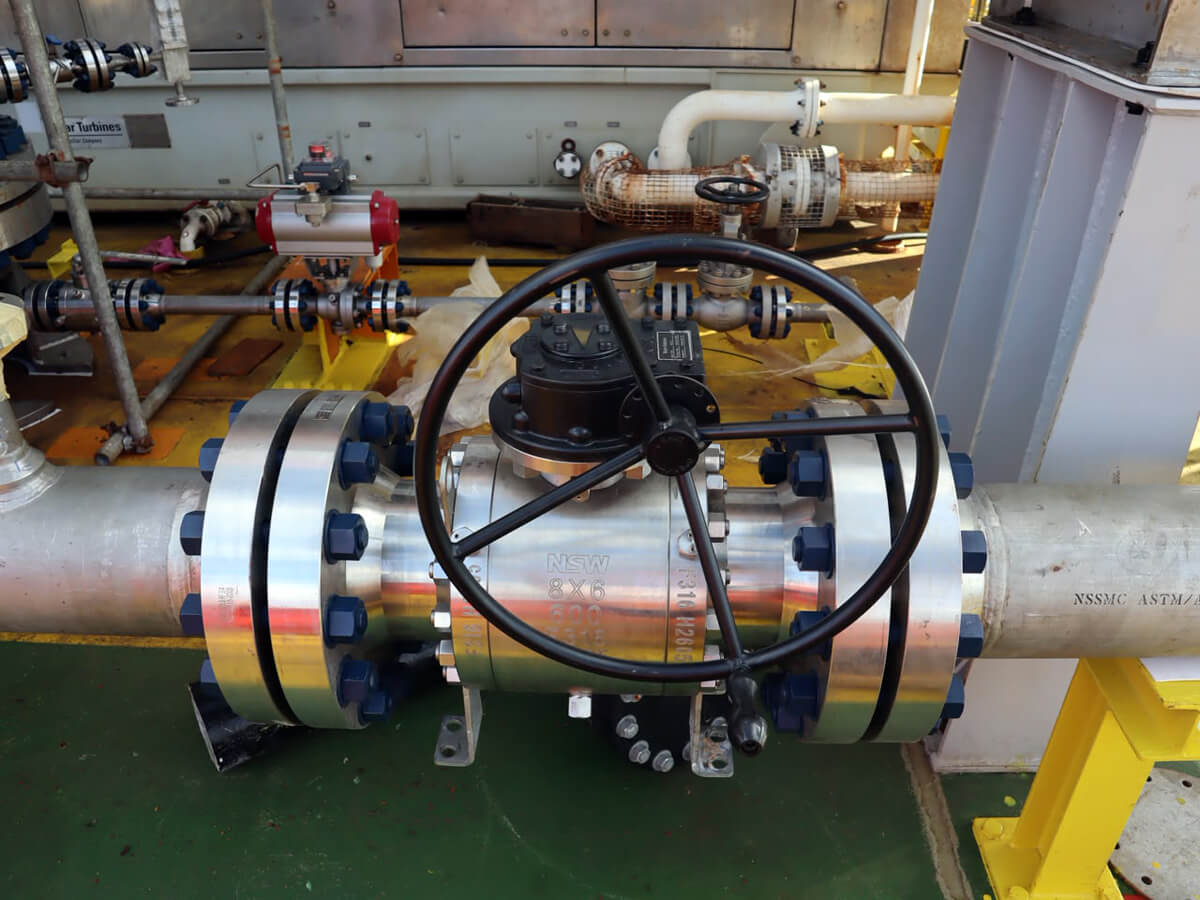
A recognized manufacturer of high-precision API 6D and ASME B16.34 compliant industrial ball valves. With over 20 years of experience in ball valve manufacturing and design, NSW specializes in Class 150 through Class 2500 trunnion-mounted, top-entry, and custom alloy valves. The company delivers fully NDE-inspected, fire-safe asset solutions for global EPC projects, manufacturing floating ball valves and trunnion-mounted ball valves in carbon steel, forged steel, and stainless steel.
6. Conclusion: Partnering for Reliable Flow Control
From selecting the correct seat metallurgy to specifying full-bore piggability, choosing the right industrial ball valve directly impacts plant safety, environmental compliance, and long-term operating costs. By matching fluid characteristics and line pressure with the appropriate body design, piping engineers ensure decades of trouble-free performance.
The global industrial ball valve market continues to expand, driven by investments in oil and gas infrastructure, chemical processing, and power generation. With increasing regulatory scrutiny on fugitive emissions and fire safety, selecting valves that meet the latest API 6D 25th Edition requirements and carry API 607 / ISO 15848 certifications is more important than ever.
Critical Warning
Every process condition is unique. The wrong valve selection can lead to leaks, unplanned downtime, and safety incidents.
At NSW VALVE COMPANY (nswvalve.com), we engineer and manufacture severe-service industrial ball valves for the world’s most demanding energy and chemical processing projects.
Ready to Secure Your Piping Infrastructure?
Contact our technical sales team at nswvalve.com to request 3D CAD models, obtain project-specific pricing, or consult with our valve engineers for your next critical application.
Post time: Aug-11-2026