


API 6D vs. ASME B16.34 Ball Valves: The Ultimate Engineering & Procurement Selection Guide (2026 Update)
For pipeline design engineers, EPC contractors, and global procurement managers, specifying ball valves often involves navigating a complex web of industry standards. Two of the most widely referenced standards in severe service and process piping are API 6D (Specification for Pipeline and Piping Valves) and ASME B16.34 (Valves—Flanged, Threaded, and Welding End).
On the surface, a 6-inch Class 600 ball valve constructed to ASME B16.34 and one built to API 6D may look nearly identical in an engineering drawing. However, their internal mechanical philosophies, testing mandates, and intended operational environments are radically different.
This technical guide breaks down the core mechanical, testing, and structural differences to help your engineering and sourcing teams make informed, cost-effective decisions.
1. Scope and Design Philosophy: Pipelines vs. Plant Piping
To understand why these standards differ, you must first look at the industry applications for which they were created.
ASME B16.34: The General Process Standard
ASME B16.34 is a foundational construction standard primarily focused on pressure integrity, wall thickness calculations, pressure-temperature ratings, and material selection for valves used in plant piping systems (refineries, power generation, chemical processing complying with ASME B31.3).
- Core Emphasis: Establishing clear boundaries for shell strength, material stress limits, and non-destructive examination (NDE).
- Functional Scope: It dictates how to build a pressure-retaining envelope, but leaves internal functional details—such as drain/bleed ports or specific seat sealing features—to the manufacturer’s discretion.
API 6D: The Pipeline Transportation Standard
API 6D is a functional performance standard tailored specifically for long-distance pipeline systems (complying with ASME B31.4 for liquid or ASME B31.8 for gas).
- Core Emphasis: Functional isolation, internal pressure relief, full-bore piggability, and verifiable inline maintenance.
- Functional Scope: API 6D mandates specific features essential for pipeline operation, including DBB/DIB, mandatory internal cavity pressure relief, and strict bore tolerances for inspection tools (pigs).
2. Core Technical Differences: The Engineering Deep-Dive
While an API 6D ball valve is almost always designed to meet the wall thickness requirements of ASME B16.34, API 6D introduces several mandatory functional requirements that go far beyond the scope of ASME B16.34.
| Engineering Metric / Feature | ASME B16.34 Ball Valve | API 6D Ball Valve |
|---|---|---|
| Primary Industry Focus | Refineries, chemical skids (ASME B31.3) | Oil & gas pipelines, metering stations (B31.4/B31.8) |
| Bore Dimensions | Standard / Reduced bore (Vendor standard) | Strictly defined Full Bore (for pigging) or Reduced |
| DBB / DIB Capability | Not standard (Must be custom-engineered) | Standard requirement (DBB, DIB-1, or DIB-2) |
| Cavity Pressure Relief | Not mandatory (Requires special request) | Mandatory (Self-relieving seats or external valve) |
| Drain and Vent Ports | Optional / Vendor discretion | Mandatory body drain, vent, and isolation fittings |
| Pressure Testing (FAT) | Hydrostatic shell/seat (Shorter hold times) | Extended hold times + Mandatory low-pressure gas testing |
| Face-to-Face Dimensions | Governed by ASME B16.10 | Governed by API 6D / ISO 14313 (Often longer) |
3. Critical Procurement Pitfalls (That Engineers Often Overlook)
Beyond the standard table, here are two high-stakes technical conflicts that frequently cause project delays and change orders.
Pitfall #1: The “Face-to-Face” Dimensional Conflict (B16.10 vs. ISO 14313)
One of the most common procurement errors involves physical fit. ASME B16.34 relies on ASME B16.10 for face-to-face (end-to-end) dimensions. API 6D relies on ISO 14313 / API 6D specifications.
- The Danger: For larger sizes (e.g., NPS 10 and above) and higher classes, API 6D valves often have significantly longer face-to-face dimensions to accommodate the complex DBB seat mechanisms and double pistons.
- The Consequence: If you purchase an API 6D valve as a “drop-in” replacement for an existing ASME B16.34 valve on a compact offshore skid, it will not fit. The piping spools will be too short. Always verify the end-to-end dimension (EN 558 or ASME B16.10 Table) before ordering.
Pitfall #2: Material Selection & NACE MR0175 (Sour Service)
This is where procurement must pay extreme attention.
- ASME B16.34 allows a wide range of materials but does not inherently mandate compliance with NACE MR0175/ISO 15156 for H₂S (sour) environments unless specified in the purchase order.
- API 6D explicitly references NACE MR0175 and imposes strict rules on material hardness, forging quality, and non-destructive testing for valves used in sour hydrocarbon transport.
- The Consequence: Using a standard ASME B16.34 valve (even with a “trunnion” design) in a high-H₂S pipeline without explicit NACE MR0175 compliance can lead to Sulfide Stress Cracking (SSC) and catastrophic brittle fracture within weeks of operation.
4. Deep-Dive into Key Functional Features
Full Bore & Piggability
- API 6D Compliance: Strictly specifies the minimum internal diameter (ID) for full-bore valves. The bore must present a smooth, unobstructed cylindrical passage matching the pipe ID to allow PIGs (Intelligent Pipeline Inspection Gauges) to pass smoothly without getting stuck.
- ASME B16.34: Allows standard manufacturer tolerances on port sizes. A “full port” valve built solely to ASME B16.34 may still have internal steps or tapers that could trap a pipeline pig, causing a costly operational shutdown.
Double Block & Bleed (DBB) vs. Double Isolation & Bleed (DIB)
- API 6D Mandate: Defines and regulates DBB (two independent seats isolating pressure from both ends, with a cavity that can be bled to verify tightness) and DIB-1/DIB-2 (bi-directional sealing mechanisms).
- ASME B16.34: Does not define DBB seating rules. A standard floating ball valve may seal against line pressure, but it does not guarantee verifiable cavity bleed capability unless custom-ordered.
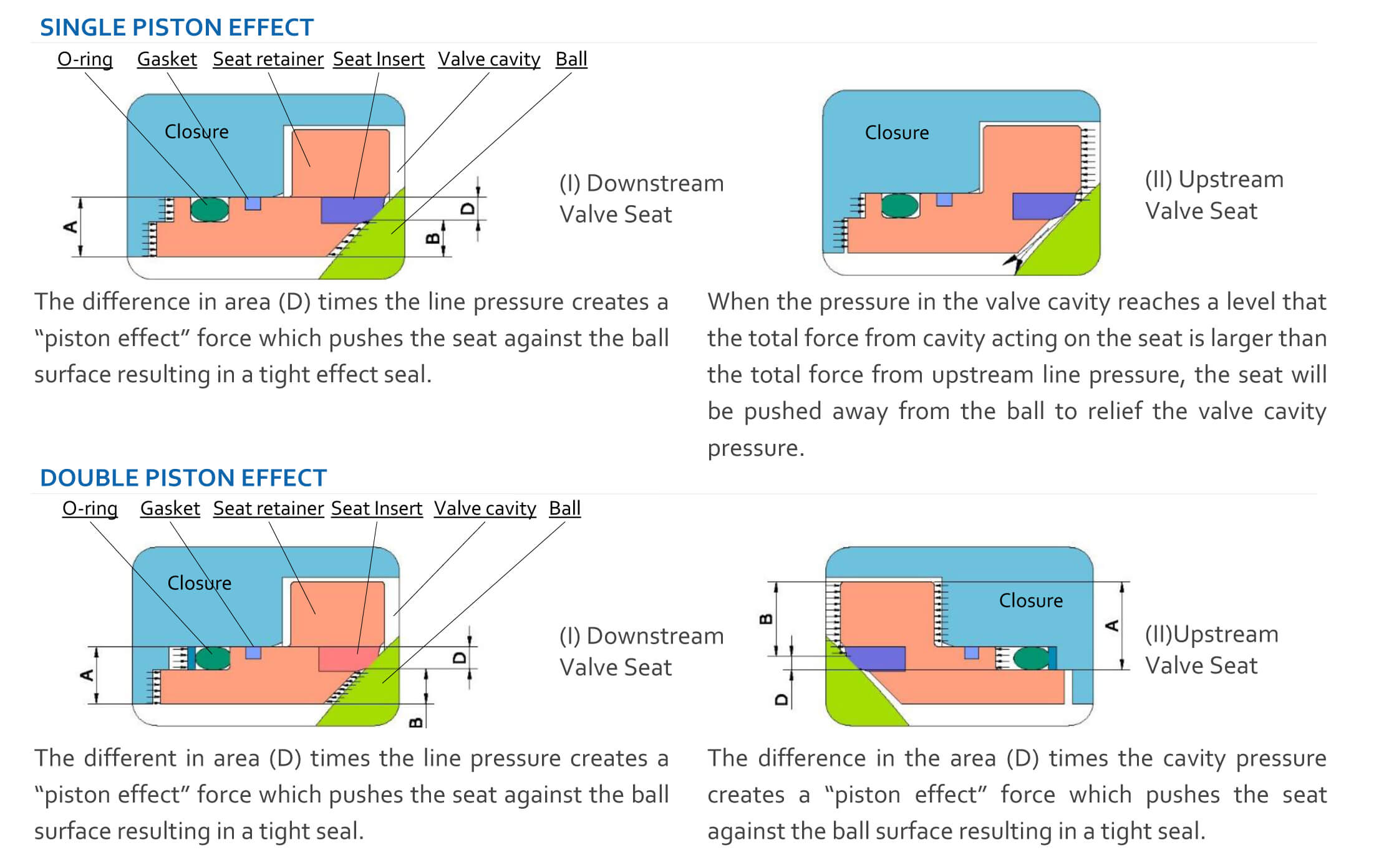
Body Cavity Pressure Relief (Thermal Expansion)
In liquid hydrocarbon service, trapped fluid inside the body cavity can expand rapidly due to solar heating.
- API 6D Solutions: Mandates Single Piston Effect (SPE) self-relieving seats or external safety relief valves to vent excess cavity pressure into the pipeline.
- ASME B16.34: Does not automatically mandate self-relieving seats. If thermal relief is required, the specifier must explicitly request vented seats (upstream relief slots) in the procurement specification.
Factory Acceptance Testing (FAT) Protocol
- Holding Times: API 6D specifies significantly longer pressure holding durations during hydrostatic tests, especially for larger NPS sizes.
- Low-Pressure Gas Testing: API 6D routinely incorporates low-pressure air/gas seat testing (typically 5.5 bar / 80 PSI) as standard to verify low-pressure sealing. ASME B16.34 defaults primarily to hydrostatic testing unless supplementary standards (like API 598) are referenced.
5. The Ultimate Procurement & Sourcing Matrix
For procurement teams, selecting the correct standard directly affects unit cost, lead time, and skid footprint.
Choose API 6D Ball Valves When:
- Application: Mainline transmission (Crude oil, cross-country gas, refined products under B31.4/B31.8).
- Operation: Pigging operations are required (cleaning, dewatering, or smart-pig inspections).
- Safety: DBB isolation is mandatory for metering skids, custody transfer, or tank farm manifolds.
- Environment: Uninsulated above-ground pipelines exposed to direct sunlight (high thermal expansion risk).
Choose ASME B16.34 Ball Valves When:
- Application: Inside a plant or process skid (Refineries, petrochemical, offshore topsides, governed by B31.1/B31.3).
- Constraints: Space and weight are critical (Compact skids where shorter B16.10 dimensions reduce structural steel costs).
- Service: General utility isolation (Steam, water treatment, chemical feed) where simple quarter-turn shut-off is sufficient.
- Budget: Smaller sizes (NPS 1/2 to NPS 4) where floating ball valves are significantly more economical than feature-heavy API 6D trunnion valves.
6. Frequently Asked Questions (FAQ)
Q1: Can an ASME B16.34 valve be used in a pipeline pigging station?
A: Generally, no. While a custom ASME B16.34 valve could be ordered with a full bore, API 6D strictly enforces the internal diameter tolerances and smooth bore contours required to guarantee PIG passage without damaging the valve internals. Using a non-API 6D valve risks sticking the pig, resulting in a costly pipeline shutdown.
Q2: Does API 6D automatically meet ASME B16.34 pressure requirements?
A: Yes, in most cases. API 6D references ASME B16.34 for pressure-containing wall thickness and material stress calculations. An API 6D valve is typically over-engineered to meet or exceed the B16.34 shell thickness requirements, especially with the addition of corrosion allowance.
Q3: What is the main difference between DBB and DIB?
A: DBB (Double Block & Bleed) ensures that when the valve is closed, both the upstream and downstream seats provide a seal, and the cavity between them can be vented to zero pressure. DIB (Double Isolation & Bleed) refers to a design where each seat provides bi-directional sealing, ensuring isolation from both ends even if one seat fails. DIB-1 provides this on one side, while DIB-2 provides it on both sides.
Q4: What happens if I over-specify an API 6D valve for a chemical skid?
A: You will incur significant CAPEX inflation (often 30-40% higher). You will also receive a heavier, longer valve that may require redesigning the pipe supports. Additionally, the mandatory drain/vent ports may introduce unnecessary potential leak paths in a compact, confined plant area.
7. Next Steps: Optimize Your Valve Sourcing Strategy
Selecting the wrong standard is a costly mistake that impacts both CAPEX and operational safety.
Ensure your next specification covers these 5 critical checkpoints:
Download the Free PDF Quick-Reference Card: “API 6D vs. ASME B16.34 – 2026 Procurement Matrix”
Includes: Dimensional conflict cheat-sheet, NACE compliance flowchart, and FAT hold-time comparison table.
Post time: Jul-22-2026