


In severe-service chemical processing—such as catalyst slurry loops, delayed coking units, and high-density polyethylene (HDPE) polymerization reactors—polymeric or elastomeric soft seats are a critical liability. Standard inserts like PTFE, RPTFE, or even reinforced PEEK quickly succumb to the destructive forces of abrasive catalyst fines, mechanical erosion, and extreme thermal cycling. When soft elements degrade, the result is immediate: packing leakage, line bypass, and unexpected plant shutdowns.
To guarantee mechanical uptime and absolute isolation in hostile environments, process automation specialists and reliability engineers are shifting away from generic commodity valves. The solution lies in highly engineered metal seated ball valves.
At NSW VALVE COMPANY (nswvalve.com), we manufacture high-pressure, severe-service metal seated ball valves designed to eliminate the common failure modes of erosion and thermal binding while delivering bi-directional, tight shut-off.
1. Supersonic Metallurgy: HVOF Coating Mechanics for Metal Seated Ball Valves
The baseline reliability of severe service metal seated ball valves is determined by the bond integrity and surface hardness of its face coatings. Rather than relying on traditional electroplating, NSW VALVE COMPANY implements High-Velocity Oxygen-Fuel (HVOF) thermal spraying. This technique applies advanced carbide matrices to high-alloy substrates, including ASTM A351 CF8M, CF3M, and Super Duplex stainless steels.
During our proprietary HVOF process, the hard-facing compound is introduced into a combustion stream fueled by oxygen and high-grade kerosene. The particles accelerate to supersonic velocities exceeding Mach 3, converting massive kinetic energy into a dense, ultra-low porosity ($< 0.5\%$) interlocking layer. The resulting mechanical bond strength exceeds $10,000 \text{ psi}$ ($69 \text{ MPa}$), ensuring that the hard coating of our metal seated ball valves will not delaminate under intense hydrodynamic shear.
| Coating Matrix | Primary Base Alloys | Micro-Hardness Range | Max Temp | Typical Applications |
|---|---|---|---|---|
| Tungsten Carbide (WC-Co-Cr) | Cobalt-Chromium-Nickel | 68 – 72 HRC | $750^\circ\text{F}$ ($400^\circ\text{C}$) | Catalyst Slurry, FCCU Slurry, Slime Tailings |
| Chromium Carbide ($Cr_3C_2\text{-NiCr}$) | Nickel-Chromium | 56 – 62 HRC | $1500^\circ\text{F}$ ($815^\circ\text{C}$) | Delayed Coking, Molecular Sieve Regeneration |
| Stellite 6 / 12 | Cobalt-Base Solid Solution | 40 – 48 HRC | $1000^\circ\text{F}$ ($538^\circ\text{C}$) | High-Pressure Steam, Boiler Feedwater |
Application-Specific Coating Selection:
- Tungsten Carbide (WC-Co-Cr): Specially designated for heavy particulate abrasion within our metal seated ball valves. The matrix provides a micro-hardness up to 72 HRC, acting as an impenetrable armor against the scouring action of catalyst fines and silica solids.
- Chromium Carbide ($Cr_3C_2\text{-NiCr}$): Engineered for high-temperature oxidizing media. It retains its crystalline structural stability up to $1500^\circ\text{F}$, preventing the thermal micro-fracturing and scaling that typically degrades industrial metal seated ball valves during rapid thermal shocks.
2. Eliminating Background Leakage via Mate-Lapping Mechanics
A frequent misconception among piping designers is that metal seated ball valves must compromise on sealing tightness. NSW VALVE COMPANY eliminates background seat bypass through a dedicated, single-unit Mate-Lapping Protocol.
Instead of bulk-lapping components against standardized master molds, each individual ball is paired with its specific metal seat ring. Technicians utilize a multi-stage mechanical process with progressively finer diamond-abrasive media, finishing down to a 1-micron grit paste.
This precise matching achieves a continuous, flawless $360^\circ$ contact band. The resulting geometric uniformity matches light-band interferometry standards, enabling NSW metal seated ball valves to regularly achieve ISO 5208 Rate A and API 598 zero-leakage performance under high-pressure gas testing—bringing bubble-tight execution to a heavy-duty metal closure design.
3. Dynamic Solids Management: Scraper Seats and Thermal Compliance
In heavy slurry or polymer applications, entrapped particulates can wedge between the ball and seat during quarter-turn actuation, causing deep abrasive scoring or mechanical seizure. NSW resolves this vulnerability through an optimized Scraper Seat Profile paired with dynamic mechanical pre-loading.
       [Process Flow Axis] ---->
  ==========================================
                |  |  [Valve Body Wall]
                |  |
           +----+--+----+
           | Belleville |  <-- Inconel 718 Spring (Axial Live-Loading)
           |   Spring   |
           +----+--+----+
                |  |
           +----+--+----+
           | Metal Seat |  <-- HVOF Supersonic Hard-Coating (>= 68 HRC)
           +----+--+----+
                 \
                  \ [Sharp Scraper Edge] <-- Shears polymer build-up & scale
                   \______
                    (     )
                   (  Ball ) <-- Precision Mate-Lapped Closure Element
                    (_____)
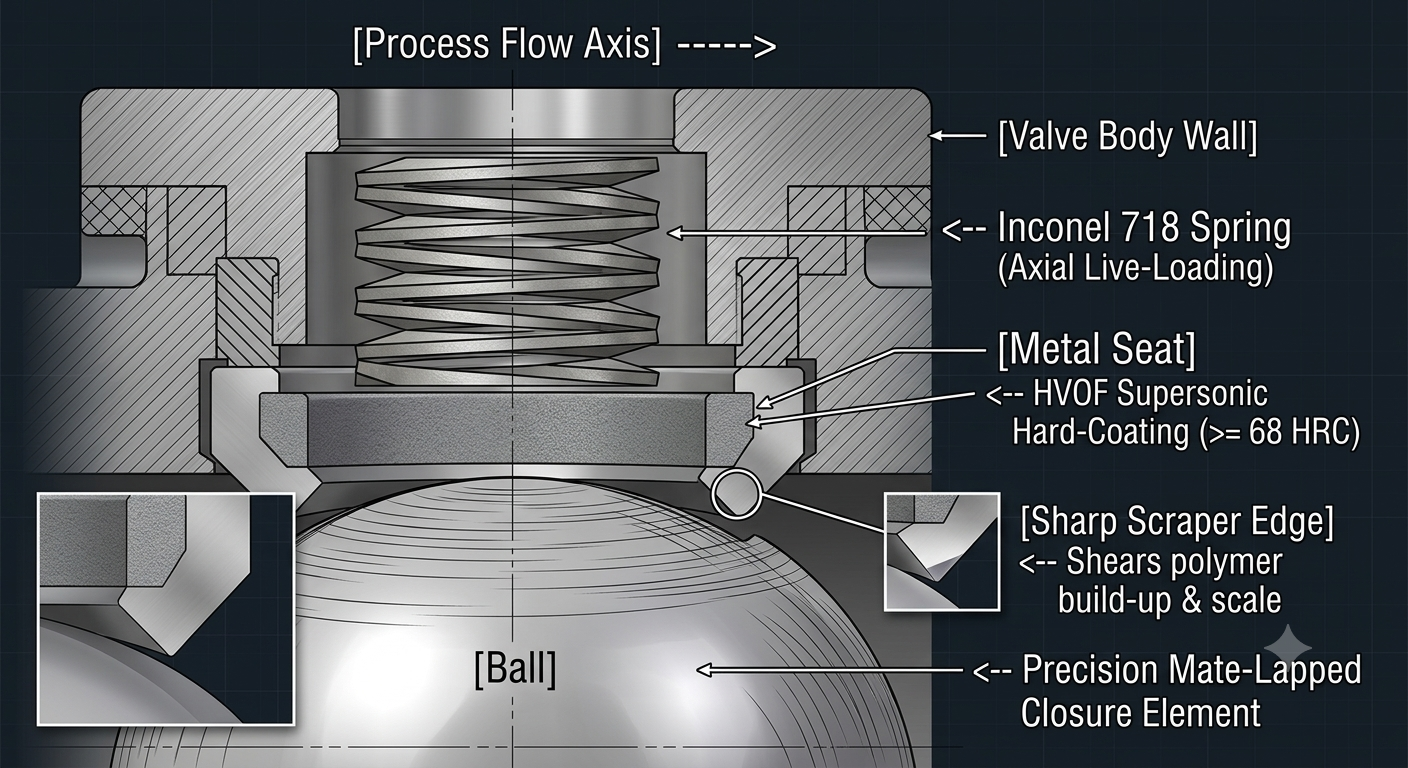
Self-Cleaning Edge Profile
The primary sealing lip of our metal seat ring features a sharp, machined geometric edge. As the ball moves toward the closed position, this profile acts as a mechanical scraper, shearing away scaling, crystalline deposits, and sticky polymer build-up before they can penetrate the sealing face of our metal seated ball valves.
Thermal Expansion Compensation
High-temperature chemical processes introduce the risk of thermal binding. When process media spikes in temperature, the expansion rate of the ball can outpace the valve body, locking the valve in place.
NSW bypasses this issue by installing heavy-duty, corrosion-resistant Inconel 718 Belleville wave springs behind the seat assembly. This configuration maintains a secure low-pressure seal while providing the mechanical flexibility required to absorb thermal expansion.
4. Environmental Compliance: Low-E Packing and Fire Safety
Environmental mandates across North America demand zero tolerance for fugitive emissions. Valve stems are the most common source of EPA LDAR (Leak Detection and Repair) violations.
Fugitive Emissions Prevention: NSW metal seated ball valves incorporate a live-loaded stem packing assembly certified to API 641 for quarter-turn valves, utilizing API 622 die-formed flexible graphite packing sets. Compressive load is constantly maintained via Belleville spring washers, successfully keeping stem leakage under 100 ppmv during extended thermal cycles.
Inherent Fire Safety: Fully certified to API 607 and API 6FA criteria. Because the pressure boundary, closure elements, and stem seals consists exclusively of robust hard-faced metallurgy and high-density graphite, the valve maintains full structural isolation during exposure to a hydrocarbon fire event ($1400^\circ\text{F}$ to $1800^\circ\text{F}$).
Engineering Procurement Specification Guide
For upcoming project data sheets, piping material specifications (PMS), or vendor lists, the severe service metal seated ball valves series from NSW VALVE COMPANY features the following standardized design parameters:
- Design & Manufacturing Codes: API 6D, ASME B16.34, API 608, ISO 17292
- Pressure Classes Available: ASME Class 150, 300, 600, 900, 1500, 2500
- Size Spectrum: NPS 2″ to NPS 48″ (Available in Full Port and Reduced Bore)
- Pressure Boundary Metallurgy: ASTM A216 WCB/WCC, A351 CF8M/CF3M, A890 4A/5A/6A (Duplex/Super Duplex), Hastelloy C276, Inconel 625
- Seat & Ball Surface Hardening: HVOF Super-Dense Tungsten Carbide (WC-Co-Cr) or Chromium Carbide ($Cr_3C_2\text{-NiCr}$)
- Verified Shut-off Standards: ISO 5208 Rate A, API 598, ANSI/FCI 70-2 Class VI
- Regulatory Certifications: NACE MR0175 / ISO 15156, API 607 (Fire-Safe), API 641 (Fugitive Emissions Compliance)
Post time: Jul-09-2026