


1. What Is a Resilient Wedge Gate Valve?
The resilient wedge gate valve is an advanced member of the wedge gate valve family. Its core feature is that the gate disc is either fully coated with or integrally made of an elastic material (typically EPDM rubber) instead of the traditional all‑metal sealing design. This construction is intended to provide reliable bidirectional shut‑off sealing while avoiding the common sticking and high‑torque operation problems found in conventional rigid wedge gate valves.
Unlike traditional metal‑seated wedge gate valves, the gate of a resilient wedge gate valve is usually a ductile iron body with a fully vulcanised EPDM rubber coating that meets drinking‑water approval standards. When closing, the elastic rubber layer makes resilient contact with the valve body seat, rather than rigid metal‑to‑metal contact. Since the 1980s, resilient wedge gate valves have become the mainstream choice in water treatment and distribution networks, especially for sizes up to DN600. Today, leading manufacturers have extended the range up to DN1000 or even DN1200.
Significance for procurement: Resilient wedge gate valves offer distinct advantages in water supply, drainage and wastewater treatment. The rubber sealing surface effectively resists wear from particulate matter in the medium, and they do not require the high‑precision lapping of metal sealing faces, thereby reducing manufacturing and maintenance costs.
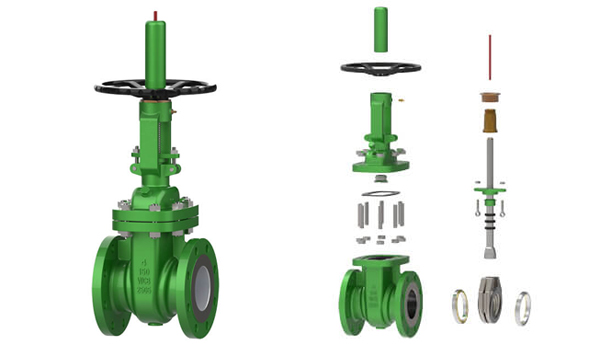
2. How Does a Wedge Gate Valve Work?
A wedge gate valve is a multi‑turn valve: its stem drives the gate via a threaded rotating motion. The gate moves perpendicular to the flow direction.
Operating sequence:
- Closing: When the handwheel or actuator is turned clockwise, the stem moves the gate downwards. The two sealing faces of the wedge‑shaped gate are designed with a thicker top and a thinner bottom. As the gate descends into the body seats, the wedge surfaces generate a forced wedging action between the seats. This action converts the axial operating force into radial sealing pressure, thus achieving a tight shut‑off. This is a force‑sealing type – the sealing force primarily comes from external actuation, not from line pressure.
- Opening: The stem rotates in the opposite direction, lifting the gate away from the seats and fully opening the flow passage. When fully open, the gate valve offers a straight‑through, unobstructed flow path with very low fluid resistance, and it allows passage of pipeline pigs.
- Operating characteristics: Because the stem requires multiple turns to complete the full stroke, gate valves open and close slowly. This inherent feature also helps prevent water hammer effects.
Important note: Wedge gate valves are designed for fully open or fully closed service. They should not be used as throttling valves. A partially open gate will be subject to fluid erosion and impact, which can damage the sealing faces and cause vibration and noise.
3. Classification of Wedge Gate Valves
Wedge gate valves can be classified according to several criteria:
3.1 By Gate Disc Construction
| Type | Structural Features | Advantages | Disadvantages | Typical Applications |
|---|---|---|---|---|
| Rigid single disc | One‑piece cast wedge disc | Simplest construction, high strength, compact size | Requires extremely high wedge‑angle machining precision; prone to jamming and galling | Ambient and medium‑temperature conventional media |
| Flexible wedge disc | Disc has a peripheral groove or special geometry allowing limited elastic deformation | Compensates for sealing‑face distortion due to temperature/pressure changes; prevents wedging | More complex than single disc | Applications with fluctuating temperatures; preferred for medium/large sizes |
| Double disc (split wedge) | Two separate discs with an adjusting mechanism between them | Less demanding wedge‑angle tolerance; discs do not jam easily; self‑aligning to seats | More complex construction | Water and steam lines |
Among these, the flexible wedge design combines the advantages of both rigid and double discs and is the current mainstream for medium‑to‑large bore wedge gate valves.
3.2 By Stem Configuration
- Rising stem (outside screw and yoke) – The stem moves up and down with operation, providing visual indication of valve position.
- Non‑rising stem (inside screw) – The stem rotates without axial movement; the stem nut moves up/down. Suitable for applications with limited installation height.
3.3 By Actuation Method
Manual, electric, pneumatic, hydraulic, etc.
3.4 By Connection Type
Flanged, butt‑welding, wafer‑type, etc.
4. Differences Between Wedge Gate Valves and Parallel Gate Valves
Gate valves are fundamentally divided into wedge and parallel types based on gate geometry. Their key differences are:
| Aspect | Wedge Gate Valve | Parallel Gate Valve |
|---|---|---|
| Sealing face geometry | Two sealing faces are angled (wedge shape), not parallel to the vertical centreline | Two sealing faces are parallel to each other and to the vertical centreline |
| Gate structure | Single, flexible or double disc | Typically double‑disc construction |
| Sealing principle | Wedging action generates radial sealing pressure (force‑sealing) | Fluid pressure or spring force pushes the disc against the seats |
| Size range | Applicable over a wide range, including large diameters | Usually limited to low‑pressure, small‑to‑medium sizes (DN40–300) |
| Sealing reliability | Very reliable, bidirectional tight shut‑off | Relatively weaker sealing performance at low pressures |
| Thermal expansion adaptability | Risk of thermal binding (wedging) under temperature changes | No wedging problem; suitable for frequent thermal cycling |
| Operating torque | Higher closing torque (needs to overcome wedging force) | Lower operating torque |
Selection guideline: Choose wedge gate valves when high reliability and bidirectional sealing are required. For superheated steam, boiler feedwater or other services with frequent thermal cycling, parallel gate valves avoid thermal wedging and may be a better choice.
5. Applicable Design Standards for Wedge Gate Valves
The design, manufacture and testing of wedge gate valves must comply with a series of rigorous technical standards. These standards ensure quality, interchangeability and safety. The major domestic and international standards are summarised below for reference by engineering and procurement personnel during selection and acceptance.
5.1 Chinese National (GB) and Industry (JB) Standards
For the domestic market, wedge gate valves usually follow these standards:
| Standard Category | Standard No. | Title | Remarks |
|---|---|---|---|
| Design specification | GB/T 12234 | Steel gate valves with bolted bonnets for petroleum and natural gas industries | Core design and manufacturing basis |
| Face‑to‑face dimension | GB/T 12221 | Metal valves – Face‑to‑face and end‑to‑end dimensions | Specifies valve length dimensions |
| Flange connections | JB/T 79 | Integral cast steel pipe flanges | Alternative: GB/T 9113, HG/T 20592, etc. |
| Testing & inspection | JB/T 9092 | Inspection and testing of valves | Covers shell strength, seat leakage, etc. |
| Pressure‑temperature | GB/T 9131 | Steel pipe flanges – Pressure‑temperature ratings | Defines allowable working pressures at different temperatures |
| Product marking | GB/T 12220 | Industrial valves – Marking | Specifies marking content and method |
| Pressure testing | GB/T 13927 | Industrial valves – Pressure testing | Complementary to JB/T 9092 |
| General requirements | GB/T 12224 | Steel valves – General requirements | Provides pressure‑temperature basis |
Previously, JB/T 1739‑1992 (“Structural elements of valves – Seat spacing and wedge angle dimensions for wedge gate valves”) specifically addressed wedge angles, but it was withdrawn in 2005. Today, wedge angle selection is based on individual manufacturer design practices and actual service conditions.
5.2 International Standards (API, ASME, AWWA, etc.)
For export projects or American‑standard designs, the following standards are commonly adopted:
| Standard Category | Standard No. | Title | Remarks |
|---|---|---|---|
| Design | API 600 | Bolted bonnet steel gate valves for petroleum, petrochemical and natural gas industries | Core standard for gate valves in oil/gas |
| Design | API 6D | Pipeline valves | Applicable to gate valves for pipeline systems |
| Design | ASME B16.34 | Valves – Flanged, threaded and welding end | Covers pressure‑temperature ratings, wall thickness, materials |
| Face‑to‑face | ASME B16.10 | Face‑to‑face and end‑to‑end dimensions of valves | For American‑standard valves |
| End connections | ASME B16.5 / B16.47 | Pipe flanges and flanged fittings | Flange dimensions |
| Testing | API 598 | Valve inspection and testing | American‑standard test and acceptance basis |
| Testing | ISO 5208 | Industrial valves – Pressure testing of metallic valves | ISO test standard |
| Actuator mounting | ISO 5211 | Industrial valves – Part‑turn actuator attachments | Defines actuator interface dimensions |
5.3 Dedicated Standards for Resilient Wedge Gate Valves (Water Industry)
For water supply and drainage, the American Water Works Association (AWWA) has developed a dedicated series:
- ANSI/AWWA C509 – Standard for resilient‑seated gate valves (3 in. and larger, up to 250 psig). It specifies requirements for the resilient coating (adhesion per ASTM D429), stem seals, bidirectional bubble‑tight shut‑off, etc.
- ANSI/AWWA C515 – Standard for large‑diameter (typically 4 in. and above) ductile‑iron resilient wedge gate valves, with strict wall‑thickness and material requirements.
- AWWA C111/A21.11 – Standard for rubber‑gasketed joints (mechanical and push‑on), applicable to mechanical‑end connections.
5.4 Other Relevant Standards
| Standard No. | Title | Remarks |
|---|---|---|
| BS 1873 | Steel gate valves (flanged and butt‑welding ends) for petroleum, petrochemical and allied industries | British standard, equivalent to API 600 |
| E101 | Valves for power generation | For high‑temperature / high‑pressure power plant service |
| MSS SP‑60 | Gate valves with butt‑welding ends and flanged ends | Standard from the Manufacturers Standardisation Society |
| ANSI B16.1 | Cast iron pipe flanges and flanged fittings | For cast‑iron valve flange connections |
5.5 Key Points for Procurement and Acceptance
When selecting and accepting wedge gate valves, procurement personnel should verify the following standard compliance aspects:
- Design standard confirmation – Ensure the valve is designed to the correct standard version (e.g., GB/T 12234, API 600 or AWWA C509) for the intended service.
- Face‑to‑face dimension – Verify that the valve length complies with GB/T 12221 or ASME B16.10 to guarantee on‑site interchangeability.
- Flange compatibility – Confirm that the flange standard (JB/T 79, GB/T 9113, ASME B16.5, etc.) matches the piping system.
- Test report review – Request factory test reports in accordance with JB/T 9092 or API 598, including shell strength, backseat, and seat leakage test results.
- Material certificates – For resilient wedge gate valves, obtain the EPDM coating material certificate and adhesion test reports.
- Marking inspection – Verify that the valve body marking meets GB/T 12220 requirements (manufacturer, size, material, pressure class, etc.).
6. What Is the Wedge Angle of a Wedge Gate Valve?
The wedge angle is one of the most critical design parameters for wedge gate valves, directly affecting sealing reliability, operating torque and temperature adaptability.
6.1 Common Wedge Angle Values
The angle between each sealing face and the vertical centreline (i.e., the wedge angle) is typically chosen from the following standard values:
- 2°52′
- 3°30′
- 5° (most common)
- 8°
- 10°
Among these, 5° is the most widely used. A parallel gate valve can be considered as a special case with a 0° wedge angle.
6.2 Factors Influencing Wedge Angle Selection
The wedge angle mainly depends on the operating temperature of the medium:
- The higher the temperature, the larger the angle should be – this reduces the risk of thermal wedging (binding) due to thermal expansion of the gate.
- For low‑temperature media, a small angle such as 2°52′ is often chosen.
- For high‑temperature services, larger angles (5°, 8° or even 10°) are preferred.
6.3 Design Principles of the Wedge Angle
The wedge angle is not arbitrary. The wedge shape is intended to generate additional mechanical sealing pressure when the valve closes. A smaller angle produces a greater radial sealing force for the same axial travel, giving more reliable shut‑off, but it requires higher machining precision and is more prone to thermal wedging. A larger angle, in contrast, allows smoother operation and less risk of binding, but needs a longer closing stroke to develop the same sealing force.
As mentioned earlier, the specialised standard JB/T 1739‑1992 was withdrawn in 2005. Currently, the selection of the wedge angle is based on each manufacturer’s design rules and the specific service conditions.
7. Additional Points of Interest for Engineering and Procurement Professionals
7.1 Typical Technical Parameters for Resilient Wedge Gate Valves
- Pressure ratings: Common values are PN16 (16 bar), 200 psi (13.8 bar) CWP, 300 psi (20.7 bar), etc.
- Temperature range: Rubber‑seated types are usually limited to ‑10°C to +130°C; metal‑seated types can handle higher temperatures.
- Size range: DN50 to DN1000+.
- Body materials: Cast iron, ductile iron, etc.
- Sealing material: EPDM rubber (drinking‑water grade).
7.2 Key Advantages of Resilient Wedge Gate Valves
- Bidirectional zero‑leakage shut‑off – the resilient rubber wedge provides bubble‑tight sealing.
- Low operating torque – rubber‑against‑metal friction is much lower than metal‑to‑metal.
- No sticking – the resilient wedge can deform slightly, so it does not jam in the seats like a rigid wedge.
- Long service life – resilient materials reduce wear on sealing faces.
7.3 Procurement Recommendations
- Match the service conditions – Choose the appropriate wedge angle based on medium temperature; for high‑temperature applications, consider flexible wedge or parallel gate designs.
- Standard compliance – Confirm that the product meets relevant standards such as EN 1074, BS 5163, AWWA C550, etc.
- Corrosion protection – Check the internal and external coating (e.g., fusion‑bonded epoxy powder – FBE).
- Actuation type – Select rising/non‑rising stem, manual/electric/pneumatic actuator according to site requirements.
Wedge Gate Valves are among the most widely used isolation valves in piping systems. Their selection involves multiple technical considerations, including sealing design, wedge angle choice, material compatibility and standard compliance. We hope this article provides a valuable reference for both engineering and procurement professionals in their project selection and purchasing decisions.
Post time: Jun-27-2026