


Trunnion Ball Valve Manufacturing in China: A Buyer’s Guide to Quality Suppliers
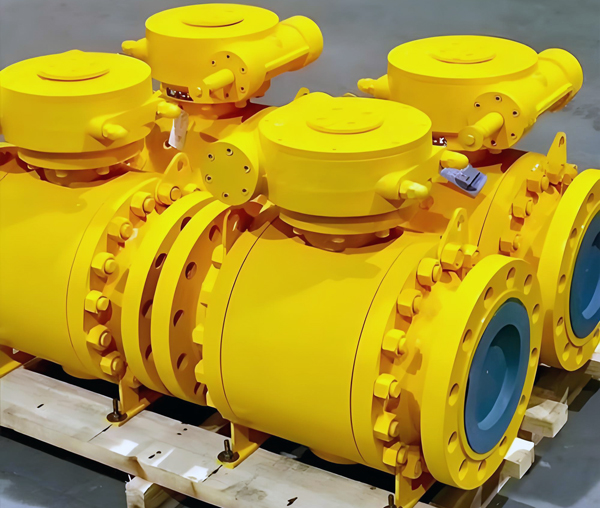
If you’ve ever sourced industrial valves, you already know that “Trunnion Ball Valves” and “floating ball valves” – though both called ball valves – are completely different animals when it comes to high‑pressure, large‑diameter pipelines.
A trunnion ball valve has its ball fixed at both the top and bottom by bearings, so it doesn’t get pushed forward by line pressure like a floating ball valve does. What does that mean in practice? Lower operating torque, more reliable sealing – especially in natural gas transmission lines, refinery units, and other services where Class 1500 or even Class 2500 is the norm. In those conditions, trunnion ball valves are practically the only choice.
The fixed ball design means the seals are spring‑loaded and pressure‑energised – the higher the pressure, the tighter the seal. The theory is simple, but getting the tolerances right, choosing the correct materials, and carrying out thorough testing – that’s where the real challenge lies, and not every Chinese manufacturer can deliver.
China has moved quickly in this space. Wenzhou (Zhejiang), Wuxi (Jiangsu), and Tianjin have formed fairly complete valve industrial clusters. From casting and machining to assembly and testing, many factories handle everything in‑house, offering lead times half those of European suppliers, often at more competitive prices.
But that’s also the problem – there are too many suppliers, and the quality varies enormously.
Over the past few years, we’ve worked with quite a few domestic trunnion ball valve factories. Some are genuinely reassuring – their API 6D certificates are valid, test reports are complete, and they proactively send third‑party inspection videos before shipment. Others, however, can’t even provide proper material traceability, and their NACE MR0175 certificates are sometimes photoshopped.
This article is not another “Top 10” ranking – you can find hundreds of those online. Instead, I want to share a few factories that we’ve actually dealt with and found noteworthy. I’ll tell you what each one excels at, which projects they’re best suited for, and what pitfalls to watch out for.
1. First, Clarify What You Need: Key Parameters for Trunnion Ball Valves
Before approaching any factory, get clear on these points:
Pressure rating – Class 150 to Class 2500 is a huge range. Higher pressures demand vastly higher standards in casting and machining.
Size range – Under 2 inches vs. over 24 inches – the factories that can handle these are often completely different. Large‑diameter trunnion ball valves require extreme machining precision; even slight deviations in ball roundness or seat fit will cause unacceptable leakage.
Material – Carbon steel, stainless steel, duplex, aluminium bronze – different media call for different alloys. If you’re dealing with sour service, you must confirm the supplier’s compliance with NACE MR0175 / MR0103.
Fire‑safe requirements – API 607 or API 6FA certification is not held by all manufacturers. If your project requires it, ask upfront.
Actuator – Manual, gearbox, pneumatic, electric, or hydraulic? Different actuators demand different valve interface designs.
Get these details sorted out before you start contacting suppliers – it will make communication far more efficient.
2. The Regional Landscape of Best Trunnion Ball Valve Manufacturing in China
Wenzhou (Yongjia) – Known as China’s “Valve Town”, this is the most complete industrial cluster. From casting to finishing to assembly, almost everything can be sourced within a few dozen kilometres. The advantages are a mature supply chain and cost control; the downside is that quality varies wildly, so you need to be careful in your selection.
Wuxi – Focuses on precision manufacturing and export‑oriented production. Many factories here have a solid grasp of API and ASME standards and execute them well.
Tianjin – Close to the port, which makes export logistics easy; it has strengths in carbon steel and alloy steel valves.
Knowing this landscape will help you judge whether a quote is reasonable – Wenzhou prices are usually a bit lower than Wuxi’s, but if a quote is shockingly low, that should raise a red flag.
3. Best Trunnion Ball Valve Manufacturers Worth Your Attention
3.1 NSW VALVE Company (Wenzhou Newsway Valve Co., Ltd.)
NSW is one of the manufacturers we’ve worked with most frequently in the trunnion ball valve space. They have over 20 years of industry experience.
Product capabilities – Sizes from ½″ to 48″ (DN15 to DN1200), pressure ratings from Class 150 to Class 2500, temperature range from ‑196°C to +550°C. Materials cover carbon steel, stainless steel, duplex steel, aluminium bronze, and special alloys. They offer side‑entry, top‑entry, and fully welded body designs to suit different project requirements.
Certifications – API 6D, API 6FA/607 fire‑safe, ISO 9001, and NACE MR0175/MR0103 for sour service. For trunnion ball valve procurement, we recommend checking each of these certifications carefully – missing any one may mean the valve is unsuitable for certain operating conditions.
Strengths – Their fully welded trunnion ball valves are particularly strong – the forged steel three‑piece body is welded into a single integral structure, eliminating flange connections and thus the risk of flange leakage. These are widely used in buried pipelines and subsea applications. Double Block & Bleed (DBB) functionality is standard, where each seat independently seals against upstream and downstream pressure, with a bleed port for cavity pressure relief.
Best for – Long‑distance oil & gas pipelines, refinery units, offshore platforms, LNG terminals – any application where reliability is paramount.
3.2 Zhejiang Poro Valve Manufacturing Co., Ltd.
Poro is another established valve manufacturer in Wenzhou, founded in 1997 with foreign investment, covering a factory area of over 20,000 m². In addition to ball valves, they also produce gate, globe, check, and butterfly valves.
Product capabilities – Trunnion ball valves are a core product. Their portfolio includes floating ball valves, trunnion ball valves, 3‑way ball valves, fully welded ball valves, and metal‑seated ball valves. Materials include carbon steel, stainless steel, and alloy steel.
Market reach – Exports to ASEAN, Europe, South America, the Middle East, and Africa. They are used in oil, petrochemical, power, steel, shipbuilding, and water treatment sectors both domestically and internationally.
Strengths – Poro has its own R&D team and has explored intelligent ball valves with remote control and monitoring capabilities. Their quality control covers the entire process from raw material inspection to finished product testing. After‑sales support includes installation guidance, maintenance training, and spare parts supply.
Best for – Conventional industrial projects in petrochemicals, power, steel, and shipbuilding, where a complete product line and good cost‑performance ratio are important.
3.3 Neway Valve (Suzhou) Co., Ltd.
Neway is a publicly listed company (SSE: 603699) and China’s largest industrial valve exporter. Their 10‑millionth valve was a pneumatic metal‑seated trunnion‑mounted ball valve – that scale says a lot.
Product capabilities – Deep‑sea ball valves rated up to 25,000 psi, which is rare among domestic manufacturers. Their side‑entry metal‑seated trunnion ball valves cover Class 150 to Class 2500, with a temperature range of ‑46°C to +450°C.
Strengths – Large scale, a wide product range, and extensive export experience. If you need to source multiple valve types from one supplier, Neway is a convenient choice. However, their size can mean slower response to customisation requests compared to smaller, more agile manufacturers.
Best for – Large EPC projects, multi‑valve packages, and tenders where supplier scale and qualifications are critical.
3.4 Other Manufacturers Worth Mentioning
Beyond the three above, Wuxi PYNOS Flow‑tech has a good reputation in trunnion ball valves, especially with consistent quality control for export markets. Zhejiang JiGong Valve specialises in metal‑seated and large‑diameter trunnion ball valves, with high‑pressure capability up to 10,000 psi. Formen Valve offers a wide size range from 2″ to 48″ and pressure classes from Class 150 to 2500 LB.
Each has its own niche – the best choice depends on your specific parameters and budget.
4. Five Key Checkpoints When Selecting a Supplier
First, verify certifications. API 6D is the bare minimum. Don’t just accept a PDF – check the certificate number directly on the API website to confirm it’s valid. Also confirm fire‑safe (API 607 or 6FA) and NACE MR0175 (if sour service) as needed.
Second, demand material traceability. Require Material Test Certificates (MTCs) for every batch, with full chemical composition and heat treatment records. Reliable factories will provide these without hesitation; those that stall or make excuses are usually hiding something.
Third, inspect testing capabilities. Does the factory have its own hydrostatic and pneumatic test benches? Can they perform tests on‑site? Are test reports issued internally or witnessed by a third party like SGS or BV? These are practical questions to ask during factory assessments.
Fourth, ask about lead times. Trunnion ball valves – especially large‑diameter ones – take time, from casting and machining to assembly and testing. A trustworthy supplier will give you a realistic schedule, not an impossibly short one just to win the order.
Fifth, request case references. Ask for a list of similar valves supplied to other projects – what were the operating conditions, and when were they delivered? Real‑world case studies are far more convincing than any brochure.
5. Additional Practical Advice
Price is certainly a factor, but it shouldn’t be the only one. A trunnion ball valve may stay in service for 10, 20 years or more; the purchase cost is a tiny fraction of its lifetime cost. Buying a substandard valve to save a few dollars can lead to leaks, repairs, and replacements that cost many times more in the long run.
We also strongly recommend ordering a sample valve for full third‑party testing before placing a bulk order. Ask the factory to manufacture one unit to your specifications and have it tested by an independent lab of your choice. Only after the sample passes should you proceed with mass production. This adds a little time and cost upfront, but it can save you a huge amount of trouble later.
Finally, if you can, visit the factory in person. A trip to Wenzhou or Wuxi isn’t that difficult. Walk through the workshop – look at the finish quality of castings, the precision of machining equipment, the organisation of the testing area – you’ll learn more in one visit than from a hundred pages of documents.
6. Conclusion
After years of development, China’s trunnion ball valve industry is now capable of competing head‑to‑head with European and American brands. NSW VALVE excels in fully welded and high‑pressure, large‑diameter solutions; Poro offers a broad product range with good value for money; Neway brings scale and export know‑how – these three represent different strengths and suit different types of buyers.
There’s no single “best” supplier – it all depends on your project needs. Get your technical parameters right, verify certifications and case histories, do sample testing – and you’ll minimise the risk of making a poor decision.
Trunnion ball valves are installed in pipelines for decades. Choose well, and you’ll have peace of mind; choose poorly, and you’ll face endless headaches. I hope this guide helps you make a more informed choice.
Post time: Jun-23-2026