


In industrial fluid control systems, valves are core components that manage media flow and ensure pipeline stability. As a key variant of specialty gate valves, the Knife Gate Valve is specifically designed for challenging media such as slurries, solids, and fibrous liquids. It is widely used across environmental protection, mining, chemical, power generation, and other industries. Many professionals often confuse knife gate valves with ordinary wedge gate valves, but they differ significantly in structure, performance, and application. This article provides a complete overview of what a knife gate valve is, its key components, classifications, pros and cons, suitable working conditions, and clear distinctions from ordinary gate valves—helping you make informed decisions for your projects.
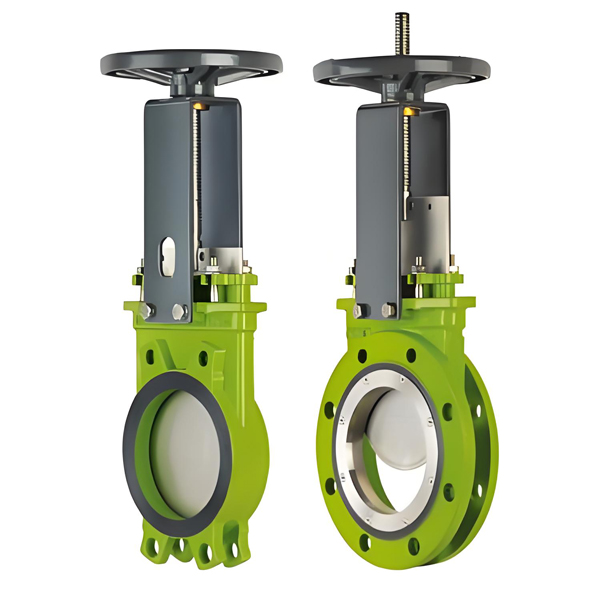
1. What Is a Knife Gate Valve?
A knife gate valve—also known as a knife gate, knife valve, or slurry gate valve—is a unidirectional, vertical shut-off valve operated manually, pneumatically, or electrically. It is a specialized subtype of gate valves. Its working principle is simple: the knife-shaped gate moves vertically, perpendicular to the flow direction. The sharp beveled edge at the bottom of the gate cuts through fibers, flocs, solid lumps, and viscous media inside the pipeline, achieving full open or full closed position.
Compared to conventional valves, the most distinctive feature of a knife gate valve is its ultra-thin, knife-like gate design. The valve body has a straight-through, obstruction-free flow path. When fully open, the gate retracts completely from the flow path, creating almost zero flow resistance. This design solves common problems found in ordinary valves when handling dirty, particle-laden media—such as clogging, poor sealing, and sticking. In harsh conditions, the knife gate valve is the go-to solution for media shut-off.
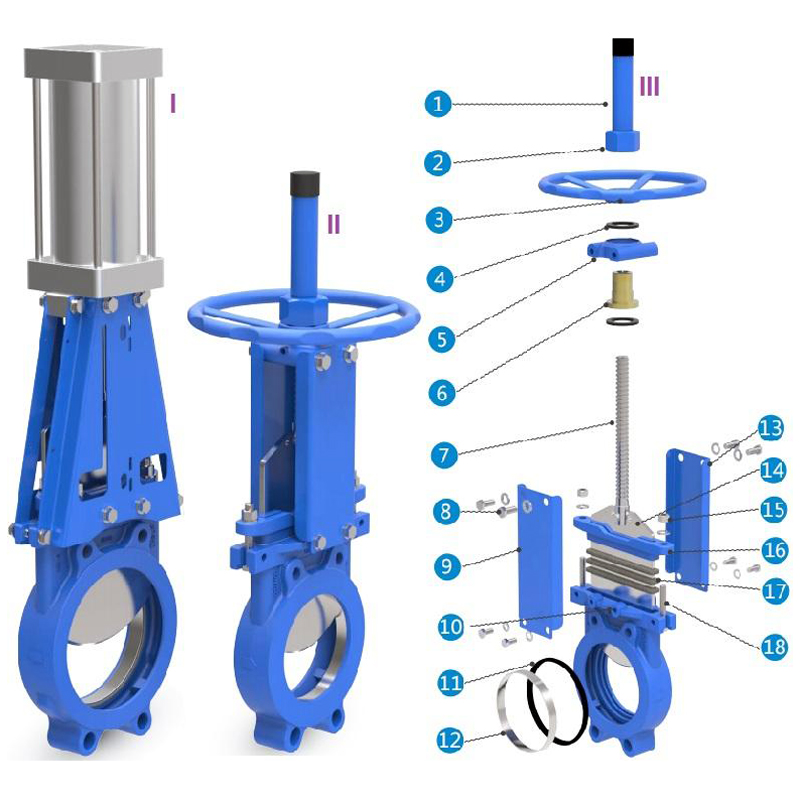
2. Key Components and Functions
The knife gate valve has a compact, highly integrated structure. Each component plays a clear role in ensuring sealing performance, operational stability, and service life.
2.1 Valve Body
The main load-bearing structure, typically cast or forged from materials like cast iron, carbon steel, or stainless steel. The internal straight-through flow channel has no recesses or dead spots, preventing debris buildup and sticking. The body withstands media pressure, connects to pipelines, and provides support for the gate and seals.
2.2 Knife Gate
This is the most distinctive part of a knife gate valve—the feature that sets it apart from all ordinary gate valves. The gate is thin but rigid, with a sharp beveled edge. Its surface is polished and hardened for wear and scratch resistance. During opening and closing, the blade cuts through pulp, sludge, slag, fibers, and other impurities, preventing wrapping or accumulation, ensuring tight shut-off and smooth operation.
2.3 Sealing Components
Includes seat seals and packing seals, divided into soft-seal and metal-seal types. Soft seals use rubber or polyurethane for excellent tightness and zero leakage, suitable for low-temperature, low-pressure clean or slurry media. Metal seals use stainless steel or alloys for high temperature, high pressure, and high abrasion resistance. Packing seals around the stem prevent external leakage.
2.4 Stem
Made of high-strength stainless steel with good tensile strength, corrosion resistance, and anti-torsion properties. The upper end connects to the actuator, and the lower end attaches to the gate. It transmits manual, pneumatic, or electric driving force to the gate for precise lifting control.
2.5 Actuator
The power source. Common types: manual (simple, low cost, for small diameters and infrequent operation), pneumatic (fast opening/closing, explosion-proof, suitable for chemical and dusty environments), electric (automated remote control for large pipelines and frequent operation), and hydraulic (high force for large diameters and heavy-duty conditions).
2.6 Gland and Bracket
The gland compresses the packing seal to prevent leakage. The bracket secures the actuator and stem, ensuring vertical movement without deviation or sticking, improving operational stability.
3. Detailed Classification of Knife Gate Valves
Knife gate valves come in many types, primarily classified by sealing design, actuation method, and construction style.
3.1 By Sealing Type
Soft-Seal Knife Gate Valve: Uses rubber, polyurethane, or PTFE for high conformability and zero leakage. Pressure rating ≤PN16, moderate temperature limits. Best for low-temperature, low-pressure applications like sewage, sludge, and light corrosive slurries containing solids. Cost-effective and most widely used.
Metal-Seated Knife Gate Valve: Gate and seat are precision-lapped alloy metals. Withstands high temperatures (up to 400°C+), high pressures, and severe abrasion. Sealing is slightly less tight than soft seals. Ideal for hot slurries, coal powder, and high-temperature ash water in harsh conditions.
Polyurethane Lined Knife Gate Valve: The flow channel of the knife gate valve is lined with polyurethane material, which is more wear-resistant than ordinary knife gate valves and is very suitable for media such as slurry and cinder.
3.2 By Actuation Type
Manual, pneumatic, electric, hydraulic, and occasionally gear-operated versions, depending on operation frequency, valve size, and automation needs.
3.3 By Construction Style
Wafer-Type Knife Gate Valve: Compact, lightweight, easy to install. Clamped between flanges, saves space. Suitable for small to medium pipelines.
Lug-Type (Flanged) Knife Gate Valve: Flanged ends bolted to pipeline. Robust structure, high pressure capacity, resistant to vibration. Suitable for large diameters, high pressure, and heavy industrial lines.
Rising Stem vs. Non-Rising Stem: Rising stem allows visual position indication and resists debris accumulation; non-rising stem is more compact for tight installation spaces.
4. Advantages and Disadvantages
4.1 Key Advantages
Superior media adaptability and clog resistance: The cutting blade easily handles fibers, flocs, solids, and viscous slurries—solving the jamming and poor sealing issues of ordinary valves.
Low flow resistance, energy efficient: Fully open, the gate retracts completely, leaving a straight-through path with nearly zero resistance and no pressure drop. Ideal for high-flow pipelines.
Simple structure, easy maintenance: Lightweight, few parts, quick to disassemble, low failure rate, reducing operating costs.
Fast operation, wide application range: Short stroke, quick response. With different materials and actuators, it suits normal, high-temperature, low-pressure, medium-pressure, abrasive, and corrosive conditions.
Cost-effective: For the same size and pressure rating, knife gate valves cost significantly less than ordinary gate or globe valves, making them practical for large-scale industrial lines.
4.2 Disadvantages
No flow regulation: The valve only works fully open or fully closed. It cannot modulate flow or pressure.
Sealing limits in high-pressure clean media: Compared to precision wedge gate valves, sealing accuracy is lower in clean, high-pressure services. Not recommended for ultra-precise, high-pressure clean fluid applications.
Wear from frequent cycling: The blade cutting through solids experiences gradual wear. After long-term heavy use, seals or gate may need replacement or servicing.
5. Typical Applications and Industries
Knife gate valves excel in shut-off duties for solids-laden, fibrous, viscous, and dirty media. Avoid using them for clean fluids or precision control. Core applications include:
5.1 Wastewater Treatment (Most Common)
Ideal for municipal sewage, industrial effluent, sludge, and biological slurry lines. Effectively cuts through flocs and solids, preventing clogging. Widely used in inlet, outlet, and sludge removal pipelines.
5.2 Mining and Metallurgy
Used for ore slurry, tailings, metallurgical ash, coal powder, and slag slurry. Metal-seated versions withstand high abrasion and high solids concentration, suitable for heavy-duty mining conditions.
5.3 Pulp and Paper, Textile
Specifically handles paper pulp and textile fiber slurries. The blade cuts through fibers, solving the wrapping and poor sealing issues of ordinary valves. A specialty valve for these industries.
5.4 Chemical and Power Generation
Chemical: viscous chemical slurries and mildly corrosive slurry media. Power: ash water, coal powder transport, and FGD (flue gas desulfurization) slurry lines. High temperature and wear resistance ensure reliable operation.
5.5 Building Materials and Food
Cement slurry, lime slurry, and other building material slurries; also viscous food slurries and particulate transport. Hygienic material versions meet food industry requirements.
Not suitable for: Clean water, gas, oil, or other particle-free media requiring precision shut-off; ultra-high pressure or ultra-high temperature precision applications; any line needing continuous flow or pressure regulation.
6. Key Differences Between Knife Gate Valve and Ordinary Wedge Gate Valve
Although both belong to the gate valve family and use a lifting gate design, their structures, performance, and applications differ greatly.
| Comparison Aspect | Knife Gate Valve | Ordinary Wedge Gate Valve |
|---|---|---|
| Core structure | Ultra-thin gate with sharp bottom blade; straight-through, dead-spot-free flow path | Thick, heavy gate, no blade; internal recesses and pockets in body |
| Media suitability | Slurries, sludge, fibers, solids, complex dirty media – anti-clogging, cuts impurities | Clean water, gas, oil – clean, particle-free media only; prone to clogging, cannot cut |
| Sealing performance | Soft seal – zero leakage; metal seal – high temp/wear. General sealing for clean media | Precision metal-to-metal sealing; high accuracy and stability for clean media under high pressure |
| Function | On-off only, no flow regulation | On-off, some can assist in fine flow adjustment for precision applications |
| Size and weight | Compact, small, lightweight, easy to install | Heavy, bulky, takes more space |
| Operating characteristics | Short stroke, fast open/close, resistant to debris interference | Long stroke, slow open/close, prone to sticking and failure in dirty environments |
| Typical applications | Harsh, dirty, viscous, abrasive conditions | Clean media, high-pressure precision sealing, fine flow adjustment |
| Cost | More cost-effective for same specs; lower maintenance cost | More expensive due to complex structure; higher maintenance requirements in precision services |
7. Conclusion
In simple terms, the knife gate valve is a specialty shut-off valve designed for difficult, dirty, and abrasive media. Its knife-like cutting action is the core advantage, solving the clogging and failure problems that plague ordinary wedge gate valves when handling slurries, solids, and fibrous materials. The knife gate valve has a simple structure, fast operation, and broad adaptability. While it cannot regulate flow and its precision sealing in clean media is limited, it remains irreplaceable in wastewater treatment, mining, pulp and paper, chemical, and other industries where media contain solids, fibers, or viscous components.
For real-world selection: choose ordinary wedge gate valves for clean media precision applications. For sludge, slurry, particles, fibers, and other clog-prone, harsh conditions, you must choose a knife gate valve to ensure long-term, reliable pipeline operation.
Post time: Jun-06-2026