


Introduction
In modern chemical processing, oil and gas refining, and heavy industrial piping networks, the demand for compact, lightweight isolation valves has driven a fundamental shift in specification. Gate valves and ball valves have long been the default choice for tight shut-off, but their weight, envelope size, and actuation costs at larger diameters present real economic barriers. The industry response has been the high-performance butterfly valve.
Among these, the double eccentric butterfly valve—also referred to as a double-offset butterfly valve—has become the engineering standard for applications involving elevated pressures, extreme temperatures, and volatile media. When deployed in hazardous hydrocarbon environments, integrating verifiable fire-safe sealing technology is not optional; it is a compliance mandate aimed at protecting personnel and preventing catastrophic refinery incidents.
1. The Geometry of the Double Offset
Standard concentric butterfly valves—where the shaft passes directly through the center of the disc and seat—suffer from continuous, high-friction contact throughout the entire 90° rotation. This leads to rapid seat wear, localized tearing, and elevated operating torque.
The double eccentric butterfly valve addresses this friction problem through two distinct geometric offsets:
First Offset: The shaft is positioned behind the sealing plane of the valve seat. This allows the disc to seal continuously across the full 360° boundary.
Second Offset: The shaft is offset laterally from the centerline of the pipe bore.
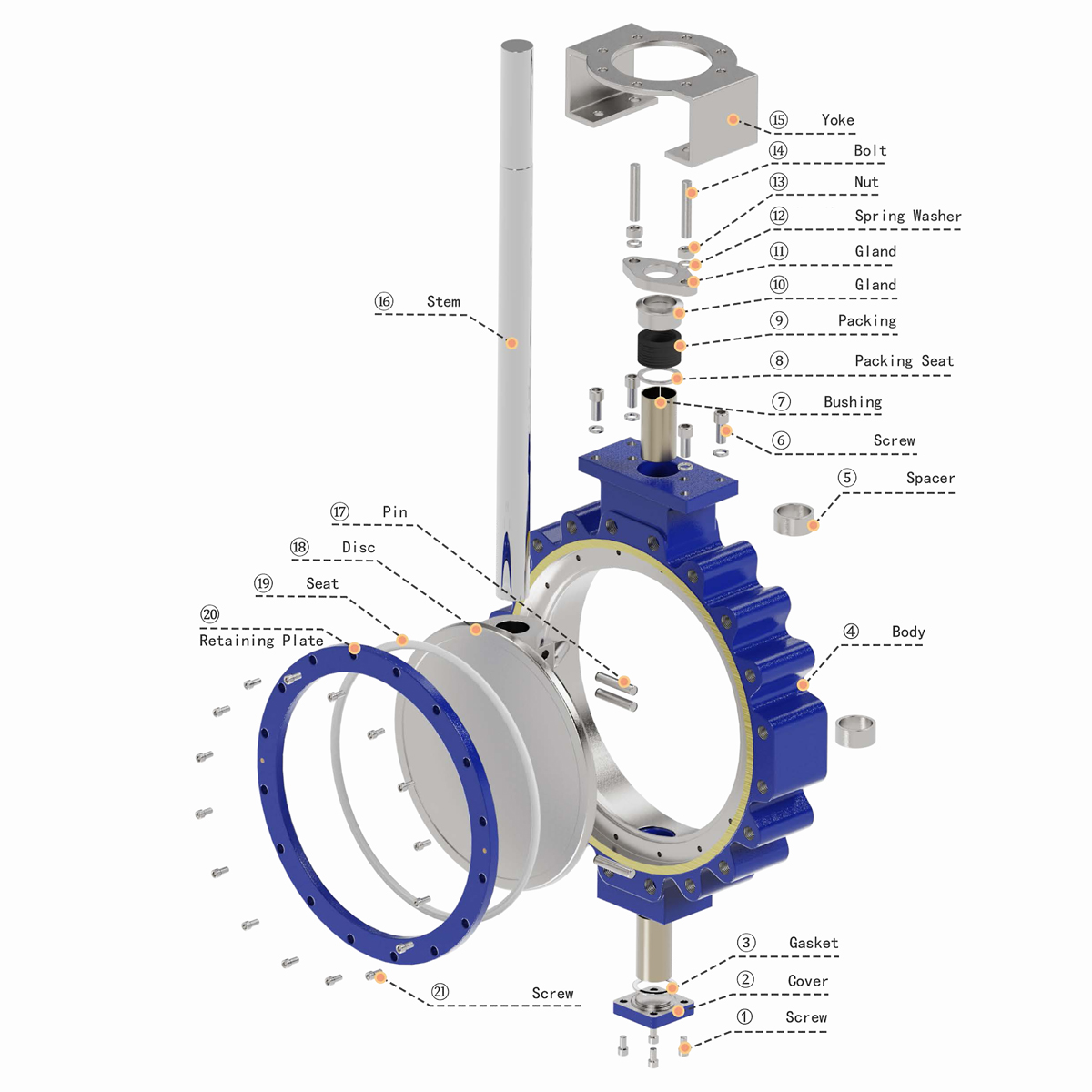
The Camming Effect
Combined, these two offsets create what engineers refer to as a cam-like action. When the valve begins to open, the disc lifts out of the seat within the first 1° to 3° of rotation. For approximately 95% of the valve’s travel, there is virtually no contact between the disc and the seat. Friction is minimized, operating torque is reduced, and the service life of soft elastomer or polymer seats—such as PTFE and RTFE—is extended significantly.
Field data indicates that properly maintained double eccentric butterfly valves often achieve 15 to 20 years of service life in moderate-pressure applications, with some designs exceeding 1 million operating cycles. The reduction in friction also translates to lower maintenance frequency—valve seat life is typically three to five times longer than that of single eccentric designs.
2. Fire-Safe Seat Design
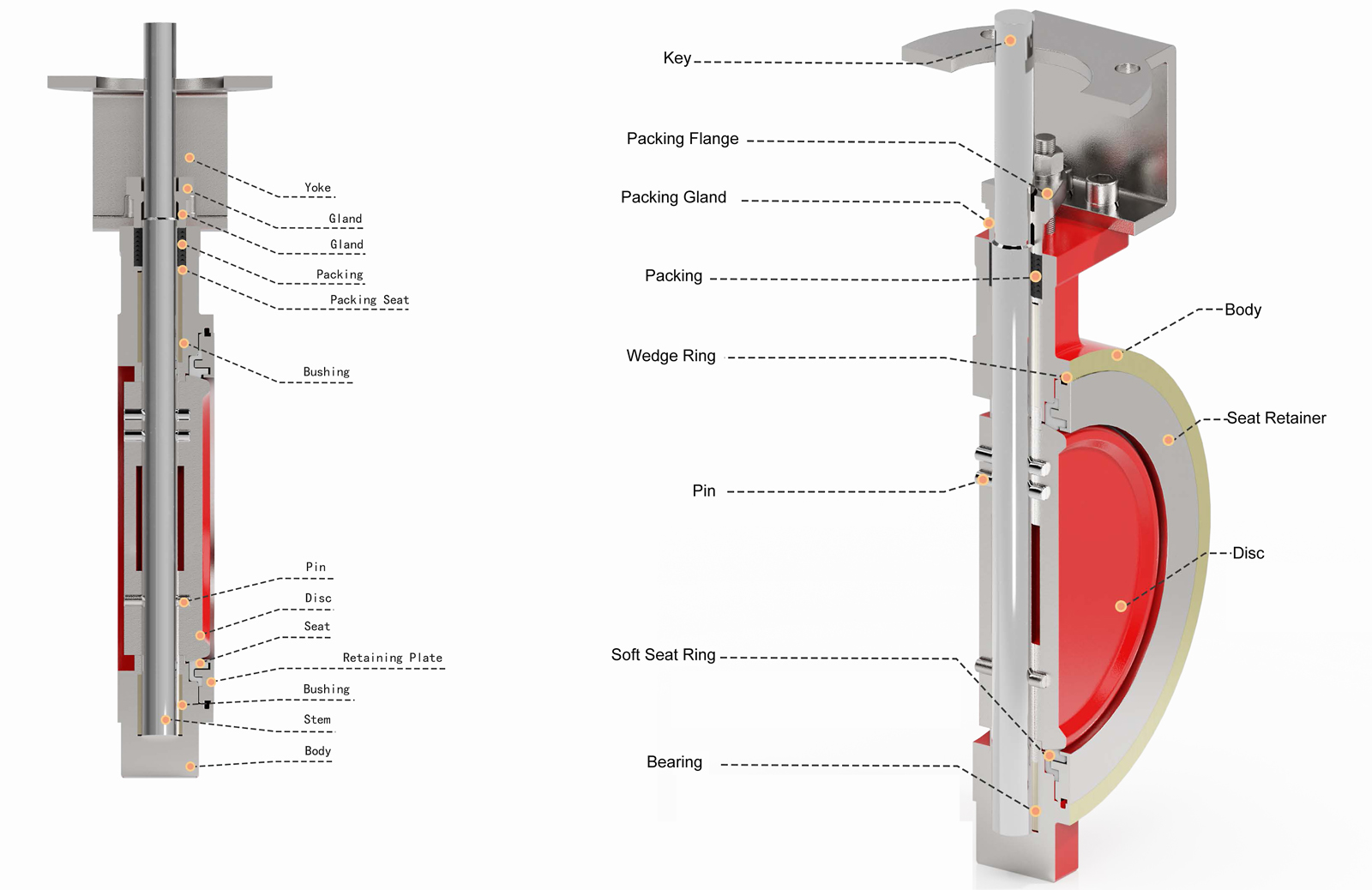
In petroleum and chemical refineries, piping components must maintain sealing integrity even when engulfed in a fully developed plant fire. Achieving true fire-safe status requires a highly specialized dual-seat configuration.
The fire-safe seat arrangement incorporates two sealing elements working in sequence:
Normal Operation (Soft Seal Dominant):
Under standard operating conditions, a resilient PTFE, RTFE, or Devlon seat serves as the primary sealing element, fully engaging with the disc edge to deliver bubble-tight shut-off in accordance with API 598 or ISO 5208 Rate A requirements. In this mode, the valve achieves zero-leakage performance.
Fire Exposure (Metal Seal Engages):
When ambient temperature exceeds approximately 540°C (1,000°F) during a plant fire, the primary soft seat softens, decomposes, and eventually burns away. At this point, a pre-loaded secondary metal seat—typically fabricated from Inconel 718 or 625—deflects under line pressure and seals against the disc edge, establishing a metal-to-metal barrier. Some designs use an RPTFE primary seat with an Inconel 625 backup, rated to API 607 6th Edition.
This secondary metal-to-metal barrier ensures compliance with stringent fire testing standards including API 607 and ISO 10497 (formerly BS 6755 Part 2). API 607 requires the valve to be cycled (opened and closed) during the fire test to verify that the mechanism remains functional while engulfed in flames. The test exposes the valve to 750–1,000°C for 30 minutes, with leakage limits specified for both the fire exposure and post-fire cooling phases.
It is worth noting that fire-safe certification applies to the valve design, not to individual valves. Once a design passes the API 607 test, all valves of that design family are certified without individual fire testing.
3. High-Performance vs. Standard Concentric Butterfly Valves
Procurement managers evaluating utility layouts are sometimes tempted to specify budget-friendly concentric butterfly valves. However, high-pressure, severe-service piping demands the mechanical robustness of a high-performance butterfly valve.
| Engineering Metric | Concentric Butterfly Valve | High-Performance Butterfly Valve (Double Offset) |
|---|---|---|
| Sealing Mechanism | Disc squeezes into elastomer lining | Cam action—disc lifts into and out of seat |
| Max Pressure Rating | Up to Class 150 (typically 150–200 PSI) | Up to ASME Class 600 (1,480 PSI) |
| Temperature Range | −10°C to 120°C (rubber liner limit) | −196°C cryogenic to 600°C (metal seat) |
| Seat Wear | High—continuous friction throughout rotation | Extremely low—friction only at final closure |
| Slurry and Viscous Service | Poor—elastomer liner prone to tearing and cavity buildup | Excellent—double offset sweeps media away from seal |
| Fugitive Emissions | Limited—standard stem packing | Certified to API 641 and ISO 15848-1 |
| Bidirectional Sealing | Fully bidirectional | Bidirectional with soft seats |
API 641, first published in 2016, governs fugitive emission testing for quarter-turn valves including butterfly, ball, and plug types. It prescribes 610 mechanical cycles and three thermal cycles, with both dynamic and static measurements.
4. Actuator Sizing and Cost Implications
Because double-offset geometry eliminates the drag friction inherent in concentric designs, it fundamentally changes the valve’s torque profile.
In a double eccentric butterfly valve, peak torque occurs only during the final 5° of closure—what engineers call the seating torque. The running torque—the force required to move the disc through the remainder of the rotation—is exceptionally low.
For automated loops, this torque profile yields substantial economic advantages:
• Smaller Actuators: You can downsize pneumatic actuators or electric multi-turn motors by 20% to 35% compared to a ball valve or a poorly specified concentric valve. Some sources report torque requirements 30% to 50% lower than midline butterfly valves.
• Reduced Footprint: Smaller actuators translate directly into lighter skid weight and lower structural support costs for pipe racks.
• Lower Energy Consumption: Pneumatic spring-return actuators require less control air volume, reducing the overall utility load on compressor stations.
A practical guideline for actuator selection: if a valve measures 80 Nm of required torque, the actuator should be sized at 100 Nm or higher, applying a safety factor. The low-torque characteristics of double eccentric designs mean that this safety factor can often be applied to a smaller baseline than would be required for a concentric valve.
5. Material Selection and Application Considerations
The double eccentric butterfly valve’s versatility extends across a wide range of service conditions, provided materials are selected appropriately.
Body Materials:
Common options include ductile iron, cast steel (WCB), and stainless steel (CF8M). For aggressive chemical and seawater services, super duplex and nickel-based alloys are available.
Seat Options:
Soft seats (PTFE, RTFE, Devlon) deliver bubble-tight shut-off for general process applications. Metal seats (Inconel, Stellite) extend temperature capability to 600°C and are inherently fire-safe.
Disc Materials:
Options range from epoxy-coated ductile iron to SS304, SS316, and duplex steel.
For abrasive slurry service—such as mining tailings, fly ash, or bauxite—double eccentric designs offer an advantage over concentric valves because the disc’s cam action sweeps media away from the sealing interface, reducing particle entrapment and seat damage. For cryogenic LNG applications, specially treated materials and deep-cooling processes enable reliable operation down to −196°C.
Partnering with NSW: Engineering Confidence
Whether you are designing a petrochemical refinery, an offshore drilling platform, or a critical chemical processing unit, selecting the correct valve specification determines long-term plant uptime and safety performance.
At NSW VALVE COMPANY (nswvalve.com), we manufacture API 607 certified, fire-safe, double eccentric butterfly valves engineered for the most demanding plant conditions. Our ISO-compliant manufacturing facilities employ rigorous Positive Material Identification (PMI), non-destructive examination (NDE), and precision CNC machining to deliver valves with zero-leakage performance, minimized operating torque, and full metallurgical traceability.
We offer a range of seat configurations—soft-seated for bubble-tight shut-off, fire-safe for hydrocarbon service, and metal-seated for high-temperature applications—all available with manual, gear, pneumatic, or electric actuation.
Contact our engineering team at nswvalve.com today to submit your datasheets, discuss custom alloy configurations (such as Super Duplex or Monel), or request our official API 607 test reports.
Technical References
• API 607: Fire Test for Quarter-Turn Valves and Valves Equipped with Nonmetallic Seats
• API 609: Butterfly Valves: Double-Flanged, Lug- and Wafer-Type
• API 641: Fugitive Emissions Testing for Quarter-Turn Valves
• ISO 10497: Fire Type-Testing Requirements for Valves
• ISO 15848-1: Industrial Valves—Measurement, Test and Qualification Procedures for Fugitive Emissions
• ASME B16.34: Valves—Flanged, Threaded, and Welding End
Post time: Jul-17-2026