


For procurement directors, global sourcing managers, and EPC engineers, the selection of an industrial-grade ball valve supplier is never a straightforward decision. When pipeline projects demand absolute mechanical reliability under high-pressure or corrosive service conditions, partnering directly with a qualified, API-certified ball valve factory becomes a critical risk-mitigation strategy. Direct factory engagement reduces total cost of ownership (TCO), ensures supply chain transparency, and protects project on-time delivery.
NSW VALVE COMPANY (nswvalve.com) , a premier ball valve manufacturer headquartered in China, offers an inside look at the technical infrastructure, testing protocols, and manufacturing standards that distinguish a high-tier ball valve China exporter. With over 20 years of industry experience and a 20,000-square-meter manufacturing facility, NSW has earned recognition from industry giants including PetroChina and Sinopec. The company’s expansion into the European market with an Italian manufacturing base established in 2015 further demonstrates its commitment to serving global oil, gas, and chemical process industries.
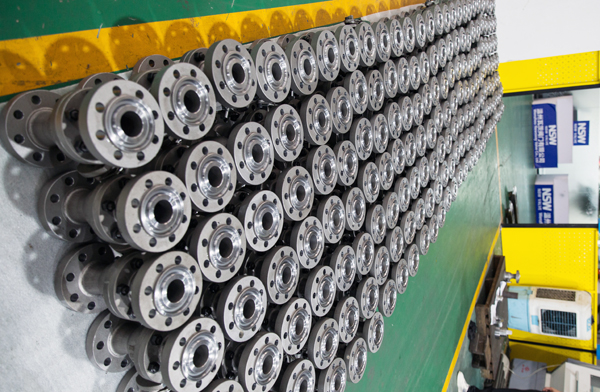
01 1. Traceability and Material Quality Control at the Foundry Level
The structural integrity of any floating or trunnion-mounted ball valve is determined long before machining begins—it originates at the foundry. Substandard casting raw materials introduce internal porosity, sand inclusions, and micro-cracking that can lead to premature wall puncture under pressure.
A world-class ball valve factory enforces a zero-compromise Material Verification Program:
02 2. Advanced Machining Capabilities: Driving Dimensional Precision
Achieving zero-leakage rates—whether to API 598 or ISO 5208 Rate A standards—requires a ball valve manufacturer to replace outdated manual lathes with advanced, high-precision automated machinery. Dimensional tolerance accumulation between the ball closure element, seat retainer rings, and stem alignment is the primary cause of elevated operating torque and localized seat deformation.
Leading ball valve China manufacturing facilities leverage multi-axis CNC machining centers to complete body boring, end-face finishing, and thread cutting in a single fixturing setup. This approach eliminates the coaxiality errors introduced by multiple clamping operations, enabling sphericity error to be strictly controlled within 5 microns. The result is significantly extended operational life for both soft-seated and metal-seated valve designs.
NSW Valve Factory CNC Manufacturing Cell
Automated Production Workflow for High-Precision Ball Valves
(High-resolution images of NSW’s actual CNC machining cells are available on the company’s official website.)
03 3. Essential Engineering Standards and Regulatory Compliance
When shortlisting an industrial ball valve supplier, regulatory compliance serves as a non-negotiable gatekeeper. A qualified factory must hold active, verifiable certifications that are visible on global engineering registries.
| Sourcing Standard | Regulatory Scope & Focus | Sourcing Verification Action for Procurement |
|---|---|---|
| API Spec 6D | Specification for Pipeline and Piping Valves | Mandates strict wall thicknesses, face-to-face dimensions, and double-block-and-bleed (DBB) capabilities. |
| ISO 9001:2015 | Quality Management System (QMS) | Verifies process consistency, corrective actions, and supply chain accountability across the factory floor. |
| API 607 / API 6FA | Fire Test Specifications for Soft/Metal Seats | Ensures pressure boundary containment and secondary sealing under full hydrocarbon fire exposure (1,400°F to 1,800°F). |
| API 641 / ISO 15848-1 | Fugitive Emissions Compliance | Validates stem packing integrity to prevent hazardous volatile organic compound (VOC) leaks (<100 ppmv). |
By consolidating production within an integrated API 6D-licensed factory, engineers gain assurance that delivered products will integrate seamlessly into any ASME B16.5 or ASME B16.47 piping layout without requiring field modifications.
04 4. Pressure Testing, Inspection, and Factory Acceptance Testing (FAT)
Every valve leaving a top-tier ball valve China plant must undergo pressure testing in strict accordance with API 598 or API 6D protocols. A qualified manufacturer provides fully documented, traceable Test Certificates (EN 10204 Type 3.1) for every serial-numbered unit.
The Factory Acceptance Testing (FAT) sequence typically comprises:
Partnering with NSW: A Direct-to-Factory Procurement Source
The selection of the right ball valve manufacturer translates directly into long-term pipeline safety and predictable project timelines. By eliminating intermediary trading companies and sourcing direct from an established ball valve factory, global operators gain direct engineering support, fully customizable alloy configurations, and radical supply chain transparency.
NSW VALVE COMPANY combines world-class Chinese manufacturing efficiency with the rigorous quality controls demanded by global oil, gas, and chemical processes. With a 20,000-square-meter workshop, over two decades of design and export experience, and a European manufacturing footprint established since 2015, NSW delivers industrial ball valves—including floating and trunnion-mounted configurations in carbon steel, forged steel, and stainless steel—that meet the most demanding international specifications.
Contact the NSW engineering team today to review your project data sheets or request a direct factory inspection audit.
Post time: Jul-11-2026