


As artificial intelligence workloads and High-Performance Computing (HPC) clusters push rack power densities past 40 kW to over 100 kW per rack, traditional air cooling has reached its physical limits. Direct-to-Chip (D2C) liquid cooling and immersion systems have become mandatory infrastructure for modern AI data centers.
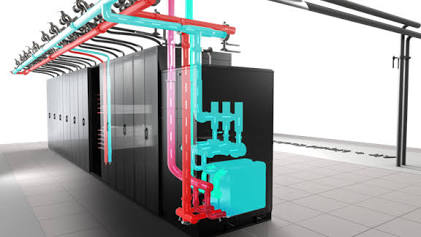
Inside these complex thermal loops, specialized AI cooling system valves serve as critical flow control devices. They balance dynamic pressure differentials, modulate coolant flow in real time, enable dry-break hot swapping, and provide emergency isolation.
Because a single coolant leak can destroy multi-million-dollar GPU clusters, selecting high-integrity AI cooling system valves is one of the most vital decisions for data center facility managers, MEP engineers, and EPC procurement teams.
1. AI Liquid Cooling Architecture: Primary vs. Secondary Loops
To specify the correct AI cooling system ball valve, globe valve, or balancing valve, you must first understand where each valve operates within the data center cooling infrastructure:
+-----------------------------------------------------------------------------------+
|                        PRIMARY LOOP (Facility Side / Utility)                      |
|  [Chiller / Cooling Tower] <=====================> [Cooling Distribution Unit]     |
|  (Coolant: Treated Water / Glycol)                  (AI Cooling System Control Valves)  |
+-----------------------------------------------------------------------------------+
                                                          || Heat Exchanger
+-----------------------------------------------------------------------------------+
|                       SECONDARY LOOP (Technology Side / IT Rack)                   |
|  [CDU Pump] ===> [Rack Manifold] ===> [GPU Cold Plate] ===> [Return to CDU]       |
|  (Coolant: DI Water / PGW / Fluorinated Fluid)    (Dry-Break QDV, Ball, Check Valves)|
+-----------------------------------------------------------------------------------+-
Primary Loop (Facility Side): Connects external chillers or cooling towers to the Coolant Distribution Unit (CDU). It handles large volumetric fluid flow at higher pressure drops ($\Delta P$), utilizing industrial-grade motorized control valves and high-flow isolation valves.
-
Secondary Loop (Technology Side): Circulates ultra-pure deionized water (DI water), Propylene Glycol Water (PGW), or dielectric fluids directly between the CDU and chip-level cold plates. This loop requires high-cleanliness 316L stainless steel AI cooling system valves with zero-leakage stem seals.
2. Core Types of AI Cooling System Valves & Key Functions
                             [AI COOLING SYSTEM VALVES]
                                         |
     +-------------------+---------------+---------------+-------------------+
     |                   |               |               |                   |
 [AI Cooling System  [AI Cooling System  [AI Cooling System  [AI Cooling System  [AI Cooling System
  Balancing Valves]   Quick Disconnect]  Motorized Valves]  Isolation Valves]   Check Valves]
     |                   |               |               |                   |
 Dynamic Pressure    Dry-Break Rack   Real-Time Temp    Zero-Pressure-Drop  Silent Backflow
    Balance          Hot-Swapping       Modulation      Full-Port Shut-Off   Prevention
1. AI Cooling System Balancing Valve (PICV)
-
Primary Location: CDU primary supply line, rack manifold branch headers.
-
Core Function: A Pressure Independent Control Valve (PICV) dynamically compensates for system pressure fluctuations, maintaining a constant flow rate across every server rack regardless of workload variations.
-
Key Advantages: Prevents thermal starvation or “fluid hijacking” when neighboring GPU racks dynamically shift power states.
2. AI Cooling System Quick Disconnect Valve (QDV)
-
Primary Location: Server blade inlet/outlet, manifold drop connections.
-
Core Function: Enables tool-less hot-swapping of server blades without interrupting coolant flow to adjacent nodes.
-
Key Advantages: Features a flush-face dry-break design that seals automatically on both sides prior to disconnection, ensuring zero coolant spillage near high-voltage GPU electronics.
3. AI Cooling System Motorized Control Valve
-
Primary Location: CDU heat exchanger bypass, primary loop control manifolds.
-
Core Function: Receives 0–10V or Modbus signals from the Data Center Infrastructure Management (DCIM) system to modulate coolant flow rates instantly during AI training workload spikes.
-
Key Advantages: Offers rapid response speeds with step-less micro-adjustment ($1\text{–}99\%$) to absorb massive thermal transients.
4. AI Cooling System Ball Valve & Isolation Valve
-
Primary Location: Main supply/return headers, CDU inlet/outlet isolation.
-
Core Function: Provides tight quarter-turn isolation during scheduled system maintenance or emergency shut-offs.
-
Key Advantages: A full-port AI cooling system ball valve offers a completely unobstructed flow path, minimizing pump head loss in the secondary loop.
5. AI Cooling System Check Valve
-
Primary Location: Parallel CDU pump discharge ports, redundant fluid manifolds.
-
Core Function: Prevents backflow and short-circuit circulation when redundant pumps cycle on or off.
-
Key Advantages: Employs silent, spring-loaded discs to eliminate fluid chatter and water hammer shockwaves.
3. Engineering Comparison Matrix
| Technical Metric | AI Cooling System Ball Valve | AI Cooling System Globe Valve | AI Cooling System Balancing Valve (PICV) | Quick Disconnect Valve (QDV) |
| Primary Function | On/Off Isolation | Flow Throttling / Regulation | Dynamic Pressure Balancing | Dry-Break Hot-Swapping |
| Flow Efficiency ($C_v$) | Highest (Full Port) | Medium-Low | Dynamic / Self-Adjusting | Optimized Low $\Delta P$ |
| Primary Material | 316L Stainless Steel | 316 / Duplex Steel | Brass / Stainless Steel | 316L / Anodized Aluminum |
| Leakage Class | ISO 5208 Rate A (Bubble Tight) | ANSI FCI 70-2 Class VI | ANSI FCI 70-2 Class IV/VI | Zero Spillage (Flush Face) |
| Control Signal | Manual / On-Off Actuator | 0–10V / 4–20mA / Modbus | Self-Actuating / Motorized | Mechanical Push-Pull |
4. Critical Procurement & Engineering Selection Checklist
When sourcing AI cooling system valves, HVAC/commercial-grade selection criteria are insufficient. Engineering teams must adhere to these four core rules:
1. Metallurgy & Coolant Compatibility
Deionized water in secondary loops is highly aggressive and seeks to leech ions from metallic surfaces.
-
Mandatory Wetted Materials: Specify ASTM A351 CF3M / 316L Stainless Steel for all wetted valve bodies and internals. Avoid cast iron, carbon steel, or low-grade brass, which cause galvanic corrosion and particulate buildup.
-
Elastomer Selection: Seals must be constructed from high-grade EPDM or FKM (Viton) tested for long-term compatibility with Propylene Glycol Water (PGW) and dielectric fluids. NBR (Nitrile) is strictly forbidden due to plasticizer leaching that clogs micro-channel cold plates ($0.1\text{–}0.3\text{ mm}$ gap).
2. Low Pressure Drop ($\Delta P$) Design
Pumping power directly impacts data center Power Usage Effectiveness (PUE). Secondary loop pumps operate under strict pressure limits to prevent over-pressurizing delicate cold plate channels.
-
Rule: Specify full-port AI cooling system ball valves and CFD-optimized valve bodies to maximize $C_v$ ratings and reduce internal fluid turbulence.
3. Ultra-Cleanliness & Degreasing Standards
-
Valve components must undergo ultrasonic cleaning, solvent degreasing, and dust-free cleanroom packaging prior to shipment. Residual machining oils, metal burrs, or silica particles will foul micro-channel cold plates and cause localized GPU burnouts.
4. Fugitive Emissions & Actuator Fail-Safe Integration
-
Fugitive Emissions: Valves must pass ISO 15848-1 Class AH or API 641 low-leakage stem packing certification.
-
Fail-Safe Actuation: Electric actuators must feature supercapacitor back-up or spring-return functionality to force the valve into a safe “Full Open” or “Full Closed” state during a facility power outage.
Partnering with NSW: Precision Valves for Next-Gen AI Infrastructure
At NSW VALVE COMPANY (nswvalve.com), we manufacture high-purity AI cooling system valves engineered specifically for liquid-cooled data centers, CDU manifolds, and high-density GPU racks. From full-port AI cooling system ball valves to high-precision motorized control valves, our 316L stainless steel solutions undergo rigorous ultrasonic cleaning and $100\%$ hydrostatic and low-pressure gas testing.
Contact our technical engineers at nswvalve.com to request 3D CAD models, fluid compatibility charts, or custom valve datasheets for your AI data center project.
Post time: Aug-07-2026