


In the complex world of industrial piping systems, reliable flow control is paramount. A Flanged Ball Valve stands out as one of the most widely used and dependable solutions.
What is a Flanged Ball Valve?
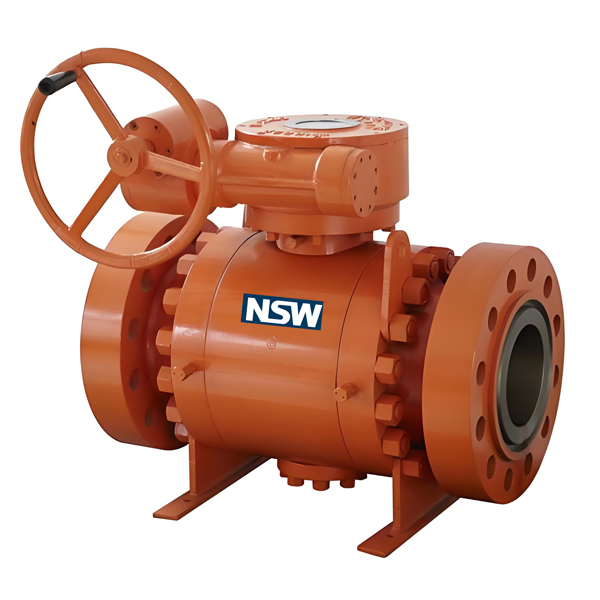
Flanged Ball Valve is a Ball Valve with Flange End Connection.
It’s a type of quarter-turn valve that uses a valve ball to control fluid flow. Its defining feature? Instead of threaded or welded ends, it incorporates Flanges at the inlet and outlet. These flanges bolt directly to matching flanges on the pipeline, creating a robust, leak-tight, and easily maintainable connection. This design makes flanged ball valves ideal for demanding applications across numerous industries, from high-pressure steam lines to corrosive chemical processing.
Understanding Flanged Ball Valves: Flanges and Ball Valves
To fully grasp the flanged ball valve, let’s break down its two fundamental elements:
What is a Ball Valve:
At its heart lies the standard Ball Valve principle. A spherical ball with a bore (hole) through its center rotates 90 degrees within the valve body. When the bore aligns with the pipe, flow is unrestricted (open). When rotated perpendicular, the solid ball blocks the flow completely (closed). This design offers quick operation, excellent shut-off capability, and minimal flow restriction when fully open (especially in full-port designs).
What is Flange End Connection:
A valve flange is a structural form in which a valve is connected to a pipeline using a flange connection method. It is a common detachable connection component in industrial piping systems.
Core Definition:
A valve flange is a flange-shaped structure machined at both ends or the inlet and outlet of a valve body. It is fastened to the pipeline flange using bolts and gaskets to achieve sealing and flow.
It belongs to the category of “flange-connected valves,” emphasizing the connection method rather than the valve type (e.g., butterfly valves, ball valves, gate valves, etc., can all be flanged).
Flanges are flat, disc-like rims with a series of drilled bolt holes around their perimeter. On a flanged ball valve, these are integrally cast or welded onto the valve body ends. The valve is installed by sandwiching a gasket between its flanges and the pipeline flanges, then tightening bolts around the circumference. This creates a very strong, pressure-resistant joint that can be easily disconnected for valve maintenance or replacement without cutting the pipe. Common flange standards include ASME B16.5 (ANSI) and ASME B16.47 (API).
Main Features:
Good Sealing: Reliable sealing is achieved through gaskets (such as rubber, asbestos, metal spiral wound gaskets, etc.).
High Pressure Bearing Capacity: Suitable for medium and high pressure conditions (common pressure ratings PN1.0~PN40.0, Class 150~2500).
Easy Installation and Maintenance: Can be disassembled multiple times, suitable for piping systems requiring regular maintenance.
High degree of standardization: Domestically, the standard mainly follows GB/T 9112~9124-2010, the standard for steel pipe flanges.
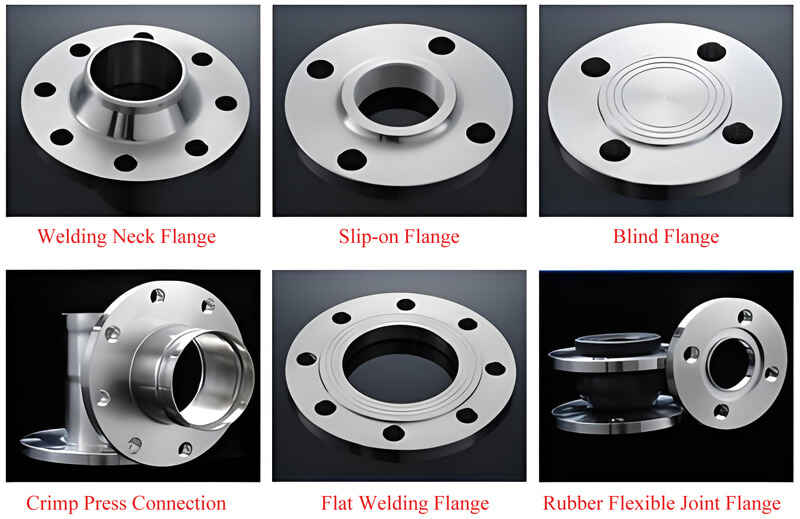
Common types (by structure):
Integral flange: Cast or forged integrally with the valve body.
Welding Neck flange: High rigidity, used for high pressure and high temperature applications.
Slip-on flange: Used for medium and low pressure applications.
Loose flange: Easy to align, commonly used for stainless steel or non-ferrous metal pipelines.
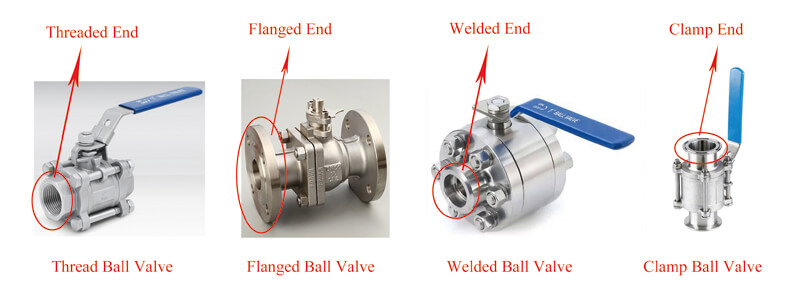
Note: During selection, due to differences in design and operating conditions, ball valves often utilize threaded connections, welded connections, clamp connections, etc. Therefore, corresponding valves to flanged ball valves include threaded ball valves, welded ball valves, and clamp ball valves.
The following ball valve picture shows ball valves with different connection .
Flanged Ball Valve Classification: Key Variations
Flanged ball valves come in several configurations to suit diverse needs. Key classification criteria include:
By Body Construction:
* One-Piece: Body is a single casting/forging. Most economical, permanent body assembly. Limited to smaller sizes/lower pressures.
* Two-Piece: Body split into two main sections (typically body + one end cap), bolted together. Allows access to internals for maintenance/cleaning without removing from the line. Most common type.
* Three-Piece: Body consists of a center section and two end caps, all bolted together. Offers easiest access to ball and seats for maintenance/repair/replacement, ideal for frequent service or sanitary applications. Often more expensive.
By Port Size:
* Full Port (Full Bore): The ball bore diameter matches the inner diameter of the connecting pipe (~same as valve nominal size). Minimizes pressure drop, allows pigging, ideal for flow-critical applications.
* Reduced Port (Reduced Bore): The ball bore diameter is smaller than the valve’s nominal size/pipe ID. Results in higher pressure drop but is more compact and economical. Suitable where flow restriction isn’t critical.
By Flange Facing (Critical Keyword Area!):
* Ball Valve RF (Raised Face): The flange has a raised, flat ring around the bore. A flat gasket (often non-metallic like graphite or PTFE) sits on this raised surface. The most common facing type for general industrial applications (ASME B16.5). Highly relevant for “Ball Valve RF”.
* Ball Valve RTJ (Ring Type Joint): The flange has a groove machined into its face. A specially shaped metal ring gasket (oval or octagonal) fits into this groove, deforming under bolt load to create a high-integrity metal-to-metal seal. Essential for very high-pressure, high-temperature, or critical service (e.g., ASME 900# and above, offshore, subsea). Highly relevant for “Ball Valve RTJ”.
* Flat Face (FF): Less common for ball valves, mainly for low-pressure cast iron valves mating to flat face flanges.
By Materials:
Body/Trim materials vary widely (Carbon Steel, Stainless Steel 316/304, Duplex, Alloy 20, Hastelloy, PVC, CPVC) to handle different fluids, pressures, temperatures, and corrosion requirements. Seats (often PTFE, reinforced PTFE, PEEK, metal) and seals are chosen for compatibility and sealing performance.
Key Advantages of Flanged Ball Valves
Their popularity stems from several compelling advantages:
1. Robust & Leak-Tight Connection: Flanged ends provide exceptional strength and sealing integrity, especially with proper gasketing (RF or RTJ), making them suitable for high-pressure and high-temperature applications.
2. Ease of Installation & Maintenance: Bolting simplifies installation compared to welding. Valves can be easily removed for inspection, repair, or replacement without disturbing the entire pipeline.
3. Excellent Shut-Off: The ball design provides bubble-tight sealing when closed with quality seats.
4. Low Torque & Quick Operation: Quarter-turn operation (90°) allows for fast open/close cycles with minimal effort.
5. Minimal Pressure Drop (Full Port): When fully open, full-port valves offer very little resistance to flow.
6. Versatility: Available in a vast range of sizes, pressure ratings (ASME 150# to 2500#), materials, and designs to suit almost any industrial application.
7. Durability & Long Life: Constructed from robust materials and designed for demanding service, they offer long-term reliability.
Diverse Applications of Flanged Ball Valves
Flanged ball valves are ubiquitous across industries requiring reliable flow control:
* Oil & Gas Production & Refining: Wellheads, pipelines, separation, refining processes (handling crude, gas, refined products).
* Chemical & Petrochemical Processing: Handling acids, solvents, bases, and various process fluids under corrosive conditions.
* Power Generation: Steam lines (high pressure/temp), feedwater, cooling systems.
* Water & Wastewater Treatment: Pump control, distribution networks, sludge handling.
* Pharmaceutical & Food & Beverage (Sanitary 3-piece): Hygienic processes requiring frequent cleaning (CIP/SIP).
* Pulp & Paper: Processing chemicals, steam, water.
* HVAC: Large commercial/industrial heating and cooling systems.
* Marine & Shipbuilding: Seawater, ballast, fuel oil systems.
Choosing the Right Flanged Ball Valve Manufacturer & Supplier
Selecting a reliable Flanged Ball Valve Manufacturer and Flanged Ball Valve Supplier is critical for performance and safety. Consider these factors:
* Compliance & Certifications: Look for manufacturers adhering to international standards (API 6D, API 607/6FA, ASME B16.34, ISO 17292, PED, CE) and holding relevant quality certifications (ISO 9001).
* Material Expertise: Ensure they offer valves in materials suitable for *your* specific fluid, pressure, temperature, and corrosion needs.
* Design Capability: Can they provide the specific type (2/3-piece, Full/Reduced Port), flange facing (RF, RTJ), pressure class, and actuation (manual, gear, pneumatic, electric) you require?
* Testing & Quality Control: Reputable manufacturers perform rigorous testing (shell test, seat test, fire test if applicable).
* Supplier Support: Choose a supplier with strong technical knowledge, inventory availability, and responsive customer service for quotes, delivery, and after-sales support.
Conclusion
The Flanged Ball Valve is a cornerstone of modern industrial fluid handling. Its combination of a simple yet effective ball valve mechanism with the strength and serviceability of flanged connections makes it an indispensable solution for countless applications. Understanding the key aspects – what it is, its classification (including crucial differences like Ball Valve RF vs. Ball Valve RTJ), its significant advantages, and wide-ranging uses – empowers engineers and procurement specialists to make informed decisions. When sourcing, partnering with reputable Flanged Ball Valve Manufacturers and Suppliers ensures you receive high-quality, reliable valves that meet your specific operational demands safely and efficiently.
Post time: Jun-04-2025