


Why a Y strainer sits upstream of the valve
A Y strainer, also called a Y-type filter, is a compact inline filtration component installed upstream of API 6D ball valves, check valves, control valves and flow meters. Its job is to catch sand, welding slag, rust scale and mill debris carried by the process medium before those particles reach a valve seat, a stem guide or a moving disc.
The damage is easy to picture. A single weld slug passing through an isolation valve can score a soft seat, and no amount of maintenance brings the leakage class back. Grit that settles behind a check valve disc keeps it from closing fully, and the pump sees reverse flow every stop. Scale in a control valve trim erodes the plug and destroys the characterised flow curve. None of these failures look like valve defects at the warranty stage, and none of them are.
This is why most project specifications treat a strainer as part of the valve package rather than as a piping afterthought. The strainer is the cheapest component in the spool and the one that decides how long the expensive components last. Our Y strainer range is built to the same project specification as the valves it protects, so material grades and pressure classes match across the whole package.
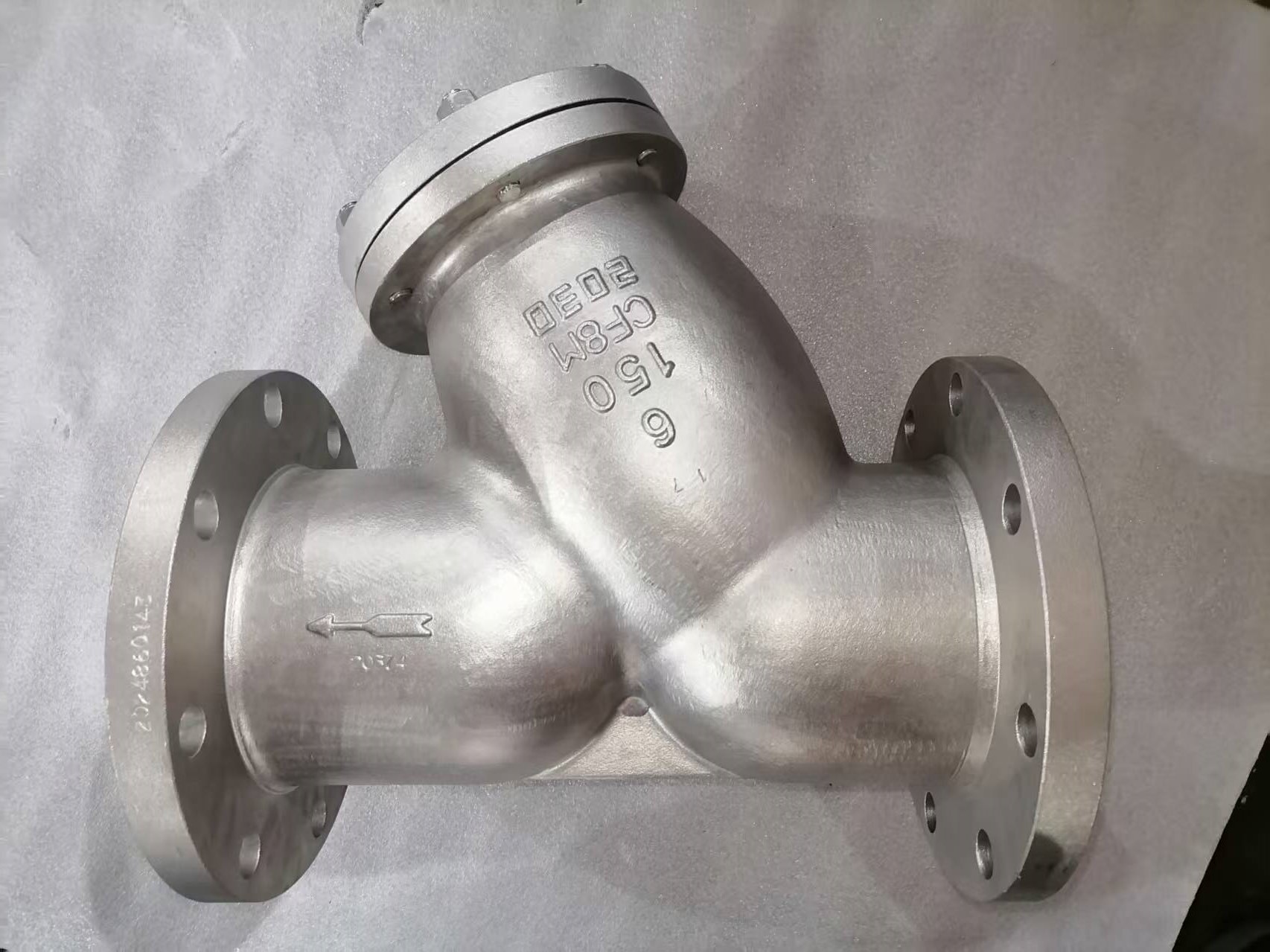
What the strainer actually does
Flow enters the body, turns into the branch and passes through the screen, then leaves through the outlet. Particles larger than the screen opening stay on the upstream face of the screen and collect in the pocket at the bottom of the branch. Because the pocket is outside the main flow path, debris does not have to be carried anywhere, it simply drops out of the stream.
Two construction details matter more than buyers expect. The first is the screen itself: most industrial units combine a perforated plate for mechanical strength with a woven wire mesh for fine retention, so the plate takes the differential pressure load and the mesh sets the filtration rating. The second is the blowdown connection on the pocket. On larger bores or dirty service, a valved drain at the bottom lets the maintenance crew flush the collected solids online, without pulling the screen.
Cleaning is normally by removing the screen and washing it, or by backflushing where the layout allows. What matters for the specification is that the screen is replaceable without cutting pipe, and that a spare screen set is on site.
Standards that actually apply to strainers
Strainers are fabricated piping components, so the standards that govern them are the piping and flange standards, not the valve product standards:
ASME B16.5 covers flange dimensions and pressure classes up to NPS 24. For NPS 26 and above, ASME B16.47 and MSS SP-44 take over, and large-diameter strainers on main headers need to be specified to that series rather than to B16.5, Bodies are available from Class 150 through Class 2500, in RF, FF, RTJ, NPT and socket weld ends.
ASME B36.10 and B36.19 set pipe dimensions and wall schedules for carbon steel and stainless steel respectively. They matter because the strainer bore has to match the line, otherwise a schedule mismatch quietly becomes a pressure-drop penalty.
ASME B31.3 governs fabrication, welding and examination of the pressure-containing shell. ASME B16.34 is used as the reference for pressure-temperature ratings of the body material group, since a strainer body is rated the same way a valve body is.
API 598 / EN 12266 covers shell and seat testing. API 598 is written for valves, and it is common practice to apply its test pressures and hold times to strainer shells by analogy; if the project insists on a strainer-specific protocol, state it in the RFQ.
MSS SP-25 covers marking, so the body carries heat number, material, size and rating in a readable place. For sour service, NACE MR0175 / ISO 15156 material certification is mandatory to avoid sulfide stress cracking, and it applies to the body, the screen and the gaskets, not only to the shell.
Body and screen materials
Material choice follows the medium, the operating temperature and the corrosion allowance, not the lowest quote. These are the grades we build most often:
WCB carbon steel covers water, steam and general oil service and is rated to about 425 Deg C under ASME B16.34 Group 1.1. LCB is the low-temperature variant for cold service. This is the default for most standard industrial jobs on a budget.
CF8 and CF8M stainless steel suit clean water, weak acids and mildly corrosive chemical streams, and are the usual choice where the downstream valve is stainless.
Duplex and super duplex (UNS S31803 and S32750) are the right answer for seawater, brine and desalination lines, and we see steady demand for these from Middle East marine and desalination projects.
Screen material is normally SS304 or SS316, with SS316L, F51 duplex, Monel and Hastelloy available where chlorides or reducing acids rule out the standard grades. A Monel screen in a seawater strainer with a carbon steel body is a classic mistake: the screen survives and the body does not.
The practical rule we give every client is to match the strainer body to the valve body in the same spool. A carbon steel strainer bolted to a stainless valve creates a galvanic couple at the flange, and the first sign of it is usually a leaking joint two seasons later. If the piping specification forces dissimilar materials, break the couple with an insulating gasket kit and record it in the line list.
Choosing the mesh size
Mesh is the single most misunderstood item in a strainer RFQ. The number refers to wires per inch, not particle size, so a finer number means a smaller opening. Approximate openings for standard woven mesh:
10 mesh: about 2.00 mm. 20 mesh: about 0.84 mm. 40 mesh: about 0.42 mm. 60 mesh: about 0.25 mm. 80 mesh: about 0.18 mm. 100 mesh: about 0.15 mm. 200 mesh: about 0.075 mm.
Select the mesh from the tolerance of what sits downstream, not from habit. A 20 mesh screen protects a resilient-seated gate valve perfectly well; putting a 200 mesh screen in the same line buys nothing and costs pressure drop plus cleaning frequency. As a working rule, 20 to 40 mesh covers general valve protection, 60 to 100 mesh suits control valves and meters with tight clearances, and 200 mesh only belongs in service where the medium is clean and the screen can be changed on a schedule.
Whatever the mesh, check the net open area. A coarse screen in a small body can have less open area than the pipe it serves, and the strainer becomes the flow restriction. In practice the screen open area should be well above the pipe cross-section so that the clean pressure drop stays small and the dirty margin is usable.
Sizing and pressure drop
Sizing a strainer by nominal bore alone is the shortcut that causes most of the complaints. Two numbers need to be separated:
Clean pressure drop, measured with a new screen at design flow. Keep this small, typically a fraction of a bar, so that the system has head left to give. If the clean loss is already significant, the strainer is undersized or the mesh is too fine for the duty.
Dirty pressure drop, the point at which the screen must be cleaned. This is the number that goes into the operating procedure, together with a differential pressure indicator or two gauge tappings across the strainer. A dirty allowance of 0.5 to 0.7 bar is a common band for process lines, but the acceptable figure belongs to your pump curve, not to a catalogue.
For lines carrying heavy solids, or on large bore where pulling a screen is a two-person job, specify the blowdown tap. It costs little at the factory and saves a shutdown later. For lines that must not stop at all, specify a duplex basket arrangement instead and switch duty without breaking the line.
Installation orientation
The pocket has to hang where gravity can work. A standard Y strainer is installed on a horizontal run with the branch pointing down, or on vertical piping with flow downward. Vertical upward flow is the layout we decline: solids cannot settle into the pocket, and the screen blinds off on its underside instead of collecting into a drainable sum. If the only available orientation is upward, a T-type or basket strainer with a top-entry screen is the better answer.
Leave access for the screen to be removed, keep the blowdown valve reachable from the platform, and insulate the body only up to the branch so the pocket stays visible during inspection. A strainer boxed in behind insulation is a strainer that gets cleaned when the plant shuts down, which is exactly what it was installed to prevent.
Y strainer or basket strainer?
This question comes up in almost every RFQ technical review, and neither answer is universally right:
A Y strainer has a small footprint and the lower purchase price. It suits continuous service with light to moderate solids and is the default protection device upstream of valves in normal piping layouts. Its limitation is holding capacity: the pocket fills, and it fills sooner than most people expect on a dirty line.
A basket strainer holds several times the solids before cleaning is needed, and the screen is usually larger and easier to service. It is specified for heavy fouling, large main lines and anywhere the strainer must stay in service for long intervals. The price is space, weight and cost.
A T strainer sits between the two on layout: flow runs straight through and the screen sits in a vertical branch, which suits certain horizontal headers better than a Y pattern. Our strainer product range covers Y, T and basket patterns so the three can be compared on the same datasheet.
Where they are used
Oil and gas gathering lines and wellhead valve packages. Boiler feedwater and steam piping in power stations. Municipal water treatment and seawater desalination plants. Fire protection piping networks, ahead of the alarm valve and the pump suction gate valve. Chemical dosing skids, where a blinded screen is easier to find than a damaged metering pump.
What to put in the RFQ
Design pressure class and maximum operating temperature. Service medium, including chlorides, H2S and solids content. Body and screen material, with the screen grade stated separately. Mesh size and the net open area requirement. Flange standard and size: B16.5 up to NPS 24, B16.47 or MSS SP-44 above it. End style: RF, FF, RTJ, NPT or socket weld. Blowdown port, yes or no, and its size. Differential pressure indication. Test standard and whether third-party witness is required. Documentation: material certificates, test reports, and marking to MSS SP-25.
Getting those eleven items onto one sheet removes most of the correspondence that follows a strainer enquiry, and it lets a supplier quote a comparable unit instead of a cheaper one that quietly differs on screen area.
Frequently asked questions
Can a Y strainer be used in steam service?
Yes. A WCB body with a stainless steel screen is the standard arrangement for saturated and superheated steam. State the steam condition and whether a blowdown connection is needed, because both change the body class.
What end connections are available?
Flanged ends in RF, FF and RTJ, NPT threaded ends, and socket weld ends. We build each unit to match the end style of the valves in the same spool so site fit-up stays simple.
Which mesh should I specify for a ball valve upstream line?
Usually 20 to 40 mesh. Finer screens do not protect a ball valve any better, and they cost pressure drop and cleaning time. Go finer only when a control valve, meter or close-clearance device sits downstream.
Does a strainer replace flushing?
No. Flushing removes the bulk of construction debris; the strainer catches what arrives afterwards. A strainer used as a substitute for flushing blinds off within days, and the resulting pressure drop is often mistaken for a valve problem.
Can NSW Valve supply strainers with the valve order?
Yes. The strainers are built to the same material and pressure class as the API 6D ball valves, API 600 cast steel gate valves and BS 1868 swing check valves in the same package, so one purchase order covers a compatible spool. Send the P&ID and flow data and our engineering team will quote the set.
Closing note
A strainer is the only component in the spool whose failure mode is visible, cheap and reversible: a blinded screen raises the differential pressure long before anything downstream is damaged. That is the whole argument for putting one upstream of every critical valve, and for specifying it properly instead of ordering it by bore size at the end of the project. If a valve is already sticking or leaking, the cause is often upstream of the valve, and the shutdown diagnosis guide covers what debris does to a valve that has been sitting closed. For material pairing on the rest of the line, the carbon steel valve selection guide covers WCB, A105 and NACE service.
For datasheets, 2D / 3D CAD drawings or a bundled quotation covering strainers and valves, send your line list to the NSW engineering team.
Post time: Nov-27-2026