


How to Verify a Fire-Safe Ball Valve Actually Holds in a Fire
Buyers ask us this almost every week: “You say the valve is fire-safe — how do I know it will really hold in a fire?”
It is a fair question, because “fire-safe” is one of the most overused claims in the valve industry. The honest answer has two parts: fire-safe is a design, not a material, and the design is only as trustworthy as the documented fire test behind it. This guide explains both — what API 607 actually proves, what to check inside the valve, and the specific evidence you should ask a supplier for before you order.
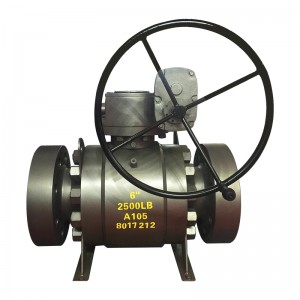
Fire-safe is a design, not a material
A fire-safe ball valve is a quarter-turn ball valve designed to keep limiting leakage when exposed to fire. Standard ball valves achieve bubble-tight shutoff with a soft seat — usually PTFE or another polymer. The problem is that these materials burn and degrade at elevated temperature. In a fire, a conventional soft-seated valve can leak through its seat, letting flammable media escape and feed the fire.
A fire-safe design adds a secondary metal-to-metal sealing path. In normal service, the soft seat does the sealing. When that seat burns away, the metal ball seats directly against the machined metal surface of the body, holding shutoff and holding leakage within an acceptable limit. That dual-sealing arrangement is exactly what a fire test like API 607 exists to prove.
Two things follow from this, and they matter more than any marketing claim:
• “Fire-safe” does not mean the valve comes out of a fire undamaged.
• It means the valve keeps limiting leakage during and after the fire — long enough for personnel to get out and for the incident to be brought under control.
That distinction is the whole point. If a supplier cannot show you the test, you are trusting an adjective.
What the API 607 test actually proves
API 607 — Fire Test for Quarter-turn Valves and Valves Equipped with Nonmetallic Seats — is the standard most buyers reference when specifying a fire-safe ball valve. The principle is simple: put a closed, pressurized valve in a real flame, then measure how much it leaks.
A typical test run follows four steps:
1. Closed and pressurized — the valve is closed and the body cavity is filled with the test medium under pressure.
2. In the flame — burners hold the valve at roughly 704 °C (1,300 °F) for about 30 minutes — long enough to burn away the soft seats and packing.
3. Cool down — the flame is cut, and the valve cools to ambient temperature.
4. Measure the leaks — two leak paths are checked: external leakage through the stem/body (packing) seal, and internal leakage through the seat. Each is compared against the limits in the standard. Pass both, and the valve is certified for that configuration.
API 6FA, briefly: pipeline valves built to API 6D are often held to a tougher standard — API 6FA — with higher temperatures, a longer burn, and stricter acceptance limits. NSW Valve’s fire-safe range is tested to API 607; API 6FA documentation is available for pipeline projects.
What actually changes inside a fire-safe valve
A genuine fire-safe ball valve differs from a standard valve in measurable design features, not in a certificate. Here is what you should verify when you open one up.
The metal secondary seat is the feature that matters most. The valve must have a machined metal sealing surface that the ball contacts after the soft seat burns away. Without it, the valve loses shutoff in a fire — and no certificate can make up for a design that is not there. The engineering drawing below (NSW Valve’s trunnion-mounted fire-safe design) shows the seat ring before and after fire exposure: the soft seat degrades, and the ball transfers to the metal sealing surface.
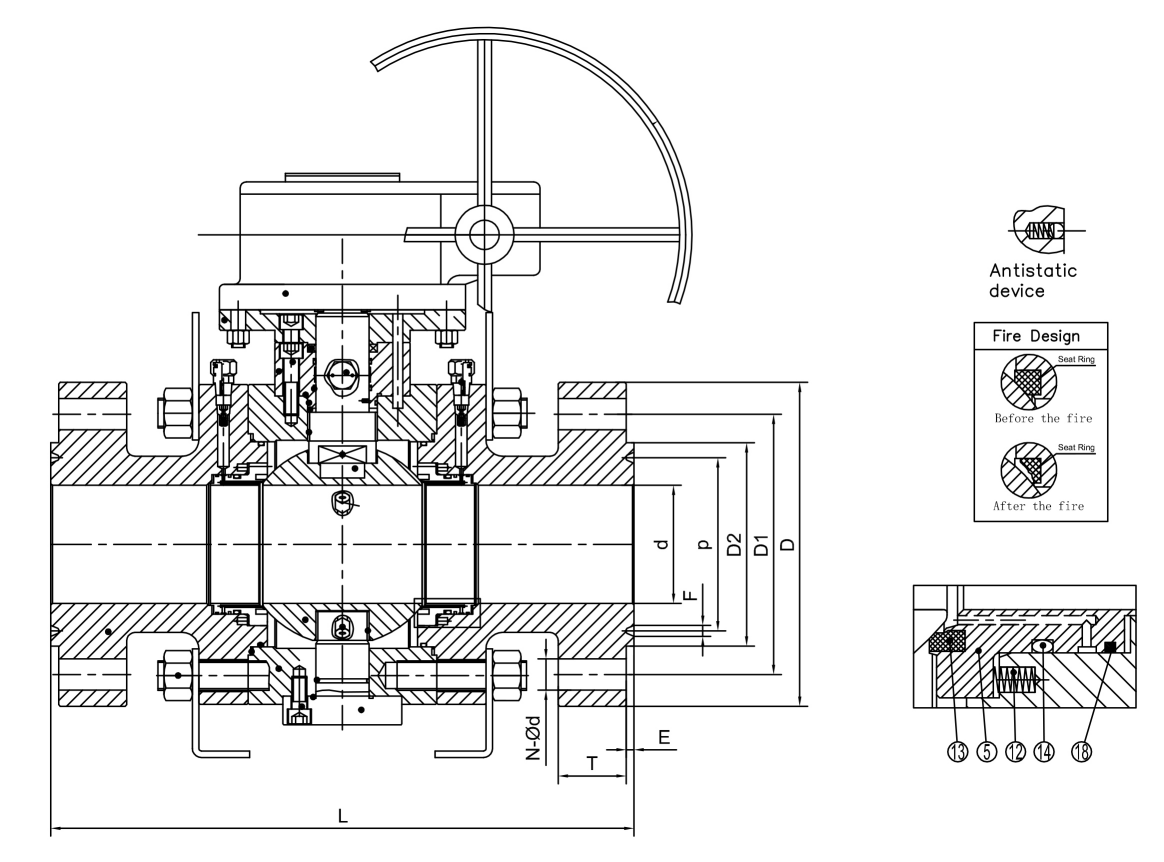
A fire test examines three leak paths, and each needs its own protection:
• Stem-to-body seal (packing area) — graphite packing is the standard choice for high-temperature integrity; PTFE packing will not survive the test.
• Body-to-bonnet / body joints — metal gaskets or fire-resistant seals.
• Ball-to-seat — the metal secondary seat described above.
Two more features matter in flammable service. The anti-blowout stem is mechanically retained so it cannot be ejected under pressure and heat, which would otherwise create a direct leak path. The anti-static device — spring-loaded and standard on fire-safe configurations — prevents static discharge between ball and body when handling hydrocarbons.
NSW Valve’s fire-safe ball valves are available in both floating and trunnion-mounted configurations, in carbon steel (WCB) and stainless steel (CF8/CF8M) bodies, with sizes from 1/2″ to 24″ and pressure classes from Class 150 to Class 2500.
Seat materials: PTFE vs RPTFE vs PEEK vs METAL
Seat material determines both normal-service sealing and fire behavior. Here is how the common options compare:
| Material | Max Continuous Temp (typical) | Fire Behavior | Typical Use |
|---|---|---|---|
| PTFE | ~180 °C | Burns/decomposes in fire; relies on metal secondary seat | Standard soft-seated ball valves |
| RPTFE (glass/carbon filled) | ~200–230 °C | Improved thermal stability; still needs metal backup | Higher-temp soft seat |
| PEEK | ~260 °C | Retains some integrity longer; limited fire resistance | Severe-service soft seat |
| Metal seat (hard-faced) | 400 °C+ | Fully fire-resistant; primary + secondary sealing in one | Fire-safe & severe service |
For fire-safe service, the accepted industry approach is a soft seat for normal operation plus a metal secondary seat for fire conditions. This combination gives bubble-tight performance in everyday service and certified leakage control in a fire. Purely metal-seated valves offer the highest fire resistance but typically need higher operating torque and can show higher seat leakage in normal service.
When do you need a fire-safe ball valve?
Fire-safe ball valves are required wherever flammable, combustible, or toxic media are handled and where fire is a credible scenario. Typical applications include:
• Oil & gas production and pipelines — crude, natural gas, condensate isolation
• Petrochemical and refinery plants — hydrocarbons, solvents, reactive media
• LNG and cryogenic terminals — where released gas can ignite rapidly
• Offshore platforms — fire risk plus compact layouts demand certified equipment
• Chemical plants — toxic or flammable chemicals requiring fail-safe isolation
To decide whether your project needs one, check the project specification, the process safety review, and insurance requirements. Most projects handling Class I flammable liquids — especially those governed by API 6D, ISO 10497, or local fire codes — will call for API 607 or API 6FA certified valves. When in doubt, specify the fire-safe version: the cost difference is small compared with the consequence of a fire.
How to verify a supplier’s fire-safe claim (the checklist)
Here is the exact evidence to ask for. A supplier that can produce all of it is worth dealing with; one that cannot is not.
1. Ask for the actual fire test certificate — not a claim. A real certificate names the test standard, the tested valve size and configuration, and the testing laboratory. Be suspicious of generic statements without a documented test report. Ask: “Can you send the API 607 certificate for this exact size and configuration?”
2. Verify the design features, not just the paperwork. Confirm the metal secondary seat, anti-blowout stem, graphite packing, and anti-static device are actually built into the valve you are buying. Some suppliers certify one design and manufacture another. Ask for a cross-section drawing and a photo of the actual product.
3. Check the manufacturing quality system. Look for ISO 9001 quality management plus applicable API certifications. A factory that controls material traceability and testing consistently is far more reliable for safety-critical valves.
4. Confirm test traceability on the shipment. Every fire-safe valve shipment should include material certificates, pressure test reports, and fire test documentation. Ask how the manufacturer traces each valve back to its test records — serial number, heat number, and certificate.
5. Evaluate delivery and support. Fire-safe valves are often on critical-path schedules. Choose a manufacturer with stable production capacity and responsive engineering support.
7. The evidence behind this article (NSW Valve)
We are not asking you to take our word for it. Here is what we ship with every fire-safe valve, and what you can inspect before you order:
• API607 Fire Safe Certificate
• Fire test documentation
• Cross-section engineering drawing of the metal secondary seat design
• Material certificates with heat numbers and full material traceability
• Pressure test reports for every valve
NSW Valve (Wenzhou Newsway Valve Co., Ltd.) manufactures fire-safe ball valves in a 10,000 m² factory with over 20 years of valve production experience. Our fire-safe designs are certified to API 607, with ISO 9001 quality management, CE-PED compliance, and API 6D pipeline capability. Contact us for API 607 fire-safe ball valve specifications and factory-direct pricing.
FAQ
Q1: What is the difference between API 607 and API 6FA?
API 607 applies to quarter-turn valves with nonmetallic seats, while API 6FA is a more stringent fire test for pipeline valves built to API 6D — higher temperature, longer burn, and stricter acceptance limits. Many pipeline projects require API 6FA in addition to API 607.
Q2: Can a fire-safe ball valve still provide bubble-tight shutoff in normal service?
Yes. Fire-safe valves use a soft seat for normal operation, giving bubble-tight shutoff. The metal secondary seat only engages in a fire, so everyday performance is not compromised.
Q3: Do fire-safe ball valves cost much more than standard ones?
The premium is modest relative to the safety benefit — typically a small percentage over a standard soft-seated valve, depending on size, material, and certification.
Q4: What materials are available?
WCB carbon steel and CF8/CF8M stainless steel bodies, with graphite packing and metal secondary seats as standard fire-safe features. Special alloys are available for corrosive media.
Q5: What is the lead time for API 607 certified ball valves?
Standard sizes ship within 7–15 days; custom fire-safe specifications typically take 25–40 days depending on size, material, and quantity.
Q6: Can you provide the fire test certificate with the shipment?
Yes. API 607 fire test documentation, material certificates, and inspection reports accompany every fire-safe valve order.
Conclusion
A fire-safe ball valve is not a luxury — it is a requirement wherever flammable media meet high consequences. What separates a genuine fire-safe valve from a look-alike is two things you can verify: a real metal-to-metal secondary seat and a documented API 607 fire test certificate. Ask for both, on the exact configuration you are buying, and you will never need to take a supplier’s word again.
At NSW Valve, fire-safe ball valves are standard engineering, not a special request. With over 20 years of manufacturing experience, API 607 certified designs, and full inspection documentation on every shipment, we help engineering and procurement teams specify the right valve the first time.
If you are sourcing API 607 fire-safe ball valves for a project, send us your size, pressure class, material, and quantity to sales1@nswvalve.com — we will respond within 24 hours with a specification and factory-direct pricing.
Post time: Nov-03-2026