


When specifying industrial valves for harsh media, high pressure, or critical shutoff applications in oil, gas, chemical, and power plants, compliance with API standards is paramount. An API 609 butterfly valve is designed, manufactured, and tested to meet the stringent standards set by the American Petroleum Institute. This technical guide breaks down the core structural classifications, design categories, material selection, and pressure-temperature capabilities of API 609 butterfly valves to help mechanical engineers and procurement specialists make informed sourcing decisions.
API 609 Certificate Sample:
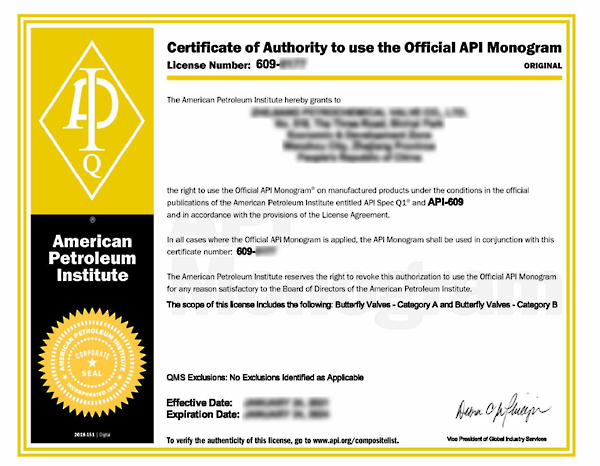 To verify the authenticity of API license, go to the www.api.org/compositelist
1. What is the API 609 Standard?
API 609 (full standard title: “Butterfly Valves: Double-Flanged, Lug- and Wafer-Type”) is the global benchmark for designing and dimensioning butterfly valves used in heavy-duty industrial pipelines. The latest edition is API 609-2021 (8th Edition), which expands specifications to include butt-weld end designs. The standard governs key design aspects, including:
- Face-to-Face & End-to-End Dimensions: Ensures exact dimensional interchangeability with ASME B16.5 and ASME B16.47 flanges.
- Wall Thickness & Body Integrity: Structural integrity built to withstand pressure ratings from Class 150 up to Class 600.
- Blowout-Proof Stem Requirements: Ensures safety by preventing internal pressure from ejecting the stem during operation.
- Actuator Mounting: Standardization (typically aligned with ISO 5211) for seamless automation using gear, pneumatic, or electric actuators.
2. API 609 Category A vs. Category B: Key Differences
The API 609 standard divides butterfly valves into two distinct engineering classifications based on design geometry, pressure capabilities, and sealing mechanism: Category A and Category B.
| Feature | Category A (Resilient-Seated) | Category B (High-Performance / Offset) |
|---|---|---|
| Design Type | Concentric (Zero-Offset) | Double-Offset / Triple-Offset (TOV) |
| Pressure Class | Class 125 / Class 150 (up to 285 psi) | Class 150 / Class 300 / Class 600 (up to 1,480 psi) |
| Sealing System | Soft Seat (EPDM, NBR, FKM) | High-Performance PTFE, RTFE, or Metal-to-Metal |
| Stem Motion | Single-axis rotation with continuous disc-seat contact | Camming action; disc disengages seat upon opening |
| Max Temperature | Up to +120°C (248°F) depending on elastomer | Up to +538°C (1000°F) with metal seats |
| Leakage Rating | ANSI/FCI 70-2 Class VI (Bubble-Tight) | ANSI/FCI 70-2 Class IV, V, or VI |
| Fire-Safe Option | No | Yes (Fire-tested per API 607 / API 6FA) |
| Best For | Water treatment, HVAC, low-pressure utilities | Oil & Gas, Petrochemical, Refinery, High-Temp Steam |
Category A: Concentric Butterfly Valves
Category A valves feature a disc centered within the pipe bore. The disc compresses into a resilient rubber liner (EPDM, NBR) to form a seal. They offer a cost-effective solution for lower-pressure utility applications where high temperatures and harsh chemical erosion are not factors.
Category B: High-Performance & Triple-Offset Butterfly Valves
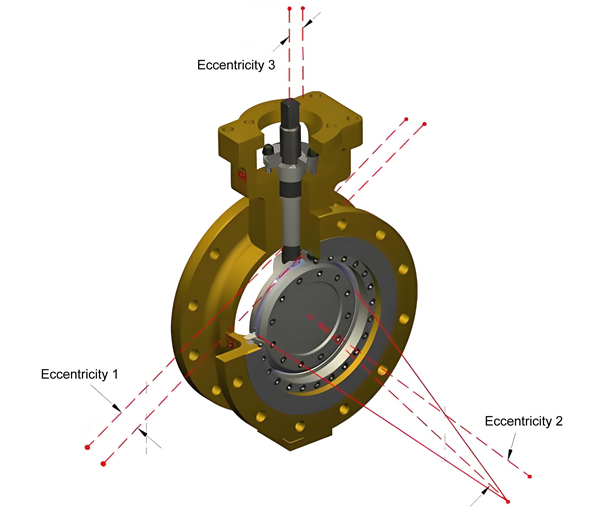
Category B covers eccentric disc geometry. The double- or triple-offset shaft moves the disc clear of the seat immediately upon opening. This design reduces seat friction, minimizes operational torque, extends service life, and enables bi-directional bubble-tight shutoff under extreme temperature and pressure conditions. For critical high-temperature services, Triple-Offset Valves (TOV) with metal-to-metal seats are the industry standard. For more detailed specifications on our triple-offset product line, please refer to our [Triple Offset Butterfly Valve Series].
3. End Connection Options
Selecting the right end connection depends on line location, maintenance needs, and system design:
| API 609 End Configurations | ||
|---|---|---|
| Wafer Type | Lug Type | Double-Flanged |
| Lightweight; clamped between pipeline flanges | Threaded lugs allow dead-end pipeline service | Bolted directly; structural rigidity |
- 1 Wafer Style: Lightweight and compact. Positioned between pipe flanges using long stud bolts. Ideal for space-constrained installations.
- 2 Lug Style: Features threaded inserts on the valve body outer perimeter. Allows single-side flange removal during downstream pipeline maintenance (dead-end service).
- 3 Double-Flanged Style: Features integrated flanges at both ends. Preferred for large-diameter pipelines (NPS 24 and above) to provide structural stability and reduce pipe strain.
4. Material Selection & Operating Specifications
Selecting materials for an API 609 butterfly valve requires matching body metallurgy and seat material to your process medium. For a comprehensive overview of our material capabilities, explore our Stainless Steel Butterfly Valve Series and Duplex Butterfly Valve Series.
Body & Disc Materials
| Material | Grade | Temperature Range | Best For |
|---|---|---|---|
| Carbon Steel | ASTM A216 WCB | -29°C to 427°C (-20°F to 800°F) | Non-corrosive hydrocarbons, steam, industrial water |
| 316 Stainless Steel | ASTM A351 CF8M | -29°C to 538°C (-20°F to 1000°F) | Organic acids, seawater, harsh chemicals |
| Duplex / Super Duplex | 4A, 5A | -46°C to 427°C (-50°F to 800°F) | Marine environments, offshore, sour gas (NACE MR0175) |
Seat & Sealing Materials
| Material | Temperature Limit | Application |
|---|---|---|
| RPTFE (Reinforced PTFE) | Up to 230°C (446°F) | Chemical processing, medium-pressure steam |
| Metal-to-Metal (Stellite / SS316 + Graphite) | Up to 538°C (1000°F) | Refinery lines, hydrocrackers, fire-safe services |
5. Industrial Applications
API 609 butterfly valves play a vital role in isolating and regulating flow across critical process industries:
| Industry | Typical Application | Recommended Valve Type |
|---|---|---|
| Petroleum & Refining | Heavy crude lines, FCCU catalyst lines, high-pressure steam | Category B, Class 300/600, Metal-seated TOV |
| Chemical & Petrochemical | Corrosive solvent lines, acid transport | Category B, PTFE-lined or 316 SS, Double-offset |
| Power Generation | Main cooling water, boiler feedlines, condenser isolation | Category A or B based on pressure/temperature |
| Water & Municipal | Treatment plants, desalination, pumping stations | Category A, Wafer or Lug, EPDM-seated |
6. How to Specify API 609 Butterfly Valves (RFQs)
To obtain an accurate quotation and engineering review, include the following parameters in your RFQ specification sheet:
- 1 Standard: API 609 (Specify Category A or Category B)
- 2 Nominal Size: e.g., NPS 8 (DN 200)
- 3 Pressure Rating: Class 150 / Class 300 / Class 600
- 4 Body Style: Wafer / Lug / Double-Flanged
- 5 Body Material: ASTM A216 WCB / ASTM A351 CF8M / Duplex
- 6 Disc & Stem Material: 316 SS / 17-4PH / Monel
- 7 Seat Material: RPTFE / Metal-Seated (Stellite)
- 8 Testing & Certification: API 598 Shell & Seat Test, API 607 Fire-Safe Test
- 9 Operation: Bare shaft with ISO 5211 top flange / Lever / Worm Gearbox / Actuator
Technical Support & Custom Manufacturing
As a specialized valve manufacturer, NSW Valve produces API 609 Category A and Category B butterfly valves engineered for demanding industrial environments. Every valve undergoes 100% pressure and seat leakage testing in accordance with API 598 prior to shipment.
Need a quick selection guide for your next project?
Download our API 609 Valve Sizing & Selection Checklist (PDF) to ensure you specify the correct valve for your critical application.
For engineering consultation or a customized quote, please Contact the NSW Valve Engineering Team.
When specifying industrial valves for harsh media, high pressure, or critical shutoff applications in oil, gas, chemical, and power plants, compliance with API standards is paramount. An API 609 butterfly valve is designed, manufactured, and tested to meet the stringent standards set by the American Petroleum Institute.
This technical guide breaks down the core structural classifications, design categories, material selection, and pressure-temperature capabilities of API 609 butterfly valves to help mechanical engineers and procurement specialists make informed sourcing decisions.
Post time: Jul-14-2025