


1. What are High Performance Butterfly Valves
High performance butterfly valve refers to a new type of butterfly valve product that improves the sealing and wear resistance of butterfly valves, increases high temperature resistance and corrosion resistance, and improves service life and reliability based on ordinary butterfly valves (Concentric butterfly valves and triple eccentric butterfly valves) by improving structure and materials. Compared with ordinary butterfly valves, high performance butterfly valves have longer life, lighter torque, wider application pressure range, and better sealing performance.
High performance butterfly valves (HPBVs) represent an advanced evolution of the standard butterfly valve design. Engineered for superior sealing, durability, and control in critical applications, they feature offset disc geometries (double or triple eccentric) and utilize metal-to-metal or resilient seated seals. Unlike their concentric counterparts, high performance butterfly valves excel in handling high pressures, extreme temperatures, corrosive media, and provide bubble-tight shut-off, making them indispensable in modern industrial processes.
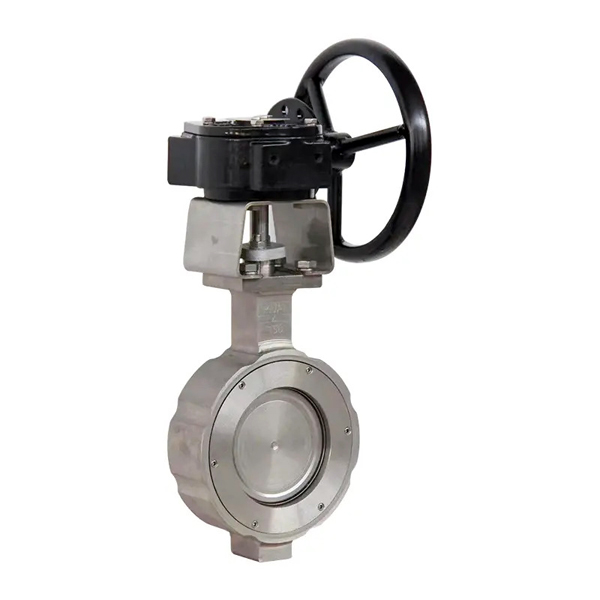
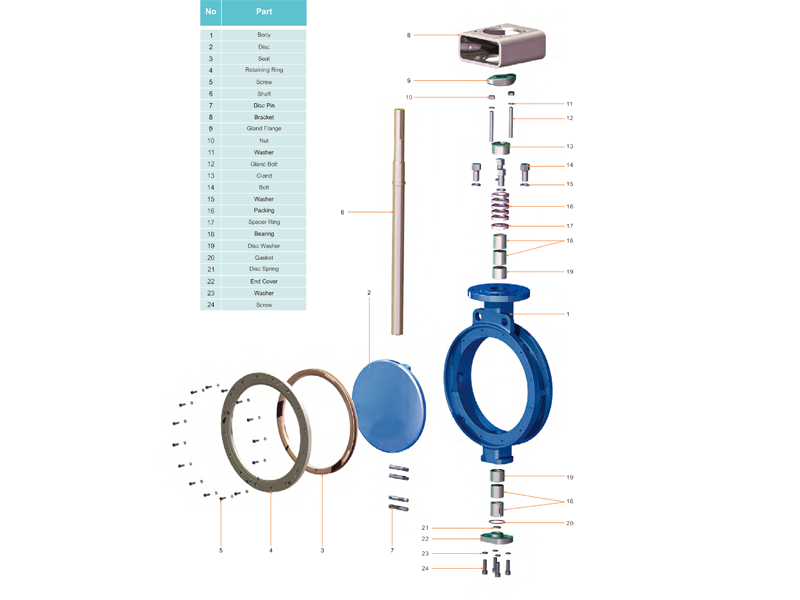
1.1 Key Components of Butterfly Valve: Body, Disc, Stem, Seat, and Actuator Connection
The core components of a butterfly valve fall into five major categories: the valve body, butterfly disc, valve stem, sealing seat, and actuator connection parts.
• Valve Body: The valve body serves as the main outer shell, bearing pipeline pressure and medium loads while acting as the mounting base for all other components. It is available in wafer and lug-type configurations, commonly made from cast iron, carbon steel, or stainless steel.
• Valve Disc: The butterfly disc is the critical component for opening, closing, and throttling. Its disc-shaped design, available in concentric or eccentric structures, directly determines sealing performance and wear resistance. It must resist corrosion and erosion.
• Valve Stem: The valve stem transmits power, connecting the actuator to the disc to enable rotational movement. It is typically made of stainless steel, with reinforced and oversized designs for large-diameter, high-pressure applications to prevent bending or deformation.
• Valve Seat:The sealing seat is key to leak-tight closure. It comes in soft-sealing rubber or hard-sealing metal materials, fitting tightly against the disc to achieve zero leakage.
• Actuator: The actuator connection components include handles, worm gears, and electric/pneumatic actuators. They provide the necessary torque for opening and closing, accommodating manual operation as well as automated remote control. All components work together to ensure stable operation, reliable sealing, and precise regulation of the butterfly valve.
1.2 Structural Design Principle Analysis of High-Performance Butterfly Valve
A high-performance butterfly valve is a precision-engineered lined butterfly valve, ideally suited for regulating or controlling flow and pressure in applications such as tap water, industrial water, wastewater, air, HVAC, city gas, and LPG. When closed, the valve achieves zero leakage.
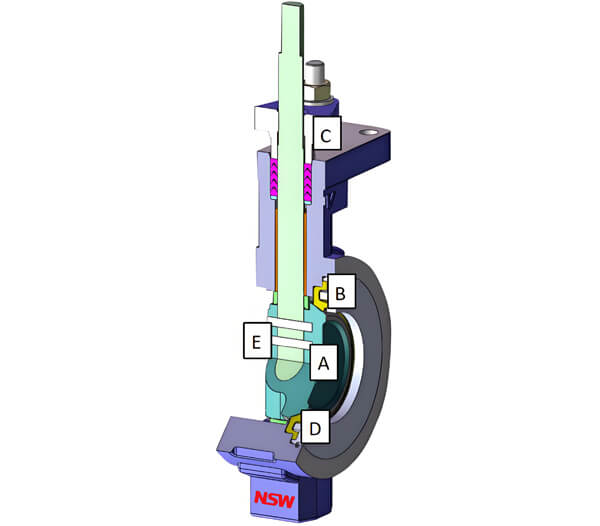
The valve seat structure features a patented COS curve sealing design, which reduces friction between the disc and seat, lowers actuator torque, and extends seat life. Its sealing process is similar to that of a double-eccentric valve. The sealing surface of the disc is spherical, ensuring smooth contact during sealing. Reduced friction, especially at the shaft seal, greatly prolongs seat service life. A metal retaining ring inside the seat ring automatically closes any gap between the stem and seat ring when the stem is subjected to unbalanced forces, eliminating the possibility of axial leakage.
• COS Curve: The COS curve sealing design ensures no torque increase before sealing occurs. At the moment of sealing, the disc contacts the seat ring simultaneously across the full 360° circumference, reducing friction, lowering torque, extending seat life, and maintaining zero leakage over long-term operation. The reduced friction and torque allow the use of lower-power actuators, lowering user costs.
• Spherically Machined Disc: The disc is machined to a complete spherical shape, with every part of the sealing surface forming a segment of a sphere. Both the disc and the seat ring are processed to the same spherical contour, resulting in minimal clearance and no friction. The disc rotates smoothly, even at the axial sealing surfaces at the top and bottom. Despite contact, the sealing surfaces are extremely smooth, reducing torque and enhancing sealing performance.
• High-Performance PTFE-Lined Butterfly Valve: This valve features a PTFE-lined body cavity and is widely used in food, biopharmaceutical, electronics, and other sanitary applications for regulating or controlling flow and pressure of various fluids, as well as in chemical industry applications involving strong acids, strong alkalis, and highly corrosive gases. It offers superior durability, excellent sealing performance, and outstanding corrosion resistance, achieving zero leakage when closed.
• I-Type Seal Design: The seal ring design keeps rubber and Teflon independent yet complementary, enhancing sealing performance. The use of rubber adds elasticity to the seal while reducing the amount of rubber required, eliminating the risk of disc jamming in the closed position due to rubber expansion from temperature rise.
Enhanced Sealing Performance of the New High-Performance Butterfly Valve Design:
a. PFA lining with a thickness of 3 mm or more effectively prevents permeation of various gases and offers strong corrosion resistance.
b. Springs are added to both the upper and lower packing boxes to overcome the effects of temperature fluctuations on sealing.
2. High Performance vs. Standard Butterfly Valves: Key Differences
Standard concentric butterfly valves have limitations. Here’s how High Performance Butterfly Valves stand apart:
| Feature | Standard Butterfly Valve | High Performance Butterfly Valve (HPBV) |
| Disc Design | Concentric (stem through disc center) | Double or Triple Offset (eccentric stem) |
| Sealing | Primarily rubber/elastomer seat | Metal-seated or advanced composite seats |
| Pressure | Low to Medium (e.g., PN10-PN16) | Medium to Very High (e.g., PN16 to PN100/ASME 600+) |
| Temperature | Limited by elastomer seat | Very High (Limited by seat/body material) |
| Shut-off | Good (soft seat) / Poor (metal disc) | Bubble-tight (Zero Leakage) |
| Application | Water, Air, Low-Pressure Fluids | Steam, Hydrocarbons, Chemicals, Power, Severe Service |
3. Key Advantages of High Performance Butterfly Valves
Choosing high performance butterfly valves delivers significant operational benefits:
3.1. Bubble-Tight Shutoff: Achieves zero leakage, critical for safety, emissions control, and process integrity.
3.2. High Pressure & Temperature Capability: Handles demanding conditions far beyond standard valves.
3.3. Reduced Torque & Wear: The eccentric design minimizes friction during operation, lowering operating torque and extending seat/disc life.
3.4. Bi-Directional Sealing: Effectively seals against flow from either direction.
3.5. Long Service Life: Robust metal seats and advanced materials ensure durability in abrasive or corrosive services.
3.6. Lower Lifecycle Cost: Reduced maintenance, longer replacement intervals, and reliable performance offset the higher initial investment.
3.7. Throttling Capability: Offers better flow control characteristics compared to standard butterfly valves, especially triple offset designs.
4. Types of High Performance Butterfly Valves
High performance butterfly valves are primarily classified by their disc offset design:
4.1. Double Offset Butterfly Valves (Double Eccentric):
The stem is positioned behind the disc centerline (1st offset) and off the pipe centerline (2nd offset). This creates a cam action, lifting the disc seal completely away from the seat during the first 10° of opening, minimizing wear. Ideal for resilient or metal seats in moderate to high-pressure applications.
4.2. Triple Offset Butterfly Valves (TOV / Triple Eccentric):
Incorporates the two offsets of the double offset design plus a third offset: the conical geometry of the seating surface. This ensures pure metal-to-metal contact, eliminating friction throughout the entire operation. Triple Offset Butterfly Valves excel in the most severe services – extreme temperatures, high pressures, corrosive media, and where fire-safe certification is required (API 607/API 641). They are the pinnacle of high performance butterfly valves.
5. Materials, Sizes, and Pressure Ratings
High performance butterfly valves offer extensive customization:
5.1. Valves Materials:
• Body/Disc: Carbon Steel (WCB, LCC), Stainless Steel (304, 316, 316L), Duplex/Super Duplex (2205, 2507), Alloy 20, Hastelloy, Titanium. Coatings (Xylan, PFA) for corrosion resistance.
• Seat: Stainless Steel, Inconel, Stellite (metal); PTFE, RPTFE, Graphite, PEEK (composite/resilient). Fire-safe designs (API 607/641) common.
• Stem: Stainless Steel (17-4PH, 316), Duplex Steel.
5.2. Valve Sizes:
Typically range from 2 inches (DN50) up to 60 inches (DN1500) or larger for specialized applications.
5.3. Pressure Ratings:
• Commonly conform to ASME Class (150, 300, 600) or PN ratings (PN16, PN25, PN40, PN63, PN100).
• Triple offset butterfly valves can achieve Class 600, 900, 1500, or higher.
6. Applications of High Performance Butterfly Valves
The robustness and tight sealing of high performance butterfly valves make them suitable for diverse demanding industries:
→ Oil & Gas (Upstream, Midstream, Downstream – pipelines, refineries, platforms)
→ Petrochemical & Chemical Processing
→ Power Generation (Fossil, Nuclear, Biomass – steam, feedwater, cooling)
→ LNG & Cryogenic Services (Specialized designs)
→ Pulp & Paper
→ Marine & Shipbuilding
→ Water & Wastewater Treatment (High-pressure sections, sludge)
→ HVAC (High-pressure steam systems)
7. Leading High Performance Butterfly Valve Manufacturers
Selecting a reputable High Performance Butterfly Valves Manufacturer is crucial for reliability and support. Key global and China high performance butterfly valves manufacturers include:
* Global Leaders: Flowserve (Argus, Durco), Emerson (Keystone), Crane (Xomox), Bray, NSW Valve, Velan (Cortec), IMI Critical Engineering.
* Leading China High Performance Butterfly Valve Manufacturers: Neway Valve (Suzhou), NSW Valve, Yuanda Valve, KMC Controls, VAT Vakuumventile AG (China operations). Many China high performance butterfly valves manufacturers offer competitive quality and pricing, often specializing in double offset butterfly valves and increasingly sophisticated triple offset butterfly valves.
8. Conclusion
High Performance Butterfly Valves, particularly double offset butterfly valves and triple offset butterfly valves, are engineered solutions for critical fluid control where standard valves fall short. Their superior sealing, high pressure/temperature tolerance, longevity, and versatility make them essential across oil & gas, power, chemical, and other heavy industries. When sourcing, consider both established global brands and the growing capabilities of China High Performance Butterfly Valves manufacturers to find the optimal balance of performance, reliability, and value for your specific application requirements.
Post time: Jun-07-2025