


If you’ve ever dealt with backflow in a pumping system, you already know how annoying – and expensive – it can be. One of the simplest, most reliable solutions is a Ball Check Valve. It’s not the flashiest component in your piping layout, but when it works, you barely notice it. That’s the point.
In this article, I’ll walk you through what a ball check valve really does, how it compares to other valves you might be considering, and why sometimes the old-school rolling ball is still the best choice.
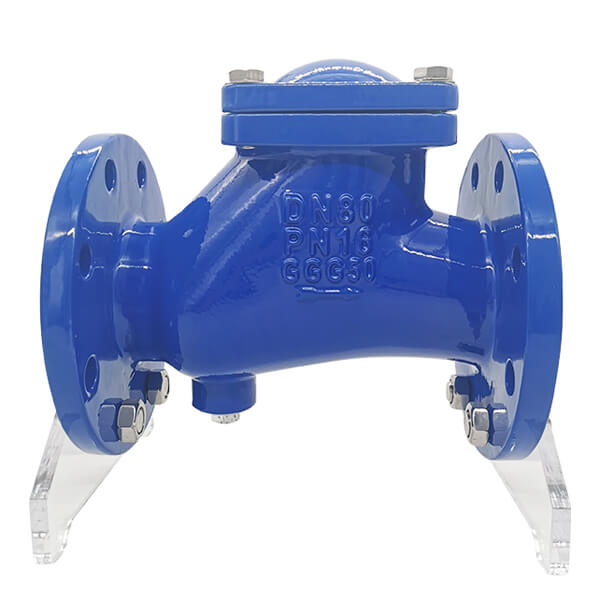
What Is a Ball Check Valve? (Introduction)
A Ball Check Valve is a type of Non-return Valve. It lets fluid flow in one direction and automatically blocks reverse flow. The sealing element is – you guessed it – a ball. Usually made of stainless steel, rubber, or sometimes a plastic like PTFE.
Unlike a gate valve or a ball valve (the kind with a lever), a ball check valve needs no handle, no actuator, and no manual intervention. It works entirely on pressure differences.
How a ball check valve works (basic mechanism)
Inside the valve body, there’s a cavity where the ball sits freely. When fluid comes in from the inlet side, it pushes the ball off its seat. Fluid flows around the ball and out through the outlet. When the inlet pressure drops or reverse flow tries to happen, the ball gets pushed back against the seat. That seals the opening. No backflow.
It sounds simple because it is. And that simplicity is exactly why these valves are so hard to kill.
The role of the ball as a sealing element
The ball does double duty. It’s both the moving part and the seal. If the seat is machined properly and the ball is round (which sounds obvious, but cheap valves sometimes fail here), the contact surface creates a tight shut-off. For dirty fluids or liquids with small particulates, a rubber-coated ball can actually seal better than a metal one because it compresses slightly into the seat.
How Does a Ball Check Valve Operate?
Let’s get a little more detailed about the mechanics. Because if you’re sizing a valve for a real system, you need to know what’s happening inside.
Mechanics of the Check Ball Valve
When the pump starts, fluid velocity creates a pressure differential. Inlet pressure rises, outlet pressure is still low. That difference lifts the ball. The ball doesn’t need to lift very far – usually just a few millimeters. That’s why ball check valves have a low cracking pressure. Once the flow stops or reverses, gravity and back pressure roll the ball back into the seat.
In horizontal installations, gravity helps the ball fall back. In vertical lines (flow upward), the ball drops back when the pump stops. Some designs add a light spring to assist seating in low-pressure systems.
Key Components
A basic ball check valve has only three essential parts: the body, the ball, and the seat. That’s it. No springs, no hinges, no diaphragm. Some variants add a spring (spring-loaded ball check) for faster response, but the classic “free-ball” design is as simple as a valve gets.
The body can be plastic (PVC, CPVC), brass, stainless, or cast iron. The seat is often machined into the body or made of a separate soft material like NBR or EPDM.
Ball Check Valve Diagram
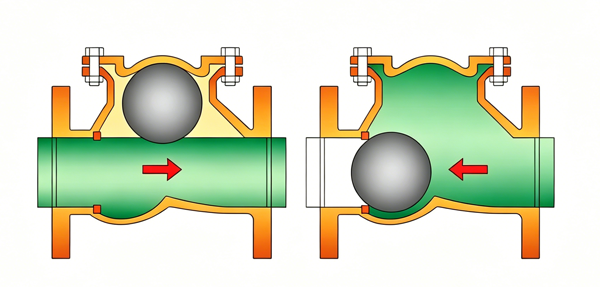
(If you’re looking at an actual diagram right now – imagine it.)
Picture a horizontal pipe. On the left is the inlet. The valve body bulges slightly in the middle to create a chamber. Inside that chamber, a ball sits against the left-side seat when closed. When flow enters from the left, the ball moves to the right, uncovering the opening. Fluid passes around the ball through a larger bore. When flow stops, the ball rolls back left.
That “bulge” is the key difference from a regular pipe. Without it, the ball couldn’t move out of the way.
Ball Check Valve vs. Other Valve Types
I often see people confuse ball check valves with other valves. Let’s clear that up.
Ball Check Valve vs. Swing Check Valve
A swing check valve uses a hinged disc that swings open and closed. It works fine for clean water or air, but the hinge can jam from debris. Ball check valves don’t have hinges. If a bit of grit gets in, the ball can usually roll over it or trap it in the bottom of the cavity without losing the seal.
Another difference: swing checks need higher flow to stay open. At low flow rates, the disc can flutter, causing wear. A ball check valve opens fully even at low flows because the ball rolls completely out of the way. However, swing checks generally have lower pressure drop when fully open. So if you’re moving high volumes of clean fluid, a swing check might be more efficient. For dirty or intermittent flow, ball check wins.
Ball Check Valve vs. Regular Ball Valve
This is a common confusion. A regular ball valve (the one with a quarter-turn handle) is not a check valve. It’s a shut-off valve. You turn the handle to align a hole in the ball with the pipe bore. It stays where you put it. It does not automatically close when flow reverses.
A ball check valve has no handle. It’s automatic. You cannot “open” or “close” it manually. So when someone asks for a “ball valve” in a backflow prevention application, make sure they actually mean a ball check valve. Otherwise, you’ll have a big mess when the pump stops.
Key Applications of Ball Check Valves
Ball check valves show up in places where reliability and dirt tolerance matter more than absolute efficiency.
Non-return Valve Capabilities
As a non-return valve, the ball check excels in pump discharge lines. Think sump pumps, irrigation systems, and chemical dosing pumps. It prevents the pumped fluid from draining back into the tank when the pump shuts off. That means the pump doesn’t have to re-prime every time it starts.
I’ve seen ball checks used in bilge pumps on boats for decades. Salt water, debris, intermittent operation – the little rubber ball just keeps working.
High-pressure Check Valve Applications
When pressures go above 1,000 psi, many check valves struggle. Spring-loaded poppet valves can fatigue. Swing checks can slam. But a floating ball check valve – especially with a metal ball and hardened seat – can handle very high pressures. The ball distributes the sealing force evenly around the seat, unlike a poppet that concentrates stress on a small ring.
You’ll find high-pressure ball check valves in hydraulic systems, high-pressure washers, and reciprocating compressor discharge lines. Some are rated up to 10,000 psi.
Floating Ball Check Valve – A Detailed Overview
The term “floating ball check valve” sounds fancy, but it just means the ball isn’t guided by a stem or cage. It’s free to move laterally and rotate. Why does that matter? Because a floating ball can spin. As fluid flows past, the ball rotates randomly. That distributes wear evenly around its surface. A guided ball, by contrast, wears on the same spot and eventually leaks.
Floating ball designs also tolerate misalignment. If the valve body gets slightly warped from heat or overtightened flanges, the ball still finds the seat. A rigid poppet wouldn’t.
One downside: floating balls can sometimes “chatter” at very low flow rates if the ball bounces between seat and stop. But in practice, that’s rare unless the fluid is almost stationary.
Advantages of Using Ball Check Valves
Let me sum up why so many engineers reach for a ball check valve first.
Simple, reliable sealing – Fewer moving parts means fewer failures. No springs to break. No hinges to rust.
Low maintenance – When a ball check valve finally wears out (after years), you usually just replace the ball and seat. Some designs let you do that without removing the valve from the line.
Suitable for viscous or dirty fluids – The ball can push aside small solids. A swing check would get jammed. A diaphragm check would tear.
Compact design – Ball checks are often shorter than swing checks. That matters in tight pump skids or marine applications.
One thing to watch: ball check valves do require a certain minimum flow to stay open. At extremely low flows (trickles), the ball may not lift fully, and you’ll get some restriction. But for most industrial and municipal applications, that’s not a problem.
Conclusion: Selecting the Right Ball Check Valve for Your System
So, how do you pick the right one?
First, look at your fluid. Clean water? Almost any material works. Saltwater or chemicals? Go with plastic or stainless. Slurries? Use a rubber-coated ball and a soft seat.
Second, check your pressure and temperature. Standard PVC ball checks max out around 140°F and 150 psi. Metal ones go much higher.
Third, think about orientation. Horizontal pipe with flow left to right? Perfect. Vertical with flow upward? Also fine. Vertical with flow downward? Don’t do it – the ball will just fall onto the seat and stay closed.
Finally, consider the cracking pressure. If your system has very low differential pressure, look for a lightweight ball (plastic) or a spring-assisted design.
A ball check valve isn’t the right answer for every single backflow problem. But for most pumps, drains, and dirty fluid lines, it’s a workhorse that will outlast the rest of the system. And when you install one, you’ll probably forget it’s even there – which is exactly what you want from a check valve.
—
*If you’re sizing a ball check valve for a specific application, always check the manufacturer’s flow coefficient (Cv) data. A valve that’s too small will keep the ball lifted all the time and may not seal properly. A valve that’s too large will let the ball bounce. Get it right, and it’ll run for years without a single service call.*
Post time: Apr-11-2026