


What Is a Pneumatic Valve?
Definition of a Pneumatic Valve
A Pneumatic Valve is a type of industrial control valve driven by compressed air. By converting air pressure into mechanical motion, the actuator opens, closes, or adjusts the valve to control the flow of liquids, gases, steam, or corrosive media.
Common designs include pneumatic ball valves, butterfly valves, gate valves, and fast-acting shut-off valves.
Working Principle of Pneumatic Valves
Compressed air enters the actuator chamber, pushing a piston or diaphragm. This motion drives the stem to rotate or move linearly, causing the valve to open or close. In automated systems, the actuator is controlled by PLC or DCS signals for precise flow management.
Typical Media
-
Air and inert gases
-
Process water and industrial liquids
-
Steam systems
-
High-temperature, corrosive, or hazardous chemicals
Functions and Advantages of Pneumatic Valves
Main Functions
Automated On/Off Control
Pneumatic valves enable reliable remote operation in industrial pipelines, eliminating the need for manual intervention.
Accurate Modulating Control
When fitted with a positioner, the valve can deliver stable and repeatable control of flow, pressure, or temperature.
Key Advantages
Fast Response Time (Often < 1 Second)
Ideal for emergency shutdown and protective systems.
High Safety With Natural Explosion-Proof Properties
Because the actuator uses air instead of electricity, it can be safely applied in hazardous zones.
Long Service Life and Low Maintenance
The mechanism is simple, with fewer parts susceptible to failure.
Suitable for Large-Diameter and High-Pressure Pipelines
Pneumatic ball and butterfly valves perform especially well in these demanding applications.
Main Components of Pneumatic Valves
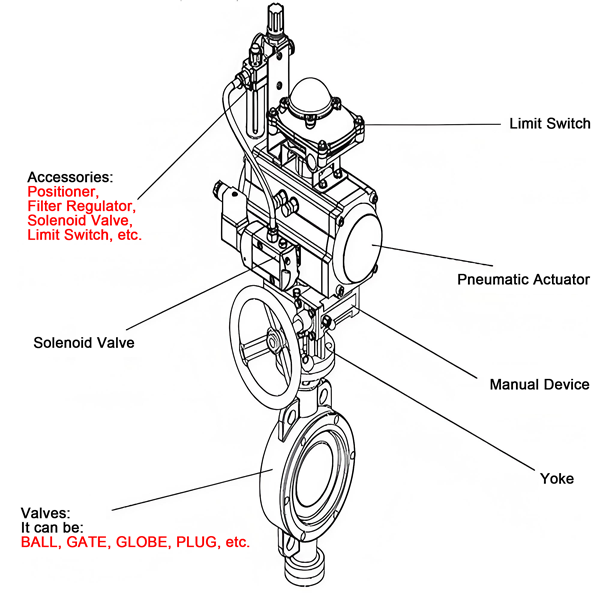
Pneumatic Actuator
Single-Acting Actuator (Spring Return)
Uses a spring to return to a safe fail-close or fail-open position during air loss.
Double-Acting Actuator
Air is supplied to both sides of the piston, providing greater torque and smoother operation.
Valve Body Types
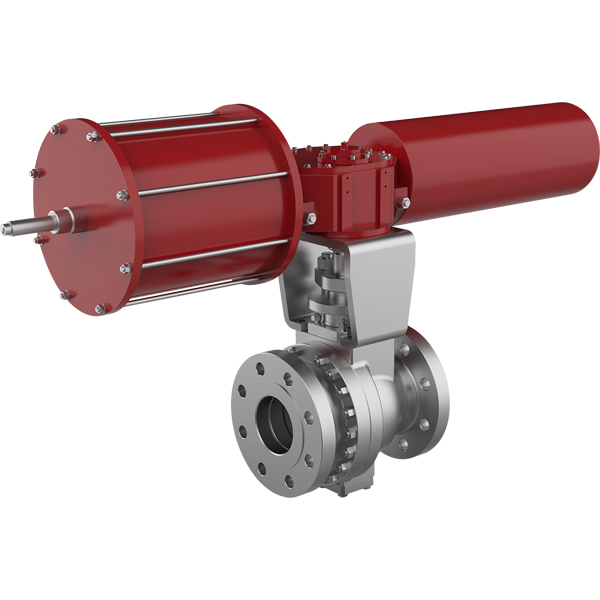
Pneumatic Ball Valve
Offers tight sealing and low leakage, commonly used for gas isolation.
Pneumatic Butterfly Valve
Lightweight and cost-effective; widely used in water treatment and large pipeline systems.
Pneumatic Gate Valve
Minimizes pressure drop; preferred for slurry, powder, or solid-laden fluids.

Pneumatic Globe / Control Valve
Designed for accurate flow modulation.
Control Accessories
-
Solenoid valve
-
Limit switch box
-
Air filter regulator (FRL)
-
Positioner for modulating control
Main Types of Pneumatic Valves
By Valve Structure
-
Pneumatic ball valves
-
Pneumatic butterfly valves
-
Pneumatic gate valves
-
Pneumatic shut-off valves
-
Pneumatic control valves
By Actuator Type
-
Single-acting
-
Double-acting
By Function
-
On/off valves
-
Modulating control valves
Comparison Between Pneumatic Valves and Manual Valves
Operation
Pneumatic valves provide automated and remote operation, whereas manual valves require physical handling.
Performance
Pneumatic valves can switch frequently and react quickly; manual valves are slower and less suitable for automated cycles.
Application
Pneumatic valves fit automated production lines; manual valves are typically used in simpler, low-frequency operations.
Comparison Between Pneumatic Valves and Electric Valves
Power Source
-
Pneumatic: compressed air
-
Electric: motor drive
Speed
Pneumatic valves generally offer faster actuation.
Safety
Because no motors or sparks are involved, pneumatic valves are suitable for explosive environments.
Maintenance
Air-driven actuators have fewer moving parts and lower overall maintenance requirements.
Application Fields of Pneumatic Valves
Oil and Petrochemical
Used in gas transmission, tank farms, cracking units, and emergency shutdown systems.
Water Treatment
Pneumatic butterfly valves are common in municipal distribution and wastewater plants.
Food & Pharmaceuticals
Sanitary pneumatic valves support beverage processing and CIP systems.
Natural Gas, Steam & Energy Industry
Pneumatic ball and shut-off valves provide reliable isolation for steam and gas.
Machinery, Metallurgy & Pulp Industry
Used in air supply systems, slurry pipelines, and process control.
Maintenance of Pneumatic Valves
Daily Inspection
-
Verify correct air pressure (typically 0.4–0.7 MPa)
-
Check for air leakage
-
Confirm position feedback
Actuator Maintenance
-
Replace worn seals
-
Inspect spring force
-
Lubricate internal moving surfaces
Valve Body Maintenance
-
Clean internal surfaces
-
Replace sealing rings
-
Lubricate the stem
Accessory Maintenance
-
Clean solenoid valves
-
Drain filter regulators
-
Calibrate positioners
Pneumatic Valve Selection Guide
Key Considerations
-
Type of medium
-
Pressure and temperature conditions
-
Required Cv/Kv value
-
Valve size (DN15–DN1500)
-
Explosion-proof or safety requirements
-
Actuation speed and fail-safe design
-
Environmental and installation conditions
Industry Standards
Common International Standards
-
ISO 5211 (Actuator mounting interface)
-
API 6D / API 608 (Ball valve standards)
-
GB/T 12237 (Industrial valves)
-
GB/T 9113 (Flange specification)
FAQ About Pneumatic Valves
1. Is a pneumatic ball valve better than a pneumatic butterfly valve?
Ball valves provide superior sealing, while butterfly valves are more economical for large pipelines.
2. How long does a pneumatic actuator last?
Typically between 300,000 and 1,000,000 cycles, depending on air quality and operating conditions.
3. Do pneumatic valves need lubrication?
Most actuators are self-lubricating, but some mechanisms may require periodic greasing.
4. When should a pneumatic shut-off valve be used?
In emergency shutdown (ESD), hazardous media isolation, or rapid-response safety applications.
5. What’s the difference between single-acting and double-acting actuators?
Single-acting provides a fail-safe action; double-acting offers higher torque and more stable control.
Post time: Dec-06-2025